The table below shows the raw material requirement (in units) for a crank-shaft machining line of a major automobile manufacturer based in western India. Company policy requires that raw material be kept in stock at least one day in advance, so an order placed on a given day is delivered and ready for use only from the next day onward, unless a delay is stated.
| Day | 1 | 2 | 3 | 4 | 5 | 6 | 7 | 8 | 9 | 10 | 11 | 12 | 13 | 14 | 15 |
| Units | 50 | 25 | 30 | 20 | 5 | 6 | 2 | 10 | 15 | 20 | 25 | 10 | 5 | 20 | 10 |
If the raw material inventory on Day 0 was 165 units, the manager needs to place an order latest by which day?
If the raw material inventory on Day 0 was 165 units, the manager needs to place an order latest by which day?
Show Hint
- 8th
- 9th
- 10th
- 11th
The Correct Option is B
Solution and Explanation
Instead of subtracting units one day at a time, build a running (cumulative) total of the requirement column. This total tells us how much material has been used up to and including each day.
\[ 50,\ 75,\ 105,\ 125,\ 130,\ 136,\ 138,\ 148,\ 163,\ 183,\ldots \]
These are the cumulative totals for Day 1 through Day 10.
Step 2: Compare the cumulative total with the opening stock.
The opening stock is 165 units. As long as the cumulative total stays below 165, the stock on hand (165 minus the cumulative total) is still positive, so production is safe without a fresh order.
Up to Day 9, the cumulative total is 163, which is less than 165, leaving 2 units.
Up to Day 10, the cumulative total becomes \(163 + 20 = 183\), which is more than 165.
Step 3: Locate the exact break point.
Since the cumulative total crosses 165 between Day 9 and Day 10, it is Day 10 whose requirement cannot be met from the opening stock alone.
Step 4: Apply the one day advance rule.
Material ordered on a day is usable only from the next day. To have fresh stock ready for Day 10, the order has to go in on Day 9, one day ahead of the shortfall.
Final Answer:
The latest day to place the order is the 9th day, matching option (2).
\[ \boxed{9} \]
If the raw material inventory on Day 0 was 73 units and the manager orders 17, 53 and 86 units on the first, second and fourth day respectively, when does he need to order next?
If the raw material inventory on Day 0 was 73 units and the manager orders 17, 53 and 86 units on the first, second and fourth day respectively, when does he need to order next?
Show Hint
- 10th day
- 11th day
- 13th day
- 14th day
The Correct Option is C
Solution and Explanation
Think of the raw material stock as a bank balance: deposits are the opening stock plus any orders that have arrived, and withdrawals are the day's requirement. The balance must never go negative.
Step 2: List the deposits by the day they actually arrive.
Opening deposit (Day 0): 73 units.
Order of 17 units, placed Day 1, credited on Day 2 (one day advance rule).
Order of 53 units, placed Day 2, credited on Day 3.
Order of 86 units, placed Day 4, credited on Day 5.
Step 3: Compute the balance after each day's withdrawal.
\[ \begin{aligned} \text{Day 1: } &73 - 50 = 23 \\ \text{Day 2: } &23 + 17 - 25 = 15 \\ \text{Day 3: } &15 + 53 - 30 = 38 \\ \text{Day 4: } &38 - 20 = 18 \\ \text{Day 5: } &18 + 86 - 5 = 99 \\ \text{Day 6: } &99 - 6 = 93 \\ \text{Day 7: } &93 - 2 = 91 \\ \text{Day 8: } &91 - 10 = 81 \\ \text{Day 9: } &81 - 15 = 66 \\ \text{Day 10: } &66 - 20 = 46 \\ \text{Day 11: } &46 - 25 = 21 \\ \text{Day 12: } &21 - 10 = 11 \\ \text{Day 13: } &11 - 5 = 6 \end{aligned} \]
Step 4: Check the next withdrawal against the balance.
Day 14 needs a withdrawal of 20 units, but the balance is only 6 units at the start of Day 14. The balance would turn negative without a fresh deposit.
Step 5: Place the deposit one day early.
Because a deposit made on a day only counts from the next day, the manager must place the order on Day 13 so the material is credited in time for Day 14.
Final Answer:
The next order must be placed on Day 13, option (3).
\[ \boxed{13} \]
If the raw material supplier starts acting unreliable and delays deliveries by 48 hours, which day's production will be hit if the starting inventory on Day 0 is 163 units and an order is placed on the morning of Day 7?
If the raw material supplier starts acting unreliable and delays deliveries by 48 hours, which day's production will be hit if the starting inventory on Day 0 is 163 units and an order is placed on the morning of Day 7?
Show Hint
- None
- Day 8
- Day 9
- Day 10
The Correct Option is A
Solution and Explanation
First find the day the stock would naturally run out if no order at all were placed. Subtracting the requirements one by one from 163 gives the stock at the end of each day:
\[ 163,\ 113,\ 88,\ 58,\ 38,\ 33,\ 27,\ 25,\ 15,\ 0 \]
These are the levels at the end of Day 0 through Day 9. The stock hits exactly 0 at the end of Day 9, so Day 10 (needing 20 units) is the first day that truly needs new material.
Step 2: Work out the normal arrival day of the Day 7 order.
With the standard one-day lead time, an order placed on the morning of Day 7 would normally arrive on Day 8. That is 2 full days earlier than Day 10, the day it is actually needed, so there are 2 spare days of buffer already built in.
Step 3: Compare the buffer with the delay.
The supplier's delay adds 48 hours, which is exactly 2 days, to the delivery time. Since the buffer built into the order (2 days) exactly equals the delay (2 days), the delayed delivery still lands on Day 10, right when it is first required.
Step 4: Confirm no shortfall occurs.
Because the delayed order reaches the plant on the morning of Day 10, before that day's production starts, every day's requirement from Day 1 to Day 15 is still met without a gap.
Final Answer:
Since the 2 day buffer absorbs the 2 day delay exactly, no day's production is hit. The correct choice is None, option (1).
\[ \boxed{\text{None}} \]
Suppose the raw material inventory on Day 0 was 73 units and the manager orders 17, 53 and 86 units on the first, second and fourth day respectively, so that the next order falls due on Day 13. If the cost of placing an order is Rs. 650 per order, find the minimum cost incurred over the whole 15 day cycle.
Suppose the raw material inventory on Day 0 was 73 units and the manager orders 17, 53 and 86 units on the first, second and fourth day respectively, so that the next order falls due on Day 13. If the cost of placing an order is Rs. 650 per order, find the minimum cost incurred over the whole 15 day cycle.
Show Hint
- Rs. 1,950
- Rs. 650
- Rs. 2,600
- Rs. 3,250
The Correct Option is C
Solution and Explanation
Since the order cost is a flat Rs. 650 per order no matter how many units are in it, the cheapest plan is simply the plan that uses the fewest orders while keeping the stock non negative on every single day.
Step 2: Count the orders already fixed by the scenario.
The scenario fixes 3 orders: on Day 1, Day 2 and Day 4. These carry the stock, after meeting daily requirements, down to 6 units by the start of Day 14.
Step 3: Test whether one more order is enough for the rest of the cycle.
The only requirements left are Day 14 (20 units) and Day 15 (10 units), a total of 30 units, against a stock of 6. A single top up of \(30 - 6 = 24\) units, placed on Day 13 so it is ready for Day 14, exactly clears the remaining requirement with zero left at the end of Day 15. No second top up is needed, since one order already closes the gap fully.
Step 4: Add up the order count.
That gives 4 orders in total across the whole 15 day cycle: Day 1, Day 2, Day 4, Day 13.
Step 5: Multiply by the fixed ordering cost.
\[ \text{Minimum cost} = 4 \times Rs.\ 650 = Rs.\ 2600 \]
Final Answer:
The minimum cost for the cycle is Rs. 2,600, option (3).
\[ \boxed{2600} \]
If the daily pilferage is 5 units, find the minimum number of units that need to be ordered through the whole cycle, given that the inventory on Day 0 is 100 units and the inventory ends at zero after Day 15.
If the daily pilferage is 5 units, find the minimum number of units that need to be ordered through the whole cycle, given that the inventory on Day 0 is 100 units and the inventory ends at zero after Day 15.
Show Hint
- 296
- 153
- 75
- 228
The Correct Option is D
Solution and Explanation
Let \(O\) be the total units ordered over the whole cycle. The stock at the end of the cycle equals what came in, minus what left:
\[ \text{Opening stock} + O - \text{Production used} - \text{Pilferage lost} = \text{Closing stock} \]
Step 2: Fill in the known values.
Opening stock \(= 100\), closing stock \(= 0\) (given). Production used is the sum of the Units row:
\[ 50+25+30+20+5+6+2+10+15+20+25+10+5+20+10 = 253 \]
Pilferage lost over 15 days at 5 units a day:
\[ 5 \times 15 = 75 \]
Step 3: Substitute into the balance equation.
\[ 100 + O - 253 - 75 = 0 \]
\[ O = 253 + 75 - 100 \]
Step 4: Solve for O.
\[ O = 328 - 100 = 228 \]
Step 5: Interpret the result.
So 228 units must be ordered in total across the cycle for the stock to exactly hit zero after covering both the day-to-day production and the daily pilferage loss.
Final Answer:
The minimum quantity to be ordered is 228 units, option (4).
\[ \boxed{228} \]
Top Questions on Table
- Five restaurants, coded R1, R2, R3, R4 and R5 gave integer ratings to five gig workers – Ullas, Vasu, Waman, Xavier and Yusuf, on a scale of 1 to 5. The means of the ratings given by R1, R2, R3, R4 and R5 were 3.4, 2.2, 3.8, 2.8 and 3.4 respectively.
The summary statistics of these ratings for the five workers is given below.* Range of ratings is defined as the difference between the maximum and minimum ratings awarded to a worker.Ullas Vasu Waman Xavier Yusuf Mean rating 2.2 3.8 3.4 3.6 2.6 Median rating 2 4 4 4 3 Model rating 2 4 5 5 1 and 4 Range of rating 3 3 4 4 3
The following is partial information about ratings of 1 and 5 awarded by the restaurants to the workers.
(a) R1 awarded a rating of 5 to Waman, as did R2 to Xavier, R3 to Waman and Xavier, and R5 to Vasu.
(b) R1 awarded a rating of 1 to Ullas, as did R2 to Waman and Yusuf, and R3 to Yusuf. - Odsville has five firms – Alfloo, Bzygoo, Czechy, Drjbna and Elavalaki. Each of these firms was founded in some year and also closed down a few years later.
Each firm raised Rs. 1 crore in its first and last year of existence. The amount each firm raised every year increased until it reached a maximum, and then decreased until the firm closed down. No firm raised the same amount of money in two consecutive years. Each annual increase and decrease was either by Rs. 1 crore or by Rs. 2 crores.
The table below provides partial information about the five firms.Firm First year of existence Last year of existence Total amount raised (Rs. crores) Alfloo 2009 2016 21 Bzygoo 2012 2015 Czechy 2013 9 Drjbna 2011 2015 10 Elavalaki 2010 13 - Three participants – Akhil, Bimal and Chatur participate in a random draw competition for five days. Every day, each participant randomly picks up a ball numbered between 1 and 9. The number on the ball determines his score on that day. The total score of a participant is the sum of his scores attained in the five days. The total score of a day is the sum of participants’ scores on that day. The 2-day average on a day, except on Day 1, is the average of the total scores of that day and of the previous day. For example, if the total scores of Day 1 and Day 2 are 25 and 20, then the 2-day average on Day 2 is calculated as 22.5. Table 1 gives the 2-day averages for Days 2 through 5.Participants are ranked each day, with the person having the maximum score being awarded the minimum rank (1) on that day. If there is a tie, all participants with the tied score are awarded the best available rank. For example, if on a day Akhil, Bimal, and Chatur score 8, 7 and 7 respectively, then their ranks will be 1, 2 and 2 respectively on that day. These ranks are given in Table 2.
Table 1: 2-day averages for Days through 5 Day 2 Day 3 Day 4 Day 5 15 15.5 16 17 The following information is also known.Table 2 : Ranks of participants on each day Day 1 Day 2 Day 3 Day 4 Day 5 Akhil 1 2 2 3 3 Bimal 2 3 2 1 1 Chatur 3 1 1 2 2
1. Chatur always scores in multiples of 3. His score on Day 2 is the unique highest score in the competition. His minimum score is observed only on Day 1, and it matches Akhil’s score on Day 4.
2. The total score on Day 3 is the same as the total score on Day 4.
3. Bimal’s scores are the same on Day 1 and Day 3. - The table given below shows the amount, in grams, of carbohydrate, protein, fat and all other nutrients, per 100 grams of nutrients in seven foodgrains. The first column shows the foodgrain category and the second column its codename. The table has some missing values.

The following additional facts are known.
1. Both the pseudo-cereals had higher amounts of carbohydrate as well as higher amounts of protein than any millet.
2. Both the cereals had higher amounts of carbohydrate than any pseudo-cereal.
3. All the missing values of carbohydrate amounts (in grams) for all the foodgrains are non zero multiples of 5.
4. All the missing values of protein, fat and other nutrients amounts (in grams) for all the foodgrains are non-zero multiples of 4.
5. P1 contained double the amount of protein that M3 contains. - Want to practice more? Try solving extra ecology questions todayView All Questions
Questions Asked in XAT exam
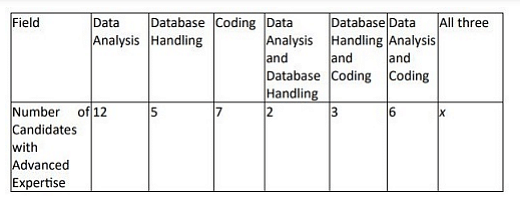
The number of applicants with advanced expertise in all three fields is given as x in the table, where x is a non-negative integer.
- XAT - 2024
- Data Interpretation