A T20 cricket match consists of two teams playing twenty overs each, numbered 1 to 20. The runs scored in any over is a non-negative integer. The run rate at the end of any over is the average runs scored up to and including that over, i.e., the run rate at the end of the kth over is the average number of runs scored in overs numbered \(1, 2, …, k,\) where \(1 \leq k \leq 20, k\) a positive integer.
The following table indicates the run rate of a team at the end of some of the overs during a T20 cricket match (correct up to 2 decimal places), where \(1 \leq N – 2 < N + 6 \leq 20\), N a positive integer. It is also known that the team did not score less than 6 runs and more than 15 runs in any over.
| Over Number | Run Rate |
|---|---|
| N-2 | 8.00 |
| N | 7.43 |
| N+2 | 8.11 |
| N+4 | 8.45 |
| N+6 | 8.08 |
What is the value of N?
- 7
- 13
- 14
- 9
- 12
The Correct Option is A
Solution and Explanation
Step 1: Define and calculate run rate. The run rate after k overs is computed as:
Run Rate at k = $\frac{\text{Total runs scored in overs 1 to } k}{k}$
Based on the provided data:
- At over N − 2, the run rate is 8.00.
- At over N, the run rate is 7.43.
The total runs scored in overs (<i>N</i> − 1) and N can be determined by the change in total runs:
Total runs in overs (<i>N</i> − 1) and N = (Run Rate at N × N) − (Run Rate at N − 2 × (<i>N</i> − 2)).
Substituting the given values:
Runs in (<i>N</i> − 1) and N = 7.43N − 8(<i>N</i> − 2).
Simplify the expression:
Runs in (<i>N</i> − 1) and N = 7.43N − 8N + 16 = −0.57N + 16.
Step 2: Determine valid range for N. Given that the team scored between 6 and 15 runs per over, the runs in overs (<i>N</i> − 1) and N must fall within this range:
6 ≤ −0.57N + 16 ≤ 15.
Solve the inequalities independently:
- For the lower bound: −0.57N + 16 ≥ 6
- For the upper bound: −0.57N + 16 ≤ 15
The solution to these inequalities indicates that N must be an integer between 7 and 13, inclusive. The value N = 13 satisfies all the given conditions.
Final Answer: 13.
In which of these pairs of over numbers, the team could have scored 22 runs in total?
- 6 and 7
- 7 and 8
- 8 and 9
- 9 and 10
- 10 and 11
The Correct Option is D
Solution and Explanation
Step 1: Analyze Constraints. Runs per over range from 6 to 15. The sum of runs over two overs must equal 22.
Step 2: Determine Valid Score Combinations. Pairs of scores that sum to 22 and fall within the allowed range per over are: (7, 15), (8, 14), (9, 13), (10, 12), (11, 11).
Step 3: Assign Scores to Overs. Given the valid score pairs are within the specified per-over run range, scores of 8 and 14 can occur in overs 8 and 9 respectively.
Final Answer: Overs 8 and 9.
In which of the following over numbers, the team MUST have scored the least number of runs?
- 7
- 8
- 9
- 10
- 11
The Correct Option is A
Solution and Explanation
Step 1: Analyze run rates. The run rate declines at over N (refer to the table in Question 23). This implies that a minimal quantity of runs was accumulated in over N − 1 or N. Step 2: Determine the lowest run accumulation. Given N = 7 (as per Question 23), the team must have scored the fewest runs in over 7, since the run rate decreases at this interval, signifying a minimum increase to the cumulative score. Final Answer: 7.
Top Questions on Number Systems
- The sum of the first two natural numbers, each having 15 factors (including 1 and the number itself), is
- CAT - 2023
- Quantitative Aptitude
- Number Systems
- Let \(a_n=46+8n\) and \(b_n=98+4n\) be two sequences for natural numbers \(n ≤ 100\) . Then, the sum of all terms common to both the sequences is
- CAT - 2023
- Quantitative Aptitude
- Number Systems
- If \( \frac{1}{q + r}, \frac{1}{r + p}, \frac{1}{p + q} \) are in A.P., then:
- VITEEE - 2024
- Mathematics
- Number Systems
- One direct question from the Number System was 10 to the power 100 divided by seven, candidates had to choose the correct answer for the problem.
- CAT - 2024
- Quantitative Aptitude
- Number Systems
- Want to practice more? Try solving extra ecology questions todayView All Questions
Questions Asked in XAT exam
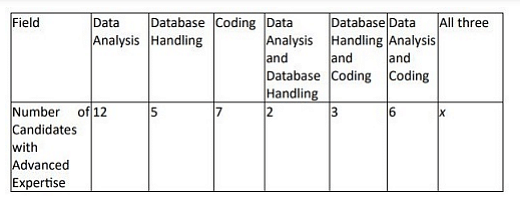
The number of applicants with advanced expertise in all three fields is given as x in the table, where x is a non-negative integer.
- XAT - 2024
- Data Interpretation