Aman has come to the market with Rs. 100. If he buys 5 kilograms of cabbage and 4 kilograms of potato, he will have Rs. 20 left; or else, if he buys 4 kilograms of cabbage and 5 kilograms of onion, he will have Rs. 7 left. The per kilogram prices of cabbage, onion and potato are positive integers (in rupees), and any type of these vegetables can only be purchased in positive integer kilogram, or none at all.
Aman decides to buy only onion, in whatever maximum quantity possible (in positive integer kilogram), with the money he has come to the market with.
How much money will he be left with after the purchase?
How much money will he be left with after the purchase?
- Rs. 12
- Rs. 9
- Rs. 7
- Rs. 5
- Rs. 1
The Correct Option is
Solution and Explanation
Step 1: Formulate the equations based on the given conditions.
Let c, o, and p represent the prices of cabbage, onion, and potato in Rs./kg, respectively.
The problem yields the following equations:
5c + 4p + 20 = 100, which simplifies to 5c + 4p = 80 (1).
4c + 5o + 7 = 100, which simplifies to 4c + 5o = 93 (2).
Step 2: Solve the system of equations. From equation (1), we get:
\(p = \frac{80 - 5c}{4}\).
For p to be an integer, (80 - 5c) must be divisible by 4. We test values for c:
- When c = 8:
- When c = 6:
- When c = 4:
Step 3: Calculate the remaining money after purchasing onions. With Rs. 100 and an onion price of o = 15, Aman can purchase:
$\frac{100}{15} = 6\frac{2}{3}$ kg of onions.
The cost of these onions is 6 × 15 = 90 Rs. The remaining amount is:
100 − 90 = 9 Rs.
Final Answer: Rs. 9.
Aman decides to buy only onion and potato, both in positive integer kilogram, in such a way that the money left with him after the purchase will be insufficient to buy a full kilogram of either of the two vegetables.
If all such permissible combinations of purchases are equally likely, what is the probability that Aman buys more onion than potato?
If all such permissible combinations of purchases are equally likely, what is the probability that Aman buys more onion than potato?
- 3/10
- 5/6
- 2/9
- 7/20
- 45392
The Correct Option is A
Solution and Explanation
Step 1: Formulate the total cost equation. The total cost is expressed as:
x ⋅ o + y ⋅ p = 100 − r,
where x and y represent the kilograms of onion and potato, respectively, and r is the remaining money, with the conditions r \(<\) o and r \(<\) p. Based on Question 16, o = 15 and p = 15.
Step 2: Determine valid purchase combinations. Aman must spend a minimum of 85 (to ensure r \(<\) 15) and a maximum of 100. By evaluating pairs of x and y such that x + y \(≤\) 6, the valid combinations are:
(<i>x</i>, <i>y</i>) = (1, 5), (2, 4), (3, 3), (4, 2), (5, 1).
Step 3: Count combinations where x \(>\) y. The combinations satisfying x \(>\) y are:
(<i>x</i>, <i>y</i>) = (4, 2), (5, 1).
The total number of possible combinations is 5.
Probability calculation:
\(P(x \(>\) y) = \frac{2}{5} = \frac{3}{10}\).
Final Answer: $\frac{3}{10}$
Top Questions on Algebra
- Let \( n(A) = m \) and \( n(B) = n \), if the number of subsets of \( A \) is 56 more than that of subsets of \( B \), then \( m + n \) is equal to:
- VITEEE - 2024
- Mathematics
- Algebra
- Solve the quadratic equation: \[ x^2 - 5x + 6 = 0 \]
- VITEEE - 2025
- Mathematics
- Algebra
- Find the value of \( x \) in the following equation: \[ \frac{2}{x} + \frac{3}{x + 1} = 1 \]
- VITEEE - 2025
- Mathematics
- Algebra
- Find the value of \( x \) in the equation \( 2x + 3 = 7x - 8 \).
- VITEEE - 2025
- Mathematics
- Algebra
- Want to practice more? Try solving extra ecology questions todayView All Questions
Questions Asked in XAT exam
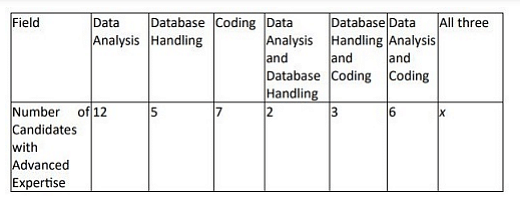
The number of applicants with advanced expertise in all three fields is given as x in the table, where x is a non-negative integer.
- XAT - 2024
- Data Interpretation