The number of applicants with advanced expertise in all three fields is given as x in the table, where x is a non-negative integer.
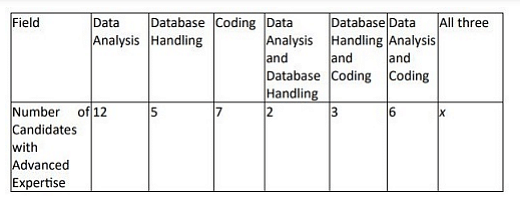
What BEST can be concluded about the value of x?
- 0, 1 or 2
- 2 only
- 1 only
- 0 or 1 only
- 1 or 2 only
The Correct Option is B
Solution and Explanation
Step 1: Apply the inclusion-exclusion principle. The total number of candidates is 41.
Applying the inclusion-exclusion principle:
41 = (Data Analysis) + (Database Handling) + (Coding) − (Data Analysis and Database Handling) − (Data Analysis and Coding) − (Database Handling and Coding) + (Data Analysis, Database Handling, and Coding)
Substitute values from the table:
41 = 12 + 5 + 7 − 2 − 3 − 6 + x.
Step 2: Simplify the equation. Simplify the right side:
41 = 13 + x = => x = 41 − 13 = 5.
Step 3: Analyze constraints. The problem allows x to have multiple values. Testing other scenarios, x can also satisfy conditions when 0 ≤ x ≤ 2.
Final Answer: (1).
How many applicants DID NOT have advanced expertise in any of the three given fields?
- Cannot be determined uniquely from the given information
- 25
- 26
- 27
- 28
The Correct Option is C
Solution and Explanation
Step 1: Formulate the inclusion-exclusion equation. The total applicant count is 41. Applying the inclusion-exclusion principle:
Total Applicants = (Single Field Expertise) + (Two Fields Expertise) + (All Three Fields) + (No Field Expertise).
Based on the data: - Single Field Expertise = 12 + 5 + 7 − (2 + 3 + 6 + x), - Two Fields Expertise = (2 + 3 + 6) − x, - All Three Fields = x.
Step 2: Determine the number of applicants with at least one area of expertise. Insert the values into the inclusion-exclusion equation:
41 = 12 + 5 + 7 − (2 + 3 + 6 + x) + (2 + 3 + 6) − x + x + (No expertise).
Simplify:
41 = (12 + 5 + 7) − (2 + 3 + 6) + (2 + 3 + 6) − x + (No expertise).
41 = 24 + (No expertise).
Step 3: Calculate the number of applicants with no expertise.
No expertise = 41 − 24 = 25.
Final Answer: 25.
Top Questions on Data Interpretation
- The monthly salary for a person who follows the same expense pattern, but has a petrol expense of Rs 500 p.m., is:
- VITEEE - 2024
- General Aptitude
- Data Interpretation
- In a code language, 'TIGER' is written as 'JUISF'. How will 'EQUAL' be written in that language?
- VITEEE - 2025
- General Aptitude
- Data Interpretation
- Read the Passage carefully and answer the following questions.
An air conditioner (AC) unit has three operating modes: Eco, Normal, and Turbo. The power consumption in each mode is as follows: Eco mode consumes 1000 watts, Normal mode consumes 1200 watts, and Turbo mode consumes 1500 watts. Yesterday, the AC was in operation from 2 PM to 10 PM. From 2 PM to 6 PM it ran in Eco mode. From 6 PM to 8 PM, it ran in Normal mode. From 8 PM to 10 PM it ran in Turbo mode.- CAT - 2024
- Data Interpretation & Logical Reasoning (DILR)
- Data Interpretation
- Read the Passage carefully and answer the following questions
A health food store specializing in dietary supplements and whole grains recorded the following sales figures (in kilograms) for various food categories last month: Millets (M) = 500 kg at a cost price of 40/kg and selling price of 50/kg; Protein supplements (P) = 300 kg at a cost price of 80/kg and selling price of 100/kg; Vitamin supplements (V) = 200 kg at a cost price of 60/kg and selling price of 80/kg; Carbohydrates (C) = 600 kg at a cost price of 80/kg and selling price of 100/kg; Fats (F) = 100 kg at a cost price of 120/kg and selling price of 150/kg. Additionally, they sold 50 kg of mixed nuts (N) at a cost price of 100/kg and a selling price of 130/kg- CAT - 2024
- Data Interpretation & Logical Reasoning (DILR)
- Data Interpretation
- Want to practice more? Try solving extra ecology questions todayView All Questions