The upper hinge of a dataset is the median of all the values to the right of the median of the dataset in an ascending arrangement, while the lower hinge of the dataset is the median of all the values to the left of the median of the dataset in the same arrangement.
For example, consider the dataset 4, 3, 2, 6, 4, 2, 7. When arranged in the ascending order, it becomes 2, 2, 3, 4, 4, 6, 7. The median is 4 (the bold value), and hence the upper hinge is the median of 4, 6, 7, i.e., 6. Similarly, the lower hinge is 2.
A student has surveyed thirteen of her teachers, and recorded their work experience (in integer years). Two of the values recorded by the student got smudged, and she cannot recall those values. All she remembers is that those two values were unequal, so let us write them as A and B, where A < B. The remaining eleven values, as recorded, are: 5, 6, 7, 8, 12, 16, 19, 21, 21, 27, 29. Moreover, the student also remembers the following summary measures, calculated based on all the thirteen values:
Minimum: 2
Lower Hinge: 6.5
Median: 12
Upper Hinge: 21
Maximum: 29
Which of the following is a possible value of B?
- 2
- 6
- 8
- 13
- 29
The Correct Option is C
Solution and Explanation
Based on the information recorded, which of the following can be the average work experience of the thirteen teachers?
- 12
- 12.5
- 13
- 13.5
- 14
The Correct Option is
Solution and Explanation
Step 1: Determine the dataset's total sum. The formula for the average is:
Average = $\frac{\text{Sum of all values}}{\text{Total number of values}}$.
Let A and B denote the obscured values, with A + B = 18 (as per Question 20). The eleven known values are:
5, 6, 7, 8, 12, 16, 19, 21, 21, 27, 29.
The sum of these eleven known values is:
5 + 6 + 7 + 8 + 12 + 16 + 19 + 21 + 21 + 27 + 29 = 171.
Step 2: Compute the total sum including A and B. The complete total sum is:
Total Sum = 171 + A + B = 171 + 18 = 189.
Step 3: Calculate the average.
Average = $\frac{189}{13} = 13$.
Final Answer: 13.
While rechecking her original notes to re-enter the smudged values of A and B in the records, the student found that one of the eleven recorded work experience values that did not get smudged was recorded wrongly as half of its correct value. After re-entering the values of A and B, and correcting the wrongly recorded value, she recalculated all the summary measures. The recalculated average value was 15.
What is the value of B?
What is the value of B?
- 7
- 9
- 10
- 12
- Cannot be determined from the given information.
The Correct Option is C
Solution and Explanation
Step 1: Determine the total recalculated sum. The recalculated average is 15. Using the formula for average:
Average = $\frac{\text{Sum of all values}}{\text{Total number of values}}$
15 = $\frac{\text{Recalculated Total Sum}}{13}$
Therefore:
Recalculated Total Sum = 15 × 13 = 195.
Step 2: Calculate the correction applied. The original sum of the eleven known values was 171. After adding A and B, the total becomes:
171 + A + B = 171 + 18 = 189.
The recalculated total sum is 195, so the difference due to the correction is:
195 − 189 = 6.
This indicates one recorded value was half of its correct value. Let the incorrect value be x. Then:
$\frac{x}{2}$ + 6 = x. Solving for x yields x = 12.
Step 3: Solve for B. Given A + B = 18 from Question 20. If A = 6, then:
B = 18 − 6 = 9.
Final Answer: 9.
Top Questions on Data Interpretation
- The monthly salary for a person who follows the same expense pattern, but has a petrol expense of Rs 500 p.m., is:
- VITEEE - 2024
- General Aptitude
- Data Interpretation
- In a code language, 'TIGER' is written as 'JUISF'. How will 'EQUAL' be written in that language?
- VITEEE - 2025
- General Aptitude
- Data Interpretation
- Read the Passage carefully and answer the following questions.
An air conditioner (AC) unit has three operating modes: Eco, Normal, and Turbo. The power consumption in each mode is as follows: Eco mode consumes 1000 watts, Normal mode consumes 1200 watts, and Turbo mode consumes 1500 watts. Yesterday, the AC was in operation from 2 PM to 10 PM. From 2 PM to 6 PM it ran in Eco mode. From 6 PM to 8 PM, it ran in Normal mode. From 8 PM to 10 PM it ran in Turbo mode.- CAT - 2024
- Data Interpretation & Logical Reasoning (DILR)
- Data Interpretation
- Read the Passage carefully and answer the following questions
A health food store specializing in dietary supplements and whole grains recorded the following sales figures (in kilograms) for various food categories last month: Millets (M) = 500 kg at a cost price of 40/kg and selling price of 50/kg; Protein supplements (P) = 300 kg at a cost price of 80/kg and selling price of 100/kg; Vitamin supplements (V) = 200 kg at a cost price of 60/kg and selling price of 80/kg; Carbohydrates (C) = 600 kg at a cost price of 80/kg and selling price of 100/kg; Fats (F) = 100 kg at a cost price of 120/kg and selling price of 150/kg. Additionally, they sold 50 kg of mixed nuts (N) at a cost price of 100/kg and a selling price of 130/kg- CAT - 2024
- Data Interpretation & Logical Reasoning (DILR)
- Data Interpretation
- Want to practice more? Try solving extra ecology questions todayView All Questions
Questions Asked in XAT exam
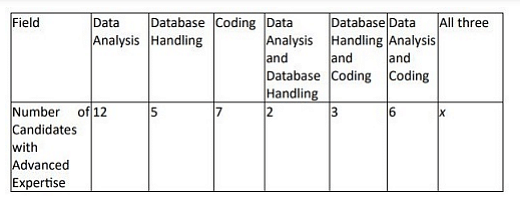
The number of applicants with advanced expertise in all three fields is given as x in the table, where x is a non-negative integer.
- XAT - 2024
- Data Interpretation