DeepSea is a natural gas extraction company that retrieves natural gas from rock formations beneath the seabed. This gas is then transported through its extensive pipeline network to a bottling plant, located at the sea surface, for processing. The gas in rock formations is pressurized, enabling it to flow to the surface and reach the bottling plant. Yet, excessive pressure can cause bursts in the pipeline, leading to uncontrolled gas release, known as blowout. A blowout carries a staggering cost, encompassing not only environmental damage but also reputation loss and financial losses totaling crores of rupees. Additionally, the impacted section of the pipeline requires a complete replacement. Industry safety regulations divide the pipeline network into three levels: Level 3 is the part under the seabed, Level 2 is the part above the seabed but in the deep sea, while Level 1 is near the surface. The safety regulations require multiple blowout preventer valves, from now on simply referred to as valves, to be placed at the three different levels of the pipeline network. The valves are normally kept closed, but when the pressure in any part of the pipeline rises beyond a critical level, nearby valves are opened remotely to release the pressure in a controlled manner to prevent blowout. The number of valves across the pipeline helps localize the pressure release, with a greater number of valves providing a backup mechanism, helping in improving pressure localization in case of a blowout. Given that the valves themselves can occasionally malfunction and not release the pressure when needed, using a higher number of valves ensures that a malfunctioning valve can seek the safety of a nearby functioning valve.
A valve can malfunction in two ways: it may fail to release pressure when needed, as previously mentioned, or it can leak gas during regular operation, resulting in unwanted losses. When a valve malfunctions, it necessitates manual replacement.
In the DeepSea Network, 30% of the valves are located at Level 3, which is the deepest level. The remaining valves are evenly distributed between the top two levels. These valves are critical to ensuring safety and are exclusively supplied by GoValve, a highly specialized manufacturer that holds a monopoly in the country’s market.
GoValve has recently proposed a maintenance package for the valves to DeepSea, which includes a clause that whenever a valve at Level 3 malfunctions, all valves at that level will be replaced. Accepting the clause will cost a significant premium. The management of DeepSea have the following pieces of additional information under consideration:
A. The valves are known to be prone to malfunction.
B. Any malfunction in one valve often results in leakage from the neighboring valves.
C. GoValve is ready to negotiate a discount if the clause is accepted.
D. Replacing the valves at Level 3 is a very difficult job, which is best done by GoValve.
E. The chances of pressure buildups are higher near the seabed.
Which of the following combinations, of the above pieces of additional information, will help the management of DeepSea the MOST in accepting the clause?
A. The valves are known to be prone to malfunction.
B. Any malfunction in one valve often results in leakage from the neighboring valves.
C. GoValve is ready to negotiate a discount if the clause is accepted.
D. Replacing the valves at Level 3 is a very difficult job, which is best done by GoValve.
E. The chances of pressure buildups are higher near the seabed.
Which of the following combinations, of the above pieces of additional information, will help the management of DeepSea the MOST in accepting the clause?
- A, B & D
- A, B & E
- B, C & D
- A, C & D
- C, D & E
The Correct Option is
Solution and Explanation
Step 1: Problem Definition. DeepSea must determine if it should approve GoValve's proposed maintenance contract. This contract mandates the replacement of all Level 3 valves upon any malfunction. The decision requires an assessment of safety implications and financial viability.
Step 2: Option Analysis.
- Option 1 (A, B, D): This option considers valve malfunction susceptibility (A), the domino effect of malfunctions on adjacent valves (B), and the technical difficulty of valve replacement at Level 3, favoring GoValve's expertise (D). These factors strongly support accepting the clause.
- Option 2 (A, B, E): While factors A and B are relevant, factor E (pressure build-ups) does not provide a strong justification for accepting the maintenance clause.
- Option 3 (B, C, D): Negotiating a discount (C) is beneficial but does not adequately address the safety concerns highlighted by factor A.
- Option 4 (A, C, D): Factors A and D are pertinent, but factor C (discount) is less critical than addressing the leakages described in factor B.
- Option 5 (C, D, E): Factor E (pressure build-ups) is less significant than the potential for malfunctions (A) and their associated consequences (B).
Final Answer: (1)
A startup, SafeValve, has started importing a technologically superior brand of valves from abroad, which boasts a significant reduction in gas leakage. SafeValve has established a large inventory of these imported valves but is struggling to gain foothold in the local market. An NGO, working for the protection of marine lives, has appealed to DeepSea to replace their existing valves with the product from SafeValve. However, the installation of this new valve will require substantial modification in the pipeline, entailing unknown challenges in installation and maintenance.
Which of the following reasons, if TRUE, can DeepSea BEST cite to publicly reject the appeal?
Which of the following reasons, if TRUE, can DeepSea BEST cite to publicly reject the appeal?
- The new valves cost twice as much as the existing valves.
- GoValve is a reputed brand and had a partnership with DeepSea for a long time.
- Only some developed countries have mandated the use of the new valves.
- SafeValve depends exclusively on imports and may be prone to procurement issues.
- GoValve follows the strictest global industry standards of leakage prevention.
The Correct Option is
Solution and Explanation
Step 1: Problem Definition.
DeepSea needs to determine a response strategy for the NGO's request to adopt SafeValve's product, ensuring its reputation and operational efficiency are maintained.
Step 2: Option Analysis.
- Option 1: Elevated expenses are a significant factor, but this justification alone might be insufficient for a public refusal.
- Option 2: Emphasizing the established relationship with GoValve could be perceived as preferential and reduce credibility.
- Option 3: The limited global implementation of the new valves diminishes the appeal's strength but is not the most potent objection.
- Option 4: SafeValve's reliance on imported components introduces supply chain stability questions but does not assess valve quality.
- Option 5: Stating that GoValve adheres to the most rigorous international leakage prevention standards offers the strongest basis for rejecting the appeal, directly addressing the critical safety and quality aspects essential for DeepSea's operations.
Final Answer: (5)
A startup, SafeValve, has started importing a technologically superior brand of valves from abroad, which boasts a significant reduction in gas leakage. An update to industry safety regulations has come out, which allows a lower number of valves in a pipeline network, if technologically superior valves, similar to those imported by SafeValve, are used for the entire network. DeepSea is aware that the more the number of valves, the better is DeepSea’s ability to contain blowouts. However, a higher number of valves increases the chance of a leakage. Therefore, DeepSea is contemplating a proposal to reduce the number of valves to almost half, by replacing the existing valves (by GoValve) with the valves sold by SafeValve.
A team, tasked with evaluating the proposal, has made some observations, listed below.
Which of the following observations is the MOST helpful in REJECTING the proposal?
A team, tasked with evaluating the proposal, has made some observations, listed below.
Which of the following observations is the MOST helpful in REJECTING the proposal?
- There is no clear industry standard for the minimum number of valves required at a certain level.
- At Level 1, the chance of a pressure rise is much lesser compared to the other two levels.
- At Level 3, a blowout results in more time consuming and expensive repairs compared to the other two levels.
- The superiority of the SafeValve products is only in terms of preventing leakage, not blowouts.
- If a GoValve valve is opened to prevent a blowout, the chance of leakage from the valves within a certain distance increases.
The Correct Option is D
Solution and Explanation
Phase 1: Problem Definition.
DeepSea's objective is to ascertain if substituting current valves with SafeValve products aligns with their operational safety standards and economic viability.
Phase 2: Option Analysis.
- Option 1: Absence of an industry standard is noted but does not directly impact SafeValve's efficacy.
- Option 2: Decreased pressure risk at Level 1 is pertinent but not a decisive factor for proposal rejection.
- Option 3: Elevated repair expenses at Level 3 are substantial but secondary to blowout prevention importance.
- Option 4: SafeValve products' failure to directly mitigate blowouts conflicts with DeepSea's paramount safety requirements, presenting the most compelling reason against the proposal.
- Option 5: Increased leakage risk near open GoValve valves is a concern but insufficient grounds for outright rejection of the SafeValve proposal.
Conclusion: (4)
Top Questions on Caselets
- Read the following scenario and answer the questions that follow.
Mr. Singh lived in a sprawling housing society. He employed two part-time domestic helps, Vimla and Sharda. Vimla was responsible for cleaning and dusting, while Sharda took care of cooking.
Once Sharda fell ill and consequently took leave for three days. When Sharda returned to work, she learned that Mr. Singh’s gold ring, a gift from his mother, was missing. Suspecting theft, Mr. Singh had terminated Vimla. Mr. Singh asked Sharda to take additional responsibility of cleaning the house, along with an offer to double her salary. Sharda accepted the offer as her previous two jobs were lost due to frequent health-related absences. She was struggling to make ends meet; this offer would go a long way to help her.
Next day, while cleaning under the dressing table, Sharda found the gold ring. Overjoyed, Mr. Singh expressed his gratitude by presenting Sharda a reward of one thousand rupees! However, he made no mention of reinstating Vimla.- XAT - 2024
- Decision Making
- Caselets
- Read the following scenario and answer the questions that follow.
In Symbolis, an upcoming medium sized IT services organization, only 1% of the employees were awarded an annual performance bonus. This annual performance bonus was decided by a committee formed of different functional heads. When Ms. Nalini Kattakayam received the annual bonus for the first time in her five years at Symbolis, Ms. Shalini Sampath, a colleague with seven years of tenure at Symbolis, told Nalini that this annual bonus was less a reflection of Nalini’s performance and more a recognition of those who have fostered a strong rapport with the powers that be. Incidentally, Shalini had never received any performance bonus in her tenure at the company.- XAT - 2024
- Decision Making
- Caselets
- Read the following scenario and answer the questions that follow.
Raman had been working tirelessly as a Project Manager in the IT department of Flying Groceries, a renowned app-based supply chain company, for the past three years. Having graduated from a top-tier engineering college, he dived straight into the corporate world, managing projects with great zeal that inspired his seniors.
At the end of his first year with Flying Groceries, impressed with his hard work, Raman’s boss, Suraj, the founder-CEO of Flying Groceries, fast-tracked his promotion and made him Delivery Manager responsible for multiple projects of a vertical. Suraj also promised Raman the position of Chief Operation Officer in the fifth year of his tenure.
In search of a greater career trajectory, Raman pursued entrance exams for business schools. His efforts bore fruits as he secured a place in the country’s best business school, known for a strong alumni base, stellar placement records and demanding academic requirements.
Raman was delighted; he had three months to join the business school. Flying Groceries demanded that any employee who wished to leave the organization should give at least a month’s notice. Raman decided to continue working and enriching his work experience, which will be beneficial when applying to companies after graduating from the business school. Therefore, he decided not to share the news of the offer with anyone else for the time being.- XAT - 2024
- Decision Making
- Caselets
- Read the following scenario and answer the questions that follow.
Kasta, a small industrial town hosted a steel plant and its associated ancillary companies. Most of its residents were steel plant employees from different states of the country. While the town offered employment opportunities, it lacked an airport. For those wanting to fly, the nearest airport was in Michaelganj, 100 kms from Kasta. To reach the airport, people rented taxi services available at Kasta, and Prabhu was one such taxi-service provider.
Prabhu’s rates were reasonable - a trip to airport cost Rs. 2200, but for a round trip, the fare was Rs. 3000. Yet, it was not just the affordability that made him popular, his reputation for punctuality and reliability was unmatched. When it came to ensuring the safety of women travelling alone, he would always be the first choice. Such was his trustworthiness that even the steel plant would solicit his services when expecting solo female visitors. Moreover, whenever residents encountered issues with their personal cars, they would turn to Prabhu for help.
However, the world shifted when the COVID-19 pandemic struck. Travel restrictions and safety concerns limited Prabhu’s trips to Michaelganj for over a year and a half. Financial strain followed, with accumulating interest on his home loan. He was weighed down by debt, but things improved once COVID-19 travel restrictions were lifted. Having faced financial hardships during COVID-19, he sought to offset his losses by raising the fare. Yet, he was aware of the stiff competition in town, where many others offered services at a similar fare as his.- XAT - 2024
- Decision Making
- Caselets
- Want to practice more? Try solving extra ecology questions todayView All Questions
Questions Asked in XAT exam
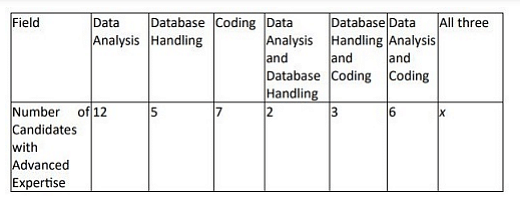
The number of applicants with advanced expertise in all three fields is given as x in the table, where x is a non-negative integer.
- XAT - 2024
- Data Interpretation