Mr. Singh lived in a sprawling housing society. He employed two part-time domestic helps, Vimla and Sharda. Vimla was responsible for cleaning and dusting, while Sharda took care of cooking.
Once Sharda fell ill and consequently took leave for three days. When Sharda returned to work, she learned that Mr. Singh’s gold ring, a gift from his mother, was missing. Suspecting theft, Mr. Singh had terminated Vimla. Mr. Singh asked Sharda to take additional responsibility of cleaning the house, along with an offer to double her salary. Sharda accepted the offer as her previous two jobs were lost due to frequent health-related absences. She was struggling to make ends meet; this offer would go a long way to help her.
Next day, while cleaning under the dressing table, Sharda found the gold ring. Overjoyed, Mr. Singh expressed his gratitude by presenting Sharda a reward of one thousand rupees! However, he made no mention of reinstating Vimla.
Sharda was contemplating whether she should inform Vimla that she found Mr. Singh’s ring.
Which of the following considerations will BEST dissuade Sharda in sharing the information about the ring with Vimla?
Which of the following considerations will BEST dissuade Sharda in sharing the information about the ring with Vimla?
- Mr. Singh will probably terminate Sharda if he gets to know that she has revealed this information.
- Had Vimla done her job properly, she would have found the ring and avoided this incident.
- Vimla already knows she has not stolen anything, so telling her will not give her any new information.
- Sharda is not keeping well, and Mr. Singh warned her that her frequent absences could lead to her termination.
- Whenever Sharda was absent, Vimla used to help her by taking over her responsibilities.
The Correct Option is A
Solution and Explanation
Context: Mr. Singh employed two part-time domestic workers, Vimla (cleaning) and Sharda (cooking). When Sharda was on a three-day leave due to illness, Mr. Singh's gold ring went missing. He suspected Vimla, terminated her employment, and then offered Sharda a pay raise to take on additional cleaning duties. Sharda subsequently found the ring but hesitated to inform Vimla, likely due to ethical and professional considerations.
Step 1: Situation Analysis. Informing Vimla about the ring could complicate matters by potentially reopening Vimla's termination case and challenging Mr. Singh's judgment. It could also impact Sharda's relationship with Mr. Singh.
Step 2: Option Evaluation.
- Option 1: Mr. Singh terminating Sharda for sharing information is purely speculative and improbable.
- Option 2: This option links Vimla's performance directly to her dismissal, thereby justifying Sharda's reluctance to disclose the information.
- Option 3: While this option is valid, it does not provide a compelling reason for Sharda to withhold information from Vimla.
- Option 4: Sharda's health is irrelevant to the decision of informing Vimla about the ring.
- Option 5: This option does not address the primary factor influencing the decision-making process in this scenario.
Step 3: Conclusion. Option 2 offers the most robust justification for Sharda's decision to withhold information from Vimla, by emphasizing Vimla's performance and its role in the events.
Final Answer: (2)
Two months passed, and owing to Sharda’s improved health and dedication, Sharda started working in three more houses. However, Vimla was dismissed from her jobs in two more houses primarily due to the ring incident. News of the discovery of the lost ring had not become public, and Sharda wanted to help Vimla. Sharda is contemplating over possible actions.
Which of the following actions, by Sharda, will BEST help Vimla?
Which of the following actions, by Sharda, will BEST help Vimla?
- Confront Mr. Singh about concealing the discovery of the lost ring from the housing society residents.
- Inform Vimla that the ring has been found and advise her to demand compensation from Mr. Singh for tarnishing her image.
- Inform as many domestic helps in the housing society as possible that she has found the ring.
- Quit the job at Mr. Singh’s house and ask him to consider offering that job to Vimla.
- Divulge to Vimla’s employers in the housing society that she has found the ring.
The Correct Option is B
Solution and Explanation
Phase 1: Assess Sharda’s alternatives. Sharda’s primary objective is to support Vimla in restoring her reputation and job prospects. Any actions that escalate discord or undermine Sharda’s trustworthiness must be disregarded.
Phase 2: Examine the alternatives.
- Alternative 1: Direct confrontation with Mr. Singh risks conflict and offers no direct aid to Vimla.
- Alternative 2: Guiding Vimla to pursue compensation directly addresses her damaged reputation and economic losses.
- Alternative 3: Disseminating information to other domestic workers could foster rumors and unforeseen repercussions.
- Alternative 4: Resigning from employment represents an impulsive response that does not ensure Vimla’s rehiring.
- Alternative 5: Revealing information to Vimla’s employers may jeopardize Sharda’s standing and precipitate further difficulties.
Phase 3: Determine the optimal course of action. Alternative 2 presents the most beneficial and feasible method for assisting Vimla.
Concluding Determination: (2)
The news of the discovery of the lost ring eventually became public. The domestic helps in the society were chagrined by the treatment meted out to Vimla and the fact that the news of the discovery was not made public immediately. They wanted to ensure that they would not get targeted every time if something goes missing.
Which of the following policy options will BEST minimize the chance of employers suspecting their domestic workers of theft in the future?
Which of the following policy options will BEST minimize the chance of employers suspecting their domestic workers of theft in the future?
- The domestic workers will undergo a daily search by the security guards when leaving the society.
- When a domestic worker is terminated on suspicion of theft without proof, they will have to be paid at least one month’s salary in full.
- The current address and contact details of all domestic workers should be submitted to the housing society.
- If there is a suspicion of theft, the security guards will first conduct a thorough search of the affected house.
- When a domestic worker is terminated on suspicion of theft, the employer will have to publicly apologize if the domestic worker can prove their innocence.
The Correct Option is A
Solution and Explanation
Phase 1: Pinpoint critical issues. Employers frequently harbor suspicions about domestic workers without substantiation. Policies designed to discourage unfounded allegations and enforce employer accountability can effectively mitigate these concerns.
Phase 2: Assess available strategies.
- Strategy 1: Daily inspections represent an intrusion and are likely to damage the trust dynamic between employers and workers.
- Strategy 2: Remuneration equivalent to one month's salary may discourage employers but does not serve to rehabilitate a worker's reputation.
- Strategy 3: Disclosure of contact information fails to address the problem of unwarranted accusations.
- Strategy 4: Comprehensive inspections are rational but inadequate for restoring trust following accusations.
- Strategy 5: Public acknowledgments of error can discourage baseless allegations and reconstruct trust, positioning it as the most effective policy.
Phase 3: Determine the optimal policy. Strategy 5 directly confronts the issue of accountability and re-establishes trust between domestic workers and their employers.
Ultimate Resolution: (5)
Top Questions on Caselets
- Read the following scenario and answer the questions that follow.
In Symbolis, an upcoming medium sized IT services organization, only 1% of the employees were awarded an annual performance bonus. This annual performance bonus was decided by a committee formed of different functional heads. When Ms. Nalini Kattakayam received the annual bonus for the first time in her five years at Symbolis, Ms. Shalini Sampath, a colleague with seven years of tenure at Symbolis, told Nalini that this annual bonus was less a reflection of Nalini’s performance and more a recognition of those who have fostered a strong rapport with the powers that be. Incidentally, Shalini had never received any performance bonus in her tenure at the company.- XAT - 2024
- Decision Making
- Caselets
- Read the following scenario and answer the questions that follow.
Raman had been working tirelessly as a Project Manager in the IT department of Flying Groceries, a renowned app-based supply chain company, for the past three years. Having graduated from a top-tier engineering college, he dived straight into the corporate world, managing projects with great zeal that inspired his seniors.
At the end of his first year with Flying Groceries, impressed with his hard work, Raman’s boss, Suraj, the founder-CEO of Flying Groceries, fast-tracked his promotion and made him Delivery Manager responsible for multiple projects of a vertical. Suraj also promised Raman the position of Chief Operation Officer in the fifth year of his tenure.
In search of a greater career trajectory, Raman pursued entrance exams for business schools. His efforts bore fruits as he secured a place in the country’s best business school, known for a strong alumni base, stellar placement records and demanding academic requirements.
Raman was delighted; he had three months to join the business school. Flying Groceries demanded that any employee who wished to leave the organization should give at least a month’s notice. Raman decided to continue working and enriching his work experience, which will be beneficial when applying to companies after graduating from the business school. Therefore, he decided not to share the news of the offer with anyone else for the time being.- XAT - 2024
- Decision Making
- Caselets
- Read the following scenario and answer the questions that follow.
Kasta, a small industrial town hosted a steel plant and its associated ancillary companies. Most of its residents were steel plant employees from different states of the country. While the town offered employment opportunities, it lacked an airport. For those wanting to fly, the nearest airport was in Michaelganj, 100 kms from Kasta. To reach the airport, people rented taxi services available at Kasta, and Prabhu was one such taxi-service provider.
Prabhu’s rates were reasonable - a trip to airport cost Rs. 2200, but for a round trip, the fare was Rs. 3000. Yet, it was not just the affordability that made him popular, his reputation for punctuality and reliability was unmatched. When it came to ensuring the safety of women travelling alone, he would always be the first choice. Such was his trustworthiness that even the steel plant would solicit his services when expecting solo female visitors. Moreover, whenever residents encountered issues with their personal cars, they would turn to Prabhu for help.
However, the world shifted when the COVID-19 pandemic struck. Travel restrictions and safety concerns limited Prabhu’s trips to Michaelganj for over a year and a half. Financial strain followed, with accumulating interest on his home loan. He was weighed down by debt, but things improved once COVID-19 travel restrictions were lifted. Having faced financial hardships during COVID-19, he sought to offset his losses by raising the fare. Yet, he was aware of the stiff competition in town, where many others offered services at a similar fare as his.- XAT - 2024
- Decision Making
- Caselets
- Read the following scenario and answer the THREE questions that follow.
Ms. Vineeta Lama, a respected figure in the small town of Jampur, found herself stranded on the road, once again, when her old small hatchback car broke down. Finding herself alone on the deserted road with no one to help, Vineeta, in desperation called Shyam Saigal, the General Manager of Balaji Motors − the only dealership in Jampur that sells Diplomatico cars, the brand that Vineeta drives. Vineeta knew Shyam from her frequent visits for getting her hatchback car serviced. Surprisingly, he arrived within fifteen minutes, accompanied by a mechanic from his dealership. Further, he arranged for the vehicle to be towed and kindly offered Vineeta a ride home. On the way back, he advised Vineeta to exchange her old car with a new Sports Utility Vehicle (SUV) on a good discount from his dealership. He assured her that he would add several additional services to ensure her SUV remained in excellent condition for many years ahead.- XAT - 2024
- Decision Making
- Caselets
- Want to practice more? Try solving extra ecology questions todayView All Questions
Questions Asked in XAT exam
The number of applicants with advanced expertise in all three fields is given as x in the table, where x is a non-negative integer.
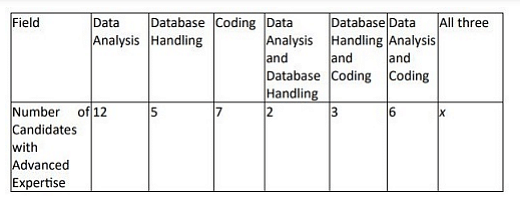
- XAT - 2024
- Data Interpretation