Raman had been working tirelessly as a Project Manager in the IT department of Flying Groceries, a renowned app-based supply chain company, for the past three years. Having graduated from a top-tier engineering college, he dived straight into the corporate world, managing projects with great zeal that inspired his seniors.
At the end of his first year with Flying Groceries, impressed with his hard work, Raman’s boss, Suraj, the founder-CEO of Flying Groceries, fast-tracked his promotion and made him Delivery Manager responsible for multiple projects of a vertical. Suraj also promised Raman the position of Chief Operation Officer in the fifth year of his tenure.
In search of a greater career trajectory, Raman pursued entrance exams for business schools. His efforts bore fruits as he secured a place in the country’s best business school, known for a strong alumni base, stellar placement records and demanding academic requirements.
Raman was delighted; he had three months to join the business school. Flying Groceries demanded that any employee who wished to leave the organization should give at least a month’s notice. Raman decided to continue working and enriching his work experience, which will be beneficial when applying to companies after graduating from the business school. Therefore, he decided not to share the news of the offer with anyone else for the time being.
Flying Groceries was planning to implement a much-needed update to enhance the functionality and user experience of their app. According to Suraj, the update was expected to take at least six months to complete. Suraj wanted Raman to lead this project because his leadership was critical for the project’s success. However, Raman knew that he would be there only for three months; he was not sure whether he should accept the project.
Which of the following information, if true, will BEST assist Raman in accepting the role of leading the project?
Which of the following information, if true, will BEST assist Raman in accepting the role of leading the project?
- During his time with Flying Groceries, Raman finished some projects ahead of schedule.
- Raman could requisition more human resources to his team for the next three months.
- Suraj might advise against the update if he got to know that Raman was leaving soon.
- The last two projects Raman led were successfully completed by his subordinates during his exams.
- Raman had previously taken many projects home, and the business school would have no classes during the weekends.
The Correct Option is
Solution and Explanation
Step 1: Situation Analysis. Raman faces a dilemma regarding project acceptance; the projected completion time surpasses his employment duration at Flying Groceries.
Step 2: Options Evaluation.
- Option 1: Past performance in early project completion does not guarantee similar outcomes here.
- Option 2: The availability of additional resources empowers Raman to delegate tasks efficiently, facilitating project continuation post-his departure.
- Option 3: Suraj's opposition to the update lacks inherent company benefit.
- Option 4: Prior successful projects managed by subordinates demonstrate trust but do not resolve resource constraints.
- Option 5: Undertaking work outside of standard hours does not ensure timely project completion.
Step 3: Recommended Action. Option 2 offers Raman a viable strategy for ensuring the project's seamless transition and eventual success.
Final Answer: (2)
After a couple of months, Raman resigned. Suraj was shocked by Raman’s resignation and asked him to reconsider his decision. When Raman expressed his inability to continue, Suraj felt betrayed. This led to a series of heated arguments between them, and they swore to never work together again.
Raman joined the business school; however, he soon realized that that summer internship placements were approaching. Consequently, he would require verification of his responsibilities from Flying Groceries.
Which of the following actions is the MOST appropriate for Raman to obtain his verification?
Raman joined the business school; however, he soon realized that that summer internship placements were approaching. Consequently, he would require verification of his responsibilities from Flying Groceries.
Which of the following actions is the MOST appropriate for Raman to obtain his verification?
- Raman should write a sincere and professional apology letter, expressing regret for the argument Raman had with Suraj.
- Raman should write an email to Suraj, emphasizing Raman’s roles and responsibilities, and request him to approve them.
- Raman should contact the HR representative to facilitate the verification of Raman’s responsibilities.
- Raman should reach out to a mutual acquaintance within the company and ask her to intervene.
- Raman should re-establish communication with Suraj through social media platforms like Facebook and persuade him there.
The Correct Option is B
Solution and Explanation
Step 1: Assess Raman's Circumstances.
Raman requires confirmation of his duties concerning summer internship placements and needs a professional and effective method for this verification.
Step 2: Appraise Alternatives.
- Option 1: Submitting an apology may resolve personal conflicts but is not a formal means of securing verification.
- Option 2: Dispatching an electronic mail to Suraj might be beneficial, but it may not guarantee an immediate reply given their strained association.
- Option 3: Engaging with Human Resources guarantees a formal and systematic procedure, circumventing any interpersonal challenges with Suraj.
- Option 4: Dependence on a common acquaintance introduces superfluous complexities and lacks professional decorum.
- Option 5: Utilizing social media platforms represents an informal methodology and is unsuitable for official matters.
Conclusion: (3)
Raman received a verification letter from Flying Groceries outlining his basic job responsibilities during his tenure there. However, Raman required a document to substantiate the additional responsibilities he undertook at Flying Groceries by going beyond his call of duty. Sadly, he did not have any documentation of such additional responsibilities.
Which of the following options will BEST help substantiate the additional responsibilities Raman undertook?
Which of the following options will BEST help substantiate the additional responsibilities Raman undertook?
- Raman should create documentation, detailing quantifiable metrics and results about his extra work based on his memory.
- Raman should collect testimonials on his additional responsibilities from his ex-teammates at Flying Groceries.
- Raman should write a public post on social media, appealing to Suraj, mentioning the challenges he faced while taking additional responsibilities, and how he overcame them.
- Raman should call Suraj and explain that he will not be able to get a consulting or an operations job without verification.
- Raman should reach out to the recently recruited Chief Supply Chain officer at Flying Groceries to highlight the additional work he contributed to facilitate the officer’s tasks.
The Correct Option is B
Solution and Explanation
Phase 1: Diagnose Raman’s situation.
Raman requires verifiable proof to substantiate his assertion of increased duties. In the absence of formal records, he must investigate supplementary avenues for corroboration.
Phase 2: Assess potential strategies.
- Strategy 1: Fabricating records from recollection lacks credibility and formal endorsement.
- Strategy 2: Statements from former colleagues offer external validation and possess greater trustworthiness.
- Strategy 3: Public requests via social media risk damaging Raman’s professional standing and are informal.
- Strategy 4: Contacting Suraj may prove unproductive given their strained professional rapport.
- Strategy 5: Approaching the new incumbent is irrelevant, as they may possess no direct insight into Raman’s contributions.
Conclusion: (2)
Top Questions on Caselets
- Read the following scenario and answer the questions that follow.
Mr. Singh lived in a sprawling housing society. He employed two part-time domestic helps, Vimla and Sharda. Vimla was responsible for cleaning and dusting, while Sharda took care of cooking.
Once Sharda fell ill and consequently took leave for three days. When Sharda returned to work, she learned that Mr. Singh’s gold ring, a gift from his mother, was missing. Suspecting theft, Mr. Singh had terminated Vimla. Mr. Singh asked Sharda to take additional responsibility of cleaning the house, along with an offer to double her salary. Sharda accepted the offer as her previous two jobs were lost due to frequent health-related absences. She was struggling to make ends meet; this offer would go a long way to help her.
Next day, while cleaning under the dressing table, Sharda found the gold ring. Overjoyed, Mr. Singh expressed his gratitude by presenting Sharda a reward of one thousand rupees! However, he made no mention of reinstating Vimla.- XAT - 2024
- Decision Making
- Caselets
- Read the following scenario and answer the questions that follow.
In Symbolis, an upcoming medium sized IT services organization, only 1% of the employees were awarded an annual performance bonus. This annual performance bonus was decided by a committee formed of different functional heads. When Ms. Nalini Kattakayam received the annual bonus for the first time in her five years at Symbolis, Ms. Shalini Sampath, a colleague with seven years of tenure at Symbolis, told Nalini that this annual bonus was less a reflection of Nalini’s performance and more a recognition of those who have fostered a strong rapport with the powers that be. Incidentally, Shalini had never received any performance bonus in her tenure at the company.- XAT - 2024
- Decision Making
- Caselets
- Read the following scenario and answer the questions that follow.
Kasta, a small industrial town hosted a steel plant and its associated ancillary companies. Most of its residents were steel plant employees from different states of the country. While the town offered employment opportunities, it lacked an airport. For those wanting to fly, the nearest airport was in Michaelganj, 100 kms from Kasta. To reach the airport, people rented taxi services available at Kasta, and Prabhu was one such taxi-service provider.
Prabhu’s rates were reasonable - a trip to airport cost Rs. 2200, but for a round trip, the fare was Rs. 3000. Yet, it was not just the affordability that made him popular, his reputation for punctuality and reliability was unmatched. When it came to ensuring the safety of women travelling alone, he would always be the first choice. Such was his trustworthiness that even the steel plant would solicit his services when expecting solo female visitors. Moreover, whenever residents encountered issues with their personal cars, they would turn to Prabhu for help.
However, the world shifted when the COVID-19 pandemic struck. Travel restrictions and safety concerns limited Prabhu’s trips to Michaelganj for over a year and a half. Financial strain followed, with accumulating interest on his home loan. He was weighed down by debt, but things improved once COVID-19 travel restrictions were lifted. Having faced financial hardships during COVID-19, he sought to offset his losses by raising the fare. Yet, he was aware of the stiff competition in town, where many others offered services at a similar fare as his.- XAT - 2024
- Decision Making
- Caselets
- Read the following scenario and answer the THREE questions that follow.
Ms. Vineeta Lama, a respected figure in the small town of Jampur, found herself stranded on the road, once again, when her old small hatchback car broke down. Finding herself alone on the deserted road with no one to help, Vineeta, in desperation called Shyam Saigal, the General Manager of Balaji Motors − the only dealership in Jampur that sells Diplomatico cars, the brand that Vineeta drives. Vineeta knew Shyam from her frequent visits for getting her hatchback car serviced. Surprisingly, he arrived within fifteen minutes, accompanied by a mechanic from his dealership. Further, he arranged for the vehicle to be towed and kindly offered Vineeta a ride home. On the way back, he advised Vineeta to exchange her old car with a new Sports Utility Vehicle (SUV) on a good discount from his dealership. He assured her that he would add several additional services to ensure her SUV remained in excellent condition for many years ahead.- XAT - 2024
- Decision Making
- Caselets
- Want to practice more? Try solving extra ecology questions todayView All Questions
Questions Asked in XAT exam
The number of applicants with advanced expertise in all three fields is given as x in the table, where x is a non-negative integer.
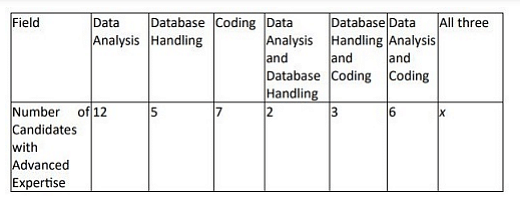
- XAT - 2024
- Data Interpretation