Ms. Vineeta Lama, a respected figure in the small town of Jampur, found herself stranded on the road, once again, when her old small hatchback car broke down. Finding herself alone on the deserted road with no one to help, Vineeta, in desperation called Shyam Saigal, the General Manager of Balaji Motors − the only dealership in Jampur that sells Diplomatico cars, the brand that Vineeta drives. Vineeta knew Shyam from her frequent visits for getting her hatchback car serviced. Surprisingly, he arrived within fifteen minutes, accompanied by a mechanic from his dealership. Further, he arranged for the vehicle to be towed and kindly offered Vineeta a ride home. On the way back, he advised Vineeta to exchange her old car with a new Sports Utility Vehicle (SUV) on a good discount from his dealership. He assured her that he would add several additional services to ensure her SUV remained in excellent condition for many years ahead.
Due to her old car’s frequent breakdowns, Vineeta decided it was a time to replace it. She was afraid whether buying a Diplomatico SUV from Balaji Motors, as suggested by Shyam, will be a right decision for her.
Which of the following pieces of additional information will help her the MOST in taking the right decision?
Which of the following pieces of additional information will help her the MOST in taking the right decision?
- She has no idea which SUV to choose, and she feels that all SUVs are the same.
- Her brother, an SUV enthusiast, staying in a metro city, has advised her to stay away from Diplomatico Cars.
- In Jampur, SUVs have a 6-month waiting period; however, one red-coloured Diplomatico SUV, not her favourite colour, is available at Balaji Motors.
- Jampur, being an old city with congested roads, has a parking problem in many areas.
- A new dealership of Panther Motors, the highest selling car brand in the country, is about to come to the town soon.
The Correct Option is B
Solution and Explanation
Phase 1: Comprehend Vineeta's Situation.
Vineeta is contemplating the acquisition of a new SUV to substitute her current vehicle, necessitating critical data for a well-grounded choice.
Phase 2: Assess the Ramifications of Available Choices.
- Choice 1: Insufficient data for informed judgment.
- Choice 2: Presents a subjective view, irrelevant to her local circumstances.
- Choice 3: Lead times and hue preferences are peripheral factors.
- Choice 4: Parking challenges are prevalent in Jampur but do not influence the procurement decision.
- Choice 5: The emergence of Panther Motors, a prominent manufacturer, introduces a viable competitor.
Concluding Selection: (5)
Shyam’s satisfaction from meeting the month’s quota for selling SUVs turned to dismay when one of his young executives nervously told him that he mistakenly punched an extended warranty for free to Vineeta’s purchase contract earlier that morning. This could not be reversed from the company’s system and meant a loss of Rs. 19,000 for the dealership. The executive was very sorry and was ready to take accountability. However, the amount was too large to be borne by the executive.
Shyam was not concerned about placing accountability, but rather the recovery of the loss. He was unsure whether he should ask Vineeta for the money.
The following pieces of information are available to Shyam:
A. Shyam is aware that Vineeta is very happy with the deal he gave her for the car.
B. Shyam feels that Diplomatico’s software system is complicated for new employees, which might have also played a role in the error.
C. Vineeta has a wide network and can connect Shyam with many potential customers.
D. Vineeta’s brother, a car enthusiast, has enough knowledge of how car dealers operate.
E. Shyam feels that if he maintains the current sales volume, he might be able to persuade Diplomatico to write off the amount (Rs. 19,000).
Which of the following combinations, of the above pieces of information, will MOST likely stop Shyam from trying to recover the money from Vineeta?
Shyam was not concerned about placing accountability, but rather the recovery of the loss. He was unsure whether he should ask Vineeta for the money.
The following pieces of information are available to Shyam:
A. Shyam is aware that Vineeta is very happy with the deal he gave her for the car.
B. Shyam feels that Diplomatico’s software system is complicated for new employees, which might have also played a role in the error.
C. Vineeta has a wide network and can connect Shyam with many potential customers.
D. Vineeta’s brother, a car enthusiast, has enough knowledge of how car dealers operate.
E. Shyam feels that if he maintains the current sales volume, he might be able to persuade Diplomatico to write off the amount (Rs. 19,000).
Which of the following combinations, of the above pieces of information, will MOST likely stop Shyam from trying to recover the money from Vineeta?
- A & B
- A & D
- C & D
- C & E
- B & E
The Correct Option is D
Solution and Explanation
Step 1: Scenario Analysis.
Shyam is required to address the problem while safeguarding his relationship with Vineeta and his dealership's standing.
Step 2: Combination Evaluation.
- Option 1 (A & B): A and B acknowledge Vineeta's satisfaction and the error; however, they do not provide a method to prevent financial recovery from Vineeta. - Option 2 (A & D): Vineeta’s brother’s awareness could aid Shyam, but A does not directly preclude recovery.
- Option 3 (C & D): Vineeta’s connections are advantageous, but her brother’s knowledge may not dissuade Shyam from seeking recovery.
- Option 4 (C & E): Vineeta’s connections present Shyam with prospects for new business, and sustaining sales volume could indirectly offset the loss.
- Option 5 (B &E): Although B and E suggest alternative approaches, they do not capitalize on Vineeta's capacity to benefit Shyam’s dealership.
Final Answer: (4)
Three months passed. While returning from a friend’s house, Vineeta’s new SUV was hit by another car. Fortunately, she was not injured, but the SUV was badly damaged. Surprisingly, when Vineeta took the car for repairs to Balaji Motors, she was told that the repairs would not cost her anything as the extended warranty on her car covered such accidents. Vineeta could not recall purchasing such a warranty; hence, she contacted Shyam. Shyam informed her that the extended warranty was mistakenly punched into her contract by an executive. As this mistake could not be reversed due to the company’s rigid policies, Shyam bore the cost of Rs. 19,000. He further added that Vineeta should consider it a gift from Balaji Motors for purchasing the highest-priced Diplomatico SUV.
As Vineeta rode back home, she wondered if she should pay Rs. 19,000 to Shyam since the extended warranty came to her aid that day.
Which of the following is the MOST compelling rationale for Vineeta to justify not paying Rs. 19,000 to Shyam?
As Vineeta rode back home, she wondered if she should pay Rs. 19,000 to Shyam since the extended warranty came to her aid that day.
Which of the following is the MOST compelling rationale for Vineeta to justify not paying Rs. 19,000 to Shyam?
- She paid more for the Diplomatico SUV, compared to the price of a similar SUV from Panther.
- She is aware that for expensive SUVs like hers, dealers often offer free extended warranty
- The mistake happened three months back and is water under the bridge now.
- Had the accident not happened, she would not have been aware of the warranty.
- Shyam would have come back to her if he had needed the money.
The Correct Option is B
Solution and Explanation
Phase 1: Contextual Appraisal.
Vineeta received an unplanned, extended warranty during a critical period. Her justification for non-payment must center on equitable principles and situational specifics.
Phase 2: Option Assessment.
- Option 1: Price comparisons are invalid as the extended warranty was disconnected from the SUV's initial cost.
- Option 2: This statement, though accurate, fails to legitimize her refusal to reimburse Shyam.
- Option 3: The temporal progression does not negate the ethical obligation for reimbursement.
- Option 4: Emphasizes that her knowledge of the warranty was opportunistic, and she would not have considered reimbursement otherwise. This strongly supports her position.
- Option 5: Presumes intent and does not directly address the circumstances.
Conclusion: (4)
Top Questions on Caselets
- Read the following scenario and answer the questions that follow.
Mr. Singh lived in a sprawling housing society. He employed two part-time domestic helps, Vimla and Sharda. Vimla was responsible for cleaning and dusting, while Sharda took care of cooking.
Once Sharda fell ill and consequently took leave for three days. When Sharda returned to work, she learned that Mr. Singh’s gold ring, a gift from his mother, was missing. Suspecting theft, Mr. Singh had terminated Vimla. Mr. Singh asked Sharda to take additional responsibility of cleaning the house, along with an offer to double her salary. Sharda accepted the offer as her previous two jobs were lost due to frequent health-related absences. She was struggling to make ends meet; this offer would go a long way to help her.
Next day, while cleaning under the dressing table, Sharda found the gold ring. Overjoyed, Mr. Singh expressed his gratitude by presenting Sharda a reward of one thousand rupees! However, he made no mention of reinstating Vimla.- XAT - 2024
- Decision Making
- Caselets
- Read the following scenario and answer the questions that follow.
In Symbolis, an upcoming medium sized IT services organization, only 1% of the employees were awarded an annual performance bonus. This annual performance bonus was decided by a committee formed of different functional heads. When Ms. Nalini Kattakayam received the annual bonus for the first time in her five years at Symbolis, Ms. Shalini Sampath, a colleague with seven years of tenure at Symbolis, told Nalini that this annual bonus was less a reflection of Nalini’s performance and more a recognition of those who have fostered a strong rapport with the powers that be. Incidentally, Shalini had never received any performance bonus in her tenure at the company.- XAT - 2024
- Decision Making
- Caselets
- Read the following scenario and answer the questions that follow.
Raman had been working tirelessly as a Project Manager in the IT department of Flying Groceries, a renowned app-based supply chain company, for the past three years. Having graduated from a top-tier engineering college, he dived straight into the corporate world, managing projects with great zeal that inspired his seniors.
At the end of his first year with Flying Groceries, impressed with his hard work, Raman’s boss, Suraj, the founder-CEO of Flying Groceries, fast-tracked his promotion and made him Delivery Manager responsible for multiple projects of a vertical. Suraj also promised Raman the position of Chief Operation Officer in the fifth year of his tenure.
In search of a greater career trajectory, Raman pursued entrance exams for business schools. His efforts bore fruits as he secured a place in the country’s best business school, known for a strong alumni base, stellar placement records and demanding academic requirements.
Raman was delighted; he had three months to join the business school. Flying Groceries demanded that any employee who wished to leave the organization should give at least a month’s notice. Raman decided to continue working and enriching his work experience, which will be beneficial when applying to companies after graduating from the business school. Therefore, he decided not to share the news of the offer with anyone else for the time being.- XAT - 2024
- Decision Making
- Caselets
- Read the following scenario and answer the questions that follow.
Kasta, a small industrial town hosted a steel plant and its associated ancillary companies. Most of its residents were steel plant employees from different states of the country. While the town offered employment opportunities, it lacked an airport. For those wanting to fly, the nearest airport was in Michaelganj, 100 kms from Kasta. To reach the airport, people rented taxi services available at Kasta, and Prabhu was one such taxi-service provider.
Prabhu’s rates were reasonable - a trip to airport cost Rs. 2200, but for a round trip, the fare was Rs. 3000. Yet, it was not just the affordability that made him popular, his reputation for punctuality and reliability was unmatched. When it came to ensuring the safety of women travelling alone, he would always be the first choice. Such was his trustworthiness that even the steel plant would solicit his services when expecting solo female visitors. Moreover, whenever residents encountered issues with their personal cars, they would turn to Prabhu for help.
However, the world shifted when the COVID-19 pandemic struck. Travel restrictions and safety concerns limited Prabhu’s trips to Michaelganj for over a year and a half. Financial strain followed, with accumulating interest on his home loan. He was weighed down by debt, but things improved once COVID-19 travel restrictions were lifted. Having faced financial hardships during COVID-19, he sought to offset his losses by raising the fare. Yet, he was aware of the stiff competition in town, where many others offered services at a similar fare as his.- XAT - 2024
- Decision Making
- Caselets
- Want to practice more? Try solving extra ecology questions todayView All Questions
Questions Asked in XAT exam
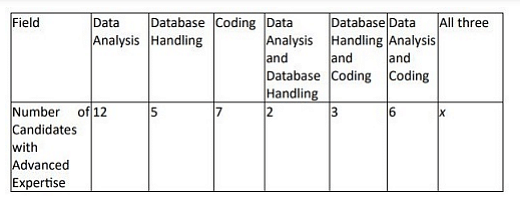
The number of applicants with advanced expertise in all three fields is given as x in the table, where x is a non-negative integer.
- XAT - 2024
- Data Interpretation