Question:hard
Read the following caselet and answer the question that follows.
Mr. Rajiv Singhal, Chairman of the Board of Directors of Loha India Ltd. (a steel manufacturing company), had just been visited by several other directors of the company. The directors were upset with the recent actions of the company president, Mr. Ganesh Thakur. They demanded that the board consider firing the president.
Mr. Thakur, recently appointed as president, had undertaken to solve some of the management-employee problems by dealing directly with individuals as often as possible. The company did not have a history of strikes or any other form of collective action and was considered to have a good work culture. However, Mr. Thakur felt that by dealing directly with individuals, he could show the management's concern for the employees. An important step Mr. Thakur took was to negotiate the wages of the supervisors with each supervisor one on one. In these negotiation meetings he did not involve anyone else, including the Personnel Department which reported to him, so that he could take an unbiased decision. After negotiation, a wage contract was drawn up for each supervisor. He felt this would recognise and reward the better performers. Mr. Thakur carried out this process for most of the supervisors, except those working the night shift. For them he drew up the contracts on his own, benchmarking the night shift supervisors' wages against the day shift supervisors' wages.
For several days, Ram Lal, a night shift supervisor, had been trying to get an appointment with Mr. Thakur about his wages. He was upset, not only because he could not see the president, but also because there had been no discussion about his wage contract before it was put into effect. As a family man with six dependents, he felt his weekly wage should be higher than what he had been given.
Last Thursday afternoon, Ram Lal stopped by the president's office and tried to see him. Mr. Thakur's secretary refused his request on the grounds that Mr. Thakur was busy. Angry, Ram Lal walked into the president's office and confronted the startled Mr. Thakur with his demand for a better wage. Mr. Thakur stood up and told Ram Lal to get out of his office and raise his grievance through the official channel. Ram Lal took a swing at the president, who in turn punched Ram Lal on the jaw and knocked him unconscious.
Apart from the supervisors working the night shift, executives of which department will have the most justified reasons to be unhappy with Mr. Thakur's initiative?
1. Production department, for not being consulted regarding the behaviour of the supervisors on the shop floor.
2. Finance department, for not being taken into confidence regarding the financial consequences of the wage contracts.
3. Marketing department, for not being consulted on the likely impact of the wage contracts on the image of the company.
4. Quality control, for not being able to give inputs to Mr. Thakur on how to improve the quality of the steel making process.
5. Personnel department, since it was their job to oversee wage policies for employees, and they had been ignored by Mr. Thakur.
Read the following caselet and answer the question that follows.
Mr. Rajiv Singhal, Chairman of the Board of Directors of Loha India Ltd. (a steel manufacturing company), had just been visited by several other directors of the company. The directors were upset with the recent actions of the company president, Mr. Ganesh Thakur. They demanded that the board consider firing the president.
Mr. Thakur, recently appointed as president, had undertaken to solve some of the management-employee problems by dealing directly with individuals as often as possible. The company did not have a history of strikes or any other form of collective action and was considered to have a good work culture. However, Mr. Thakur felt that by dealing directly with individuals, he could show the management's concern for the employees. An important step Mr. Thakur took was to negotiate the wages of the supervisors with each supervisor one on one. In these negotiation meetings he did not involve anyone else, including the Personnel Department which reported to him, so that he could take an unbiased decision. After negotiation, a wage contract was drawn up for each supervisor. He felt this would recognise and reward the better performers. Mr. Thakur carried out this process for most of the supervisors, except those working the night shift. For them he drew up the contracts on his own, benchmarking the night shift supervisors' wages against the day shift supervisors' wages.
For several days, Ram Lal, a night shift supervisor, had been trying to get an appointment with Mr. Thakur about his wages. He was upset, not only because he could not see the president, but also because there had been no discussion about his wage contract before it was put into effect. As a family man with six dependents, he felt his weekly wage should be higher than what he had been given.
Last Thursday afternoon, Ram Lal stopped by the president's office and tried to see him. Mr. Thakur's secretary refused his request on the grounds that Mr. Thakur was busy. Angry, Ram Lal walked into the president's office and confronted the startled Mr. Thakur with his demand for a better wage. Mr. Thakur stood up and told Ram Lal to get out of his office and raise his grievance through the official channel. Ram Lal took a swing at the president, who in turn punched Ram Lal on the jaw and knocked him unconscious.
Apart from the supervisors working the night shift, executives of which department will have the most justified reasons to be unhappy with Mr. Thakur's initiative?
1. Production department, for not being consulted regarding the behaviour of the supervisors on the shop floor.
2. Finance department, for not being taken into confidence regarding the financial consequences of the wage contracts.
3. Marketing department, for not being consulted on the likely impact of the wage contracts on the image of the company.
4. Quality control, for not being able to give inputs to Mr. Thakur on how to improve the quality of the steel making process.
5. Personnel department, since it was their job to oversee wage policies for employees, and they had been ignored by Mr. Thakur.
Mr. Rajiv Singhal, Chairman of the Board of Directors of Loha India Ltd. (a steel manufacturing company), had just been visited by several other directors of the company. The directors were upset with the recent actions of the company president, Mr. Ganesh Thakur. They demanded that the board consider firing the president.
Mr. Thakur, recently appointed as president, had undertaken to solve some of the management-employee problems by dealing directly with individuals as often as possible. The company did not have a history of strikes or any other form of collective action and was considered to have a good work culture. However, Mr. Thakur felt that by dealing directly with individuals, he could show the management's concern for the employees. An important step Mr. Thakur took was to negotiate the wages of the supervisors with each supervisor one on one. In these negotiation meetings he did not involve anyone else, including the Personnel Department which reported to him, so that he could take an unbiased decision. After negotiation, a wage contract was drawn up for each supervisor. He felt this would recognise and reward the better performers. Mr. Thakur carried out this process for most of the supervisors, except those working the night shift. For them he drew up the contracts on his own, benchmarking the night shift supervisors' wages against the day shift supervisors' wages.
For several days, Ram Lal, a night shift supervisor, had been trying to get an appointment with Mr. Thakur about his wages. He was upset, not only because he could not see the president, but also because there had been no discussion about his wage contract before it was put into effect. As a family man with six dependents, he felt his weekly wage should be higher than what he had been given.
Last Thursday afternoon, Ram Lal stopped by the president's office and tried to see him. Mr. Thakur's secretary refused his request on the grounds that Mr. Thakur was busy. Angry, Ram Lal walked into the president's office and confronted the startled Mr. Thakur with his demand for a better wage. Mr. Thakur stood up and told Ram Lal to get out of his office and raise his grievance through the official channel. Ram Lal took a swing at the president, who in turn punched Ram Lal on the jaw and knocked him unconscious.
Apart from the supervisors working the night shift, executives of which department will have the most justified reasons to be unhappy with Mr. Thakur's initiative?
1. Production department, for not being consulted regarding the behaviour of the supervisors on the shop floor.
2. Finance department, for not being taken into confidence regarding the financial consequences of the wage contracts.
3. Marketing department, for not being consulted on the likely impact of the wage contracts on the image of the company.
4. Quality control, for not being able to give inputs to Mr. Thakur on how to improve the quality of the steel making process.
5. Personnel department, since it was their job to oversee wage policies for employees, and they had been ignored by Mr. Thakur.
Show Hint
Ask which departments have a direct stake in wage contracts or supervisor performance, based only on what the caselet states.
Updated On: Jul 10, 2026
- 1 + 2 + 3
- 1 + 4 + 5
- 1 + 3 + 4
- 1 + 2 + 5
Show Solution
The Correct Option is D
Solution and Explanation
Instead of judging the five combination options directly, it helps to first decide, one department at a time, whether that department's stated reason actually holds up against the caselet.
- Production, for not being consulted on supervisor behaviour on the shop floor: supervisors are the frontline managers of shop floor work, so a change in how their wages and morale are handled affects Production directly. This reason holds.
- Finance, for not being told about the financial consequences of the wage contracts: any wage contract is a cost commitment, so the department that tracks company finances would reasonably expect a say before such commitments are individually signed. This reason holds too, even though Finance is not directly named in the passage, the logic follows naturally from what wage contracts are.
- Marketing, for the impact on the company's image: the caselet is about internal wage talks with supervisors, and never links this to public image or brand perception. This reason is invented and does not hold.
- Quality control, for not giving input on the steel making process: nothing in the case connects wage negotiation to production quality methods. This reason also does not hold.
- Personnel, since overseeing wage policy was their job and they were ignored: the caselet explicitly says Personnel reported to Mr. Thakur and was deliberately left out of the negotiations. This is the strongest and most directly stated reason of all five.
Only Production, Finance, and Personnel survive this check, so the combination that includes exactly these three, 1 + 2 + 5, is the answer; Marketing and Quality control do not belong in the set.
Let's summarize:
- Test each department separately for a real, caselet-backed stake before combining them.
- Reject departments whose reason relies on a link the passage never draws, like image or product quality here.
So the departments most justified in being upset are Production, Finance, and Personnel.
Was this answer helpful?
0
Top Questions on Caselets
- Read the following scenario and answer the questions that follow.
Mr. Singh lived in a sprawling housing society. He employed two part-time domestic helps, Vimla and Sharda. Vimla was responsible for cleaning and dusting, while Sharda took care of cooking.
Once Sharda fell ill and consequently took leave for three days. When Sharda returned to work, she learned that Mr. Singh’s gold ring, a gift from his mother, was missing. Suspecting theft, Mr. Singh had terminated Vimla. Mr. Singh asked Sharda to take additional responsibility of cleaning the house, along with an offer to double her salary. Sharda accepted the offer as her previous two jobs were lost due to frequent health-related absences. She was struggling to make ends meet; this offer would go a long way to help her.
Next day, while cleaning under the dressing table, Sharda found the gold ring. Overjoyed, Mr. Singh expressed his gratitude by presenting Sharda a reward of one thousand rupees! However, he made no mention of reinstating Vimla.- XAT - 2024
- Decision Making
- Caselets
- Read the following scenario and answer the questions that follow.
In Symbolis, an upcoming medium sized IT services organization, only 1% of the employees were awarded an annual performance bonus. This annual performance bonus was decided by a committee formed of different functional heads. When Ms. Nalini Kattakayam received the annual bonus for the first time in her five years at Symbolis, Ms. Shalini Sampath, a colleague with seven years of tenure at Symbolis, told Nalini that this annual bonus was less a reflection of Nalini’s performance and more a recognition of those who have fostered a strong rapport with the powers that be. Incidentally, Shalini had never received any performance bonus in her tenure at the company.- XAT - 2024
- Decision Making
- Caselets
- Read the following scenario and answer the questions that follow.
Raman had been working tirelessly as a Project Manager in the IT department of Flying Groceries, a renowned app-based supply chain company, for the past three years. Having graduated from a top-tier engineering college, he dived straight into the corporate world, managing projects with great zeal that inspired his seniors.
At the end of his first year with Flying Groceries, impressed with his hard work, Raman’s boss, Suraj, the founder-CEO of Flying Groceries, fast-tracked his promotion and made him Delivery Manager responsible for multiple projects of a vertical. Suraj also promised Raman the position of Chief Operation Officer in the fifth year of his tenure.
In search of a greater career trajectory, Raman pursued entrance exams for business schools. His efforts bore fruits as he secured a place in the country’s best business school, known for a strong alumni base, stellar placement records and demanding academic requirements.
Raman was delighted; he had three months to join the business school. Flying Groceries demanded that any employee who wished to leave the organization should give at least a month’s notice. Raman decided to continue working and enriching his work experience, which will be beneficial when applying to companies after graduating from the business school. Therefore, he decided not to share the news of the offer with anyone else for the time being.- XAT - 2024
- Decision Making
- Caselets
- Read the following scenario and answer the questions that follow.
Kasta, a small industrial town hosted a steel plant and its associated ancillary companies. Most of its residents were steel plant employees from different states of the country. While the town offered employment opportunities, it lacked an airport. For those wanting to fly, the nearest airport was in Michaelganj, 100 kms from Kasta. To reach the airport, people rented taxi services available at Kasta, and Prabhu was one such taxi-service provider.
Prabhu’s rates were reasonable - a trip to airport cost Rs. 2200, but for a round trip, the fare was Rs. 3000. Yet, it was not just the affordability that made him popular, his reputation for punctuality and reliability was unmatched. When it came to ensuring the safety of women travelling alone, he would always be the first choice. Such was his trustworthiness that even the steel plant would solicit his services when expecting solo female visitors. Moreover, whenever residents encountered issues with their personal cars, they would turn to Prabhu for help.
However, the world shifted when the COVID-19 pandemic struck. Travel restrictions and safety concerns limited Prabhu’s trips to Michaelganj for over a year and a half. Financial strain followed, with accumulating interest on his home loan. He was weighed down by debt, but things improved once COVID-19 travel restrictions were lifted. Having faced financial hardships during COVID-19, he sought to offset his losses by raising the fare. Yet, he was aware of the stiff competition in town, where many others offered services at a similar fare as his.- XAT - 2024
- Decision Making
- Caselets
- Want to practice more? Try solving extra ecology questions todayView All Questions
Questions Asked in XAT exam
Applicants have been shortlisted for interviews for some data analyst positions. Some of the applicants have advanced expertise in one or more fields among the following: data analysis, database handling and coding. The numbers of applicants with different advanced expertise are given in the 2 × 8 table below.
The number of applicants with advanced expertise in all three fields is given as x in the table, where x is a non-negative integer.
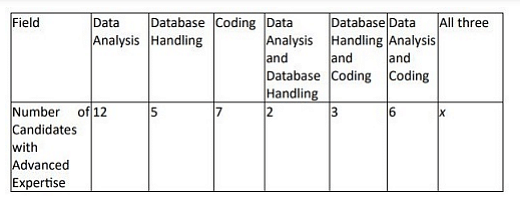
The number of applicants with advanced expertise in all three fields is given as x in the table, where x is a non-negative integer.
- XAT - 2024
- Data Interpretation