Directions: Each of the following questions is followed by two statements. Mark option (1) if the question can be answered using statement I alone. Mark option (2) if the question can be answered using statement II alone. Mark option (3) if both statements I and II together are needed to answer the question. Mark option (4) if the question cannot be answered even using both statements together.
Is x/y prime?
I. x is divisible by 3 but not by 9.
II. y is a multiple of 6.
Is x/y prime?
I. x is divisible by 3 but not by 9.
II. y is a multiple of 6.
Show Hint
- The question can be answered using statement I alone
- The question can be answered using statement II alone
- The question can be answered only if both statements I and II are used together
- The question cannot be answered even using both statements together
The Correct Option is D
Solution and Explanation
We are asked whether $x/y$ is a prime number, and we are given two clues about $x$ and $y$ separately. To check sufficiency, the fastest method is to plug in a few different numbers that satisfy the clues and see if the answer to "is $x/y$ prime" stays the same every time.
- Clue about x: x is divisible by 3 but not by 9. This describes a whole family of numbers: 3, 6, 12, 15, 21, 24, 30, 33, and so on (skip the ones divisible by 9, like 9, 18, 27).
- Clue about y: y is a multiple of 6. This is also a family: 6, 12, 18, 24, 30, and so on.
- Try x = 12, y = 6: both clues are satisfied (12 is divisible by 3 but not 9; 6 is a multiple of 6). Here $x/y = 2$, and 2 is prime.
- Try x = 24, y = 6: both clues are satisfied again (24 is divisible by 3 but not 9; 6 is a multiple of 6). Here $x/y = 4$, and 4 is not prime.
- Try x = 6, y = 12: both clues hold. Here $x/y = 0.5$, not even a whole number, so it cannot be prime.
Three valid pairs of x and y, all fitting both given clues, produce three different verdicts on whether $x/y$ is prime. That means the two statements, even combined, never pin down a single answer.
Let's summarize:
- Each clue describes a whole family of numbers, not one fixed value.
- Testing different members of these families gives different results for whether $x/y$ is prime.
- When the answer changes depending on which valid numbers we pick, the data is not sufficient.
So even using both statements together, we cannot say for certain whether $x/y$ is prime, and the correct option is (4).
\[ \boxed{\text{Answer: Not sufficient even with both statements}} \]Top Questions on Divisibility and Remainder
Let the number \((22)^{2022}\) + \((2022)^{22}\) leave the remainder \( \alpha \) when divided by 3 and \( \beta \) when divided by 7. Then \( (\alpha^2 + \beta^2) \) is equal to:}
- JEE Main - 2023
- Mathematics
- Divisibility and Remainder
- When \((629)^{24}\) is divided by 21, find the remainder.
- XAT - 2006
- Quantitative Ability and Data Interpretation
- Divisibility and Remainder
- Let x, y and z be three positive integers satisfying \(y = 3x\), \(z = 4x\), and \(x + y + z = 3k\), where k is an integer. Which of the following is the smallest value of k for which x, y and z are even numbers?
- XAT - 2006
- Quantitative Ability and Data Interpretation
- Divisibility and Remainder
- N = aebfcg is a six digit number where a, b, c, e, f, g are its six digits. If \(a = e\), \(b = f\) and \(c = g\), which of the given statements is NOT correct?
- XAT - 2006
- Quantitative Ability and Data Interpretation
- Divisibility and Remainder
- Want to practice more? Try solving extra ecology questions todayView All Questions
Questions Asked in XAT exam
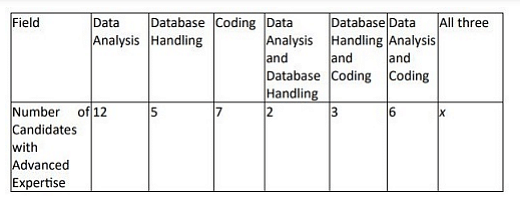
The number of applicants with advanced expertise in all three fields is given as x in the table, where x is a non-negative integer.
- XAT - 2024
- Data Interpretation