When \((629)^{24}\) is divided by 21, find the remainder.
Show Hint
- 1
- 2
- 5
- 11
The Correct Option is A
Solution and Explanation
There is a faster route here that avoids splitting 21 into factors at all. Look at how close 629 sits to a multiple of 21 itself.
Note that \(21 \times 30 = 630\). So \(629 = 630 - 1\), which means:
\[ 629 \equiv -1 \pmod{21} \]Now raise both sides to the power 24. Since the exponent is even, a negative base raised to it becomes positive:
\[ 629^{24} \equiv (-1)^{24} = 1 \pmod{21} \]So dividing \(629^{24}\) by 21 leaves a remainder of 1. None of the other options, 2, 5 or 11, matches this direct check.
Let's summarize:
- 629 is just 1 less than 630, and 630 is a clean multiple of 21 (21 x 30).
- So 629 behaves like -1 under mod 21, and -1 raised to the even power 24 gives 1.
The remainder when 629^24 is divided by 21 is 1.
Top Questions on Divisibility and Remainder
Let the number \((22)^{2022}\) + \((2022)^{22}\) leave the remainder \( \alpha \) when divided by 3 and \( \beta \) when divided by 7. Then \( (\alpha^2 + \beta^2) \) is equal to:}
- JEE Main - 2023
- Mathematics
- Divisibility and Remainder
- Let x, y and z be three positive integers satisfying \(y = 3x\), \(z = 4x\), and \(x + y + z = 3k\), where k is an integer. Which of the following is the smallest value of k for which x, y and z are even numbers?
- XAT - 2006
- Quantitative Ability and Data Interpretation
- Divisibility and Remainder
- N = aebfcg is a six digit number where a, b, c, e, f, g are its six digits. If \(a = e\), \(b = f\) and \(c = g\), which of the given statements is NOT correct?
- XAT - 2006
- Quantitative Ability and Data Interpretation
- Divisibility and Remainder
Find the remainder when \(N = 1821 \times 1823 \times 1827\) is divided by 12.
- XAT - 2006
- Quantitative Ability and Data Interpretation
- Divisibility and Remainder
- Want to practice more? Try solving extra ecology questions todayView All Questions
Questions Asked in XAT exam
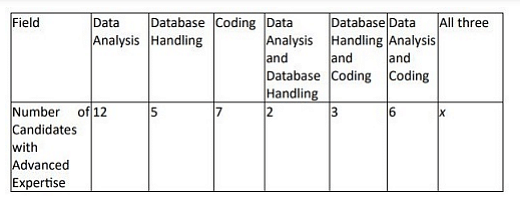
The number of applicants with advanced expertise in all three fields is given as x in the table, where x is a non-negative integer.
- XAT - 2024
- Data Interpretation