N = aebfcg is a six digit number where a, b, c, e, f, g are its six digits. If \(a = e\), \(b = f\) and \(c = g\), which of the given statements is NOT correct?
Show Hint
- If g = 4 then N is divisible by 44.
- If a + b + c = 6 then N is divisible by 33.
- If g = 8, then for different values of a, b, c and e, N may be a perfect square.
- If b = c = 0, then N is not a perfect square.
The Correct Option is C
Solution and Explanation
Instead of proving things in general, let's test this by trying real numbers and see which statement breaks down.
Since the digits of N are really a, a, b, b, c, c (because e = a, f = b, g = c), we can always write $N = 110000a + 1100b + 11c$, which is $11$ times $(10000a + 100b + c)$. This means N is a multiple of $11$ no matter what a, b, c are.
- Option 1: Take g = c = 4, and try a = 1, b = 0. Then N = $110044$, and $110044 / 44 = 2501$ exactly, no remainder. Try a = 2, b = 3: N = $223344$, and $223344 / 44 = 5076$, also exact. The pattern always holds because $100$ and $10000$ are already multiples of $4$, so having $c = 4$ is all it takes. This statement is correct.
- Option 2: Take a = 1, b = 2, c = 3, so a + b + c = 6. Then N = $112233$, and $112233 / 33 = 3401$ exactly. Try a = 2, b = 2, c = 2 (sum 6 again): N = $222222$, and $222222 / 33 = 6734$, exact again. This statement is correct.
- Option 3: Take g = c = 8, and try several pairs (a, b). With a = 1, b = 0, N = $110088$; the closest squares are $331^2 = 109561$ and $332^2 = 110224$, so $110088$ is not a square. With a = 5, b = 5, N = $550588$; the closest squares are $741^2 = 549081$ and $742^2 = 550564$, still not a square. No matter which a and b are tried, N always ends in the digits 0 and 8, and a perfect square that is 11 times another number can never end in those two digits, once you check the pattern of last two digits that squares can take. So N can never be a perfect square when g = 8, making this statement FALSE.
- Option 4: Take b = c = 0, so N = $110000a$ for a = 1 to 9, giving $110000, 220000, \ldots, 990000$. None of these are perfect squares: for example $\sqrt{110000} \approx 331.7$ and $\sqrt{990000} \approx 995.0$, neither landing on a whole number, and the same holds for every a from 1 to 9. This statement is correct.
Only option 3 breaks down under testing, since g = 8 never allows N to become a perfect square for any choice of a, b, c.
Let's summarize:
- N always has the form $11 \times (10000a + 100b + c)$, so it is always a multiple of 11.
- Options 1, 2 and 4 hold up under direct testing with real numbers.
- Option 3 fails: no choice of a, b, c ever makes N a perfect square when g = 8.
So the statement that is NOT correct is option 3.
Top Questions on Divisibility and Remainder
Let the number \((22)^{2022}\) + \((2022)^{22}\) leave the remainder \( \alpha \) when divided by 3 and \( \beta \) when divided by 7. Then \( (\alpha^2 + \beta^2) \) is equal to:}
- JEE Main - 2023
- Mathematics
- Divisibility and Remainder
- When \((629)^{24}\) is divided by 21, find the remainder.
- XAT - 2006
- Quantitative Ability and Data Interpretation
- Divisibility and Remainder
- Let x, y and z be three positive integers satisfying \(y = 3x\), \(z = 4x\), and \(x + y + z = 3k\), where k is an integer. Which of the following is the smallest value of k for which x, y and z are even numbers?
- XAT - 2006
- Quantitative Ability and Data Interpretation
- Divisibility and Remainder
Find the remainder when \(N = 1821 \times 1823 \times 1827\) is divided by 12.
- XAT - 2006
- Quantitative Ability and Data Interpretation
- Divisibility and Remainder
- Want to practice more? Try solving extra ecology questions todayView All Questions
Questions Asked in XAT exam
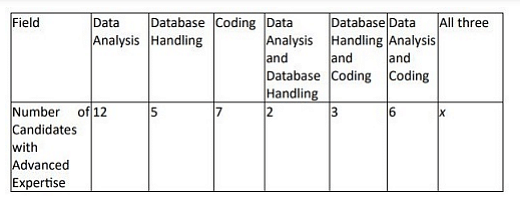
The number of applicants with advanced expertise in all three fields is given as x in the table, where x is a non-negative integer.
- XAT - 2024
- Data Interpretation