Let x, y and z be three positive integers satisfying \(y = 3x\), \(z = 4x\), and \(x + y + z = 3k\), where k is an integer. Which of the following is the smallest value of k for which x, y and z are even numbers?
Show Hint
- 8
- 10
- 12
- 16
The Correct Option is D
Solution and Explanation
We can also solve this by thinking about odd and even behaviour directly, instead of jumping straight to the algebra.
We know $y = 3x$ and $z = 4x$, and $x + y + z = 8x = 3k$.
- Why z is always even: $z = 4x$ is a multiple of 4, and any multiple of 4 is automatically even, no matter what x is.
- Why y's evenness depends only on x: $y = 3x$. Multiplying by the odd number 3 never changes whether a number is odd or even, so y is even only when x is even, and y is odd only when x is odd.
- Why x itself must be even: since we need x, y and z all even, and y is even only when x is even, x has to be even. There is no way around this.
- Why x must also be a multiple of 3: from $8x = 3k$, the right side is a multiple of 3, so the left side, $8x$, must be too. Since 8 has no factor of 3, x itself must supply it, so x must be a multiple of 3.
Putting the two requirements together, x must be even AND a multiple of 3, which forces x to be a multiple of 6. The smallest positive multiple of 6 is $x = 6$.
With $x = 6$: $y = 18$, $z = 24$. All three, 6, 18 and 24, are even, exactly as required.
Now find k from the sum: $x + y + z = 6 + 18 + 24 = 48$, and $48 = 3k$ gives $k = 16$.
Let's summarize:
- z is always even, no matter what x is.
- y is even only when x is even, so x must be even.
- k is a whole number only when x is a multiple of 3.
- Both conditions together force x to be a multiple of 6, and the smallest such x is 6, giving k = 16.
So the smallest value of k for which x, y and z are all even is 16.
Top Questions on Divisibility and Remainder
Let the number \((22)^{2022}\) + \((2022)^{22}\) leave the remainder \( \alpha \) when divided by 3 and \( \beta \) when divided by 7. Then \( (\alpha^2 + \beta^2) \) is equal to:}
- JEE Main - 2023
- Mathematics
- Divisibility and Remainder
- When \((629)^{24}\) is divided by 21, find the remainder.
- XAT - 2006
- Quantitative Ability and Data Interpretation
- Divisibility and Remainder
- N = aebfcg is a six digit number where a, b, c, e, f, g are its six digits. If \(a = e\), \(b = f\) and \(c = g\), which of the given statements is NOT correct?
- XAT - 2006
- Quantitative Ability and Data Interpretation
- Divisibility and Remainder
Find the remainder when \(N = 1821 \times 1823 \times 1827\) is divided by 12.
- XAT - 2006
- Quantitative Ability and Data Interpretation
- Divisibility and Remainder
- Want to practice more? Try solving extra ecology questions todayView All Questions
Questions Asked in XAT exam
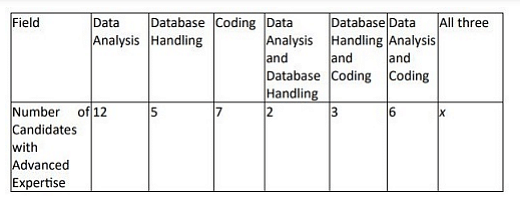
The number of applicants with advanced expertise in all three fields is given as x in the table, where x is a non-negative integer.
- XAT - 2024
- Data Interpretation