Caselet (Questions 97-100): Om Chowdhury was one of the supervisors in the Fire and Safety (F&S) department of Maqsood Textile Mills. He was a distant cousin of Mr. Bhiwani, the General Manager (Personnel & Administration), and the Personnel and Administration department handled all personnel-related decisions. It was often rumored that Om had gotten the job because of his cousin's influence. Om, however, was careful in his work and never gave anyone a reason to complain. He was known to be a quiet man who kept to himself and his duties.
All F&S supervisors reported to Mr. Rabindra, the shop-floor manager. The mill ran on a three-shift basis, and Rabindra allotted supervisors to the different shifts. Supervisors had to stay present through the whole shift and run scheduled checks on the machinery and firefighting equipment. For some reason, Rabindra kept assigning Om to the night shift more often than the other supervisors. Om never objected to this, while the other supervisors often pleaded with Rabindra to be given day shifts instead. Staying awake and alert through the night shift was one of the hardest parts of the job.
After a while, Rabindra noticed that Om seemed indifferent to his work. Twice he found Om missing from his cabin, and others told him Om had been seen wandering different parts of the shop floor. Rabindra called Om in and reminded him of his responsibilities. Om did not argue and promised not to be careless again. Rabindra also raised the matter with Mr. Bhiwani, who called Om in for a personal talk and reminded him that their family tie made the situation awkward for everyone. Om agreed to improve, and soon he became a model supervisor, even going out of his way to help employees with their problems.
Three months later, Rabindra visited the plant at night and, looking into the F&S office, found Om playing solitaire on the office computer. Rabindra fired Om on the spot.
The next morning, Mr. Bhiwani called Rabindra and asked how he could fire an employee like that, and suggested he reconsider the dismissal. Rabindra replied, "This decision has already been made. There will be no turning back."
Question: Out of the options below, which one best sums up the learning from the solitaire incident?
Caselet (Questions 97-100): Om Chowdhury was one of the supervisors in the Fire and Safety (F&S) department of Maqsood Textile Mills. He was a distant cousin of Mr. Bhiwani, the General Manager (Personnel & Administration), and the Personnel and Administration department handled all personnel-related decisions. It was often rumored that Om had gotten the job because of his cousin's influence. Om, however, was careful in his work and never gave anyone a reason to complain. He was known to be a quiet man who kept to himself and his duties.
All F&S supervisors reported to Mr. Rabindra, the shop-floor manager. The mill ran on a three-shift basis, and Rabindra allotted supervisors to the different shifts. Supervisors had to stay present through the whole shift and run scheduled checks on the machinery and firefighting equipment. For some reason, Rabindra kept assigning Om to the night shift more often than the other supervisors. Om never objected to this, while the other supervisors often pleaded with Rabindra to be given day shifts instead. Staying awake and alert through the night shift was one of the hardest parts of the job.
After a while, Rabindra noticed that Om seemed indifferent to his work. Twice he found Om missing from his cabin, and others told him Om had been seen wandering different parts of the shop floor. Rabindra called Om in and reminded him of his responsibilities. Om did not argue and promised not to be careless again. Rabindra also raised the matter with Mr. Bhiwani, who called Om in for a personal talk and reminded him that their family tie made the situation awkward for everyone. Om agreed to improve, and soon he became a model supervisor, even going out of his way to help employees with their problems.
Three months later, Rabindra visited the plant at night and, looking into the F&S office, found Om playing solitaire on the office computer. Rabindra fired Om on the spot.
The next morning, Mr. Bhiwani called Rabindra and asked how he could fire an employee like that, and suggested he reconsider the dismissal. Rabindra replied, "This decision has already been made. There will be no turning back."
Question: Out of the options below, which one best sums up the learning from the solitaire incident?
Show Hint
- Managers often do not take any responsibility towards training juniors.
- People tend to become relaxed during the night shift, and this requires surprise checks to keep them on their toes.
- Certain roles have different ways of carrying out their duties.
- Having relatives in the same organization can be a source of potential problems.
The Correct Option is C
Solution and Explanation
This question asks for the single best takeaway from the whole solitaire episode. Let's test the five statements against the story.
- A. Managers do not train juniors: training of any kind is never mentioned in the case, so this cannot be the lesson drawn from it.
- B. Night-shift staff relax and need surprise checks: this reads like a fix rather than a lesson, and it treats Om's one incident as proof of a wider pattern the case never actually shows.
- C. Different roles are carried out in different ways: an F&S supervisor's job is largely to be present and alert for an emergency, so quiet stretches with little visible activity are a normal part of that job, unlike a role with constant, visible tasks. Mistaking this for idleness is exactly what tripped up Rabindra.
- D. Relatives in the same firm cause problems: this is true of the Om-Bhiwani side detail, but it belongs to the hiring subplot, not to the specific judgment failure in the firing.
- E. Managers place silent people in certain roles: the case never claims or implies this as a general rule.
Option C is the one that generalizes correctly from the actual events without inventing extra facts.
Let's summarize:
- A watch-and-check role naturally has idle-looking stretches once the checks are done.
- Judging such a role by the busy-ness standard of a different role produces a wrong reading of the person's conduct.
So the best summary of the learning is option C.
Top Questions on Caselets
- Read the following scenario and answer the questions that follow.
Mr. Singh lived in a sprawling housing society. He employed two part-time domestic helps, Vimla and Sharda. Vimla was responsible for cleaning and dusting, while Sharda took care of cooking.
Once Sharda fell ill and consequently took leave for three days. When Sharda returned to work, she learned that Mr. Singh’s gold ring, a gift from his mother, was missing. Suspecting theft, Mr. Singh had terminated Vimla. Mr. Singh asked Sharda to take additional responsibility of cleaning the house, along with an offer to double her salary. Sharda accepted the offer as her previous two jobs were lost due to frequent health-related absences. She was struggling to make ends meet; this offer would go a long way to help her.
Next day, while cleaning under the dressing table, Sharda found the gold ring. Overjoyed, Mr. Singh expressed his gratitude by presenting Sharda a reward of one thousand rupees! However, he made no mention of reinstating Vimla.- XAT - 2024
- Decision Making
- Caselets
- Read the following scenario and answer the questions that follow.
In Symbolis, an upcoming medium sized IT services organization, only 1% of the employees were awarded an annual performance bonus. This annual performance bonus was decided by a committee formed of different functional heads. When Ms. Nalini Kattakayam received the annual bonus for the first time in her five years at Symbolis, Ms. Shalini Sampath, a colleague with seven years of tenure at Symbolis, told Nalini that this annual bonus was less a reflection of Nalini’s performance and more a recognition of those who have fostered a strong rapport with the powers that be. Incidentally, Shalini had never received any performance bonus in her tenure at the company.- XAT - 2024
- Decision Making
- Caselets
- Read the following scenario and answer the questions that follow.
Raman had been working tirelessly as a Project Manager in the IT department of Flying Groceries, a renowned app-based supply chain company, for the past three years. Having graduated from a top-tier engineering college, he dived straight into the corporate world, managing projects with great zeal that inspired his seniors.
At the end of his first year with Flying Groceries, impressed with his hard work, Raman’s boss, Suraj, the founder-CEO of Flying Groceries, fast-tracked his promotion and made him Delivery Manager responsible for multiple projects of a vertical. Suraj also promised Raman the position of Chief Operation Officer in the fifth year of his tenure.
In search of a greater career trajectory, Raman pursued entrance exams for business schools. His efforts bore fruits as he secured a place in the country’s best business school, known for a strong alumni base, stellar placement records and demanding academic requirements.
Raman was delighted; he had three months to join the business school. Flying Groceries demanded that any employee who wished to leave the organization should give at least a month’s notice. Raman decided to continue working and enriching his work experience, which will be beneficial when applying to companies after graduating from the business school. Therefore, he decided not to share the news of the offer with anyone else for the time being.- XAT - 2024
- Decision Making
- Caselets
- Read the following scenario and answer the questions that follow.
Kasta, a small industrial town hosted a steel plant and its associated ancillary companies. Most of its residents were steel plant employees from different states of the country. While the town offered employment opportunities, it lacked an airport. For those wanting to fly, the nearest airport was in Michaelganj, 100 kms from Kasta. To reach the airport, people rented taxi services available at Kasta, and Prabhu was one such taxi-service provider.
Prabhu’s rates were reasonable - a trip to airport cost Rs. 2200, but for a round trip, the fare was Rs. 3000. Yet, it was not just the affordability that made him popular, his reputation for punctuality and reliability was unmatched. When it came to ensuring the safety of women travelling alone, he would always be the first choice. Such was his trustworthiness that even the steel plant would solicit his services when expecting solo female visitors. Moreover, whenever residents encountered issues with their personal cars, they would turn to Prabhu for help.
However, the world shifted when the COVID-19 pandemic struck. Travel restrictions and safety concerns limited Prabhu’s trips to Michaelganj for over a year and a half. Financial strain followed, with accumulating interest on his home loan. He was weighed down by debt, but things improved once COVID-19 travel restrictions were lifted. Having faced financial hardships during COVID-19, he sought to offset his losses by raising the fare. Yet, he was aware of the stiff competition in town, where many others offered services at a similar fare as his.- XAT - 2024
- Decision Making
- Caselets
- Want to practice more? Try solving extra ecology questions todayView All Questions
Questions Asked in XAT exam
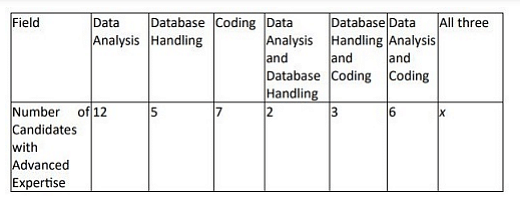
The number of applicants with advanced expertise in all three fields is given as x in the table, where x is a non-negative integer.
- XAT - 2024
- Data Interpretation