Caselet (Questions 101-104): Shekhar, an MBA from Singapore, returned to his hometown of Jamshedpur. Jamshedpur had a population of 10 lacs and one of the highest per capita incomes among Indian cities. Shekhar loved music. While listening to his favourite song on satellite radio one day, he wondered if he could combine his passion with a business. A few weeks later, by coincidence, Music World called for expressions of interest from potential franchisees. Jamshedpur did not have a single good music store where residents could buy quality, variety, and the latest releases.
Music World wanted its franchisees to own at least 1200 square feet of space and invest Rs. 30 lacs. Profits were to be split in the ratio of 3:7 between Music World and the franchisee. Shekhar liked the idea of working with a well-known brand, but he worried whether Rs. 30 lacs was too much money to put in. He did not have the full amount and was thinking of borrowing from a bank. He checked with other Music World franchisees in towns like Patna and Ranchi, expecting similar footfall in Jamshedpur. A franchisee in Patna reported monthly sales revenue of Rs. 1 to 2 lacs, with a profit margin of 25 to 30 percent. Satisfied with this, Shekhar decided to go ahead.
He then began looking for space. Jamshedpur had three main areas: Bistupur, Sakchi, and Sonari, all connected by good roads. Bistupur was a business area with most of the high-end retail stores, shopped at by the upper-middle and higher classes, and was also the city's education hub. Sakchi was a growing lower-middle-class business area, while Sonari was mostly residential.
Shekhar preferred Bistupur, since it was where he did his own shopping. But he ran into problems there: space was hard to find, and rentals had touched Rs. 30 to 40 per square foot per month, compared to Rs. 15 to 20 per square foot per month in Sakchi and Sonari. A friend who lived in Sakchi told him that several branded outlets were opening up there, and that it looked like the fastest-growing market in Jamshedpur with the highest share of teenagers. Still, Shekhar was against Sakchi because of its "downmarket" image. He wanted to target the college-going crowd, and he expected to find them in Bistupur.
The high real-estate cost in Bistupur, set against his low opinion of the Sakchi market, left Shekhar confused. To think the decision through properly, he decided to drive down the Jamshedpur-Ranchi highway in his newly bought car.
Question: Suppose sales in Patna and Bistupur are likely to be the same, how many years would it take for Shekhar to recoup the investment (consider zero inflation)?
Caselet (Questions 101-104): Shekhar, an MBA from Singapore, returned to his hometown of Jamshedpur. Jamshedpur had a population of 10 lacs and one of the highest per capita incomes among Indian cities. Shekhar loved music. While listening to his favourite song on satellite radio one day, he wondered if he could combine his passion with a business. A few weeks later, by coincidence, Music World called for expressions of interest from potential franchisees. Jamshedpur did not have a single good music store where residents could buy quality, variety, and the latest releases.
Music World wanted its franchisees to own at least 1200 square feet of space and invest Rs. 30 lacs. Profits were to be split in the ratio of 3:7 between Music World and the franchisee. Shekhar liked the idea of working with a well-known brand, but he worried whether Rs. 30 lacs was too much money to put in. He did not have the full amount and was thinking of borrowing from a bank. He checked with other Music World franchisees in towns like Patna and Ranchi, expecting similar footfall in Jamshedpur. A franchisee in Patna reported monthly sales revenue of Rs. 1 to 2 lacs, with a profit margin of 25 to 30 percent. Satisfied with this, Shekhar decided to go ahead.
He then began looking for space. Jamshedpur had three main areas: Bistupur, Sakchi, and Sonari, all connected by good roads. Bistupur was a business area with most of the high-end retail stores, shopped at by the upper-middle and higher classes, and was also the city's education hub. Sakchi was a growing lower-middle-class business area, while Sonari was mostly residential.
Shekhar preferred Bistupur, since it was where he did his own shopping. But he ran into problems there: space was hard to find, and rentals had touched Rs. 30 to 40 per square foot per month, compared to Rs. 15 to 20 per square foot per month in Sakchi and Sonari. A friend who lived in Sakchi told him that several branded outlets were opening up there, and that it looked like the fastest-growing market in Jamshedpur with the highest share of teenagers. Still, Shekhar was against Sakchi because of its "downmarket" image. He wanted to target the college-going crowd, and he expected to find them in Bistupur.
The high real-estate cost in Bistupur, set against his low opinion of the Sakchi market, left Shekhar confused. To think the decision through properly, he decided to drive down the Jamshedpur-Ranchi highway in his newly bought car.
Question: Suppose sales in Patna and Bistupur are likely to be the same, how many years would it take for Shekhar to recoup the investment (consider zero inflation)?
Show Hint
- Less than five years.
- Less than seven years.
- Less than eight years.
- May be never.
The Correct Option is D
Solution and Explanation
This question wants a payback period for Shekhar's Rs. 30 lac investment, assuming Bistupur sells like Patna. Instead of picking a year figure straight away, it helps to actually run the numbers from the case and see where they land.
- Less than five years: even at the best-case Patna numbers (Rs. 2 lacs revenue, 30% margin, so Rs. 0.6 lacs total monthly profit, and Shekhar's 70% share is Rs. 0.42 lacs a month, or about Rs. 5.04 lacs a year), payback works out to about 5.95 years, which is already past five years, so this is too optimistic.
- Less than seven years: this matches only the best-case scenario, about 5.95 years; the worst case from the same Patna range runs to about 14.3 years, so "less than seven" only holds if Bistupur performs at the very top of the range.
- Less than eight years: again true only near the best-case end of the range, not across the range Patna actually gives us.
- May be never: the worst-case Patna scenario (Rs. 1 lac revenue, 25% margin, giving Shekhar about Rs. 2.1 lacs a year) needs roughly 14.3 years just on sales and margin alone, before adding Bistupur's much higher rent (Rs. 30 to 40 per square foot versus Rs. 15 to 20 elsewhere in the city), which is not included in the Patna benchmark and would cut further into the real profit.
Since the computed payback swings from about six years to well past fourteen depending on which end of Patna's own range applies, and Bistupur's extra rent burden would stretch it even further, no fixed year figure can be trusted. The safest, most honest reading is that recovery may never happen on a reliable basis.
Let's summarize:
- A range of inputs (revenue, margin) produces a range of paybacks, not one clean number.
- Ignoring location-specific costs like Bistupur's higher rent understates the true payback period.
So "may be never" is the answer that best respects this uncertainty.
Top Questions on Caselets
- Read the following scenario and answer the questions that follow.
Mr. Singh lived in a sprawling housing society. He employed two part-time domestic helps, Vimla and Sharda. Vimla was responsible for cleaning and dusting, while Sharda took care of cooking.
Once Sharda fell ill and consequently took leave for three days. When Sharda returned to work, she learned that Mr. Singh’s gold ring, a gift from his mother, was missing. Suspecting theft, Mr. Singh had terminated Vimla. Mr. Singh asked Sharda to take additional responsibility of cleaning the house, along with an offer to double her salary. Sharda accepted the offer as her previous two jobs were lost due to frequent health-related absences. She was struggling to make ends meet; this offer would go a long way to help her.
Next day, while cleaning under the dressing table, Sharda found the gold ring. Overjoyed, Mr. Singh expressed his gratitude by presenting Sharda a reward of one thousand rupees! However, he made no mention of reinstating Vimla.- XAT - 2024
- Decision Making
- Caselets
- Read the following scenario and answer the questions that follow.
In Symbolis, an upcoming medium sized IT services organization, only 1% of the employees were awarded an annual performance bonus. This annual performance bonus was decided by a committee formed of different functional heads. When Ms. Nalini Kattakayam received the annual bonus for the first time in her five years at Symbolis, Ms. Shalini Sampath, a colleague with seven years of tenure at Symbolis, told Nalini that this annual bonus was less a reflection of Nalini’s performance and more a recognition of those who have fostered a strong rapport with the powers that be. Incidentally, Shalini had never received any performance bonus in her tenure at the company.- XAT - 2024
- Decision Making
- Caselets
- Read the following scenario and answer the questions that follow.
Raman had been working tirelessly as a Project Manager in the IT department of Flying Groceries, a renowned app-based supply chain company, for the past three years. Having graduated from a top-tier engineering college, he dived straight into the corporate world, managing projects with great zeal that inspired his seniors.
At the end of his first year with Flying Groceries, impressed with his hard work, Raman’s boss, Suraj, the founder-CEO of Flying Groceries, fast-tracked his promotion and made him Delivery Manager responsible for multiple projects of a vertical. Suraj also promised Raman the position of Chief Operation Officer in the fifth year of his tenure.
In search of a greater career trajectory, Raman pursued entrance exams for business schools. His efforts bore fruits as he secured a place in the country’s best business school, known for a strong alumni base, stellar placement records and demanding academic requirements.
Raman was delighted; he had three months to join the business school. Flying Groceries demanded that any employee who wished to leave the organization should give at least a month’s notice. Raman decided to continue working and enriching his work experience, which will be beneficial when applying to companies after graduating from the business school. Therefore, he decided not to share the news of the offer with anyone else for the time being.- XAT - 2024
- Decision Making
- Caselets
- Read the following scenario and answer the questions that follow.
Kasta, a small industrial town hosted a steel plant and its associated ancillary companies. Most of its residents were steel plant employees from different states of the country. While the town offered employment opportunities, it lacked an airport. For those wanting to fly, the nearest airport was in Michaelganj, 100 kms from Kasta. To reach the airport, people rented taxi services available at Kasta, and Prabhu was one such taxi-service provider.
Prabhu’s rates were reasonable - a trip to airport cost Rs. 2200, but for a round trip, the fare was Rs. 3000. Yet, it was not just the affordability that made him popular, his reputation for punctuality and reliability was unmatched. When it came to ensuring the safety of women travelling alone, he would always be the first choice. Such was his trustworthiness that even the steel plant would solicit his services when expecting solo female visitors. Moreover, whenever residents encountered issues with their personal cars, they would turn to Prabhu for help.
However, the world shifted when the COVID-19 pandemic struck. Travel restrictions and safety concerns limited Prabhu’s trips to Michaelganj for over a year and a half. Financial strain followed, with accumulating interest on his home loan. He was weighed down by debt, but things improved once COVID-19 travel restrictions were lifted. Having faced financial hardships during COVID-19, he sought to offset his losses by raising the fare. Yet, he was aware of the stiff competition in town, where many others offered services at a similar fare as his.- XAT - 2024
- Decision Making
- Caselets
- Want to practice more? Try solving extra ecology questions todayView All Questions
Questions Asked in XAT exam
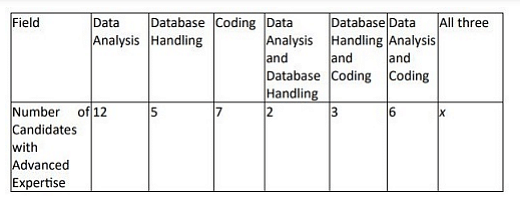
The number of applicants with advanced expertise in all three fields is given as x in the table, where x is a non-negative integer.
- XAT - 2024
- Data Interpretation