Question:hard
The coordinates of P and Q are (0, 4) and (a, 6), respectively, where a is a non-zero integer. R is the midpoint of PQ. The perpendicular bisector of PQ cuts the X-axis at the point S(b, 0). For how many integer values of a is b also an integer?
The coordinates of P and Q are (0, 4) and (a, 6), respectively, where a is a non-zero integer. R is the midpoint of PQ. The perpendicular bisector of PQ cuts the X-axis at the point S(b, 0). For how many integer values of a is b also an integer?
Show Hint
Write b in terms of a using the perpendicular bisector equation, then check which integer values of a keep b a whole number.
Updated On: Jul 10, 2026
- 4
- 3
- 2
- 1
Show Solution
The Correct Option is A
Solution and Explanation
Instead of writing the perpendicular bisector as a slope-intercept equation, let's build it using a direction vector, a slightly different route to the same relationship between a and b.
- Direction of PQ: going from P(0, 4) to Q(a, 6), the direction vector is $(a, 2)$.
- Perpendicular direction: a vector perpendicular to $(a, 2)$ is $(2, -a)$, since their dot product is $a(22) + 2(-a) = 0$.
- Parametric line through the midpoint: the midpoint R is $\left(\frac{a}{2}, 5\right)$. Moving along the perpendicular direction by a parameter $t$, points on the bisector are $\left(\frac{a}{2} + 2t,\ 5 - at\right)$.
- Find where y = 0: setting $5 - at = 0$ gives $t = \frac{5}{a}$.
- Substitute back for x = b: $b = \frac{a}{2} + 2 \times \frac{5}{a} = \frac{a}{2} + \frac{10}{a}$, the same expression as before, confirming the two methods agree.
Now check which integers a make this a whole number. Since $\frac{10}{a}$ only contributes a whole-number style fraction alongside $\frac{a}{2}$ when a shares factors with 20, a must be a divisor of 20: the candidates are $\pm1, \pm2, \pm4, \pm5, \pm10, \pm20$. Testing each shows only $a = 2, 10, -2, -10$ give a whole-number b (each giving $b = 6$ or $b = -6$); every other divisor leaves a leftover half unit, for example $a = 4$ gives $b = 2 + 2.5 = 4.5$.
Let's summarize:
- The parametric (vector) method and the slope-intercept method both give $b = \frac{a}{2} + \frac{10}{a}$.
- Only 4 integer values of a, namely $-10, -2, 2, 10$, keep b a whole number.
So there are 4 integer values of a for which b is also an integer.
Was this answer helpful?
0
Top Questions on Coordinate Geometry
- Given that \( \cot \left( \frac{A+B}{2} \right) \cdot \tan \left( \frac{A-B}{2} \right) = \), and the equation \( \frac{x}{2} + \frac{y}{3} + \frac{2}{6} - 1 = 0 \), find the area of \( \Delta ABC = 2 \).
- MHT CET - 2025
- Mathematics
- Coordinate Geometry
- Given that: \[ \cot \left( \frac{A + B}{2} \right) \cdot \tan \left( \frac{A - B}{2} \right) \] and the equation involving coordinates: \[ \frac{x}{2} + \frac{y}{3} + \frac{2}{6} - 1 = 0 \] Find the area of \( \Delta ABC = 2 \).
- MHT CET - 2025
- Mathematics
- Coordinate Geometry
- Find the distance between the following pairs of points :
(i) (2, 3), (4, 1)
(ii) (– 5, 7), (– 1, 3)
(iii) (a, b), (– a, – b)- CBSE Class X
- Mathematics
- Coordinate Geometry
- Find the distance between the points (0, 0) and (36, 15). Can you now find the distance between the two towns A and B ?
- CBSE Class X
- Mathematics
- Coordinate Geometry
- Want to practice more? Try solving extra ecology questions todayView All Questions
Questions Asked in XAT exam
Applicants have been shortlisted for interviews for some data analyst positions. Some of the applicants have advanced expertise in one or more fields among the following: data analysis, database handling and coding. The numbers of applicants with different advanced expertise are given in the 2 × 8 table below.
The number of applicants with advanced expertise in all three fields is given as x in the table, where x is a non-negative integer.
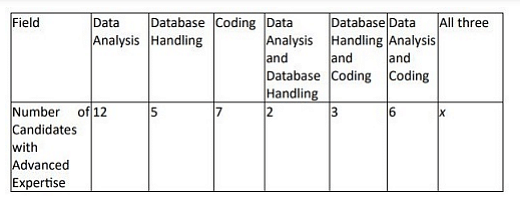
The number of applicants with advanced expertise in all three fields is given as x in the table, where x is a non-negative integer.
- XAT - 2024
- Data Interpretation