Sun Ltd. and Star Ltd. are two rivals always trying to outdo each other. The table below gives the payoff to Sun Ltd. for every pair of strategies the two companies can pick. For example, if Sun Ltd. plays strategy B and Star Ltd. plays strategy A, Sun Ltd. gains 6000 while Star Ltd. loses 6000. Besides this payoff, each company also pays an expense for running whichever strategy it picks; those expenses are given in the second table below.
| Payoffs for Sun Ltd. | |||
|---|---|---|---|
| Sun Ltd. strategy | Star Ltd. plays A | Star Ltd. plays B | Star Ltd. plays C |
| A | 8000 | 12000 | 8000 |
| B | 6000 | -2000 | 0 |
| C | 8000 | 16000 | 4000 |
| Expenses for running each strategy | |||
|---|---|---|---|
| Strategy | A | B | C |
| Star Ltd. | 7000 | 8000 | 8000 |
| Sun Ltd. | 8000 | 2000 | 8000 |
If Star Ltd. adopts strategy A, which strategy should Sun Ltd. adopt for maximum gain?
If Star Ltd. adopts strategy A, which strategy should Sun Ltd. adopt for maximum gain?
Show Hint
- A
- B
- C
- A or C
The Correct Option is B
Solution and Explanation
Rather than handling payoff and expense separately just for this question, build the full net gain table for Sun Ltd. once. Net gain equals the payoff (from the payoff table) minus Sun Ltd.'s own expense for that strategy: 8000 for A, 2000 for B, and 8000 for C.
Step 2: Fill in the full net table, column by column.
Against Star A: A gives $8000-8000=0$, B gives $6000-2000=4000$, C gives $8000-8000=0$.
Against Star B: A gives $12000-8000=4000$, B gives $-2000-2000=-4000$, C gives $16000-8000=8000$.
Against Star C: A gives $8000-8000=0$, B gives $0-2000=-2000$, C gives $4000-8000=-4000$.
So the completed net gain table, rows are Sun's strategy and columns are Star's strategy, reads: A gives 0, 4000, 0; B gives 4000, -4000, -2000; C gives 0, 8000, -4000.
Step 3: Pick the column that matches this question.
Star Ltd. has committed to strategy A, so we only need the first column of this table: A gives 0, B gives 4000, C gives 0.
Step 4: Compare and choose.
Among 0, 4000 and 0, the largest value is 4000, and it belongs to Sun Ltd. playing strategy B. Strategies A and C both leave Sun Ltd. with a net gain of exactly 0, since payoff and expense cancel out for both; neither beats B.
\[ \boxed{\text{Strategy B}} \]
If Star Ltd. adopts strategy B, what is Sun Ltd.'s maximum possible gain?
If Star Ltd. adopts strategy B, what is Sun Ltd.'s maximum possible gain?
Show Hint
- 10000
- 0
- 12000
- None of these
The Correct Option is D
Solution and Explanation
Net gain for Sun Ltd. equals its payoff from the payoff table minus its own running expense for that strategy: 8000 for A, 2000 for B, and 8000 for C. This one table then answers any question about Sun Ltd.'s net gain.
Step 2: Fill in every entry.
Against Star A: A gives $8000-8000=0$, B gives $6000-2000=4000$, C gives $8000-8000=0$.
Against Star B: A gives $12000-8000=4000$, B gives $-2000-2000=-4000$, C gives $16000-8000=8000$.
Against Star C: A gives $8000-8000=0$, B gives $0-2000=-2000$, C gives $4000-8000=-4000$.
Step 3: Pick out the column needed here.
Star Ltd. plays B, so read the middle column: Sun Ltd. gets 4000 by playing A, -4000 by playing B, and 8000 by playing C.
Step 4: Match against the answer choices.
The largest of these three values is 8000. Checking the choices: 10000 never shows up in the table, 0 is not one of the three computed values, and 12000 is only the raw, pre-expense payoff for A, not a net gain at all. None of the first three options equal the true maximum of 8000.
\[ \boxed{\text{None of these}} \]
If Sun Ltd. adopts strategy B, what strategy should Star Ltd. adopt to minimise Sun's gain, regardless of what its own gain will be?
If Sun Ltd. adopts strategy B, what strategy should Star Ltd. adopt to minimise Sun's gain, regardless of what its own gain will be?
Show Hint
- A
- B
- C
- A or C
The Correct Option is B
Solution and Explanation
Build the complete net gain table for Sun Ltd. once: net gain = payoff minus Sun Ltd.'s own expense (8000 for A, 2000 for B, 8000 for C). Filling it in for every combination gives: row A is 0, 4000, 0; row B is 4000, -4000, -2000; row C is 0, 8000, -4000, reading across Star's strategies A, B, C in each row.
Step 2: Pick out the row that matches this question.
Sun Ltd. is playing B here, so only the middle row matters: against Star A the net gain is 4000, against Star B it is -4000, and against Star C it is -2000.
Step 3: Find Star Ltd.'s best move from Sun Ltd.'s point of view.
Star Ltd. wants to push Sun Ltd.'s number down as far as possible. Scanning 4000, -4000 and -2000, the lowest is -4000.
Step 4: Confirm by checking the other two choices.
If Star Ltd. played A, Sun Ltd. would end up with 4000, its best possible outcome, so that clearly does not squeeze Sun Ltd. If Star Ltd. played C, Sun Ltd. would still keep -2000, better for Sun Ltd. than -4000. So only Star Ltd. playing B pushes Sun Ltd. down to its worst position.
\[ \boxed{\text{Strategy B}} \]
Of the following, which would be the most intelligent move on the part of Star Ltd?
Of the following, which would be the most intelligent move on the part of Star Ltd?
Show Hint
- If Sun Ltd. adopts strategy A, adopt strategy B.
- If Sun Ltd. adopts strategy B, adopt strategy B.
- If Sun Ltd. adopts strategy C, adopt strategy B.
- If Sun Ltd. adopts strategy C, adopt strategy A.
The Correct Option is B
Solution and Explanation
Every rupee Sun Ltd. gains as a raw payoff comes straight out of Star Ltd.'s pocket, and Star Ltd. separately pays its own running expense too. So Star Ltd.'s total loss for any combination is simply: (Sun Ltd.'s raw payoff) + (Star Ltd.'s own expense for the strategy it picks). This loss number is always positive, and Star Ltd. wants it as small as possible.
Step 2: Build the loss table row by row.
If Sun Ltd. plays A (payoffs 8000, 12000, 8000): losses are $8000+7000=15000$, $12000+8000=20000$, $8000+8000=16000$ for Star A, B, C. Smallest loss is 15000, at Star A.
If Sun Ltd. plays B (payoffs 6000, -2000, 0): losses are $6000+7000=13000$, $-2000+8000=6000$, $0+8000=8000$. Smallest loss is 6000, at Star B.
If Sun Ltd. plays C (payoffs 8000, 16000, 4000): losses are $8000+7000=15000$, $16000+8000=24000$, $4000+8000=12000$. Smallest loss is 12000, at Star C.
Step 3: Match each option against this loss table.
Option (1) says play B when Sun Ltd. plays A, but the smallest loss there (15000) belongs to A, not B (which costs 20000). Wrong.
Option (2) says play B when Sun Ltd. plays B, and the loss table confirms B is exactly the smallest-loss choice (6000) in that row. Correct.
Option (3) says play B when Sun Ltd. plays C, but C is the smallest-loss choice there (12000), while B costs 24000. Wrong.
Option (4) says play A when Sun Ltd. plays C, but again C is the smallest-loss choice (12000), while A costs 15000. Wrong.
Step 4: Conclude.
Only option (2) lines up with the row of the loss table it refers to.
\[ \boxed{\text{Option (2)}} \]
If both the companies adopt strategy C, then which of the following is true?
I. Star Ltd.'s net loss is 12000.
II. Sun Ltd.'s gain is 4000.
III. Sun Ltd.'s loss is 4000.
If both the companies adopt strategy C, then which of the following is true?
I. Star Ltd.'s net loss is 12000.
II. Sun Ltd.'s gain is 4000.
III. Sun Ltd.'s loss is 4000.
Show Hint
- I only
- I & III
- II only
- III only
The Correct Option is B
Solution and Explanation
Building the full net gain table for Sun Ltd. (payoff minus its own expense of 8000, 2000, or 8000 for A, B, C) gives, for the C row: 0 against Star A, 8000 against Star B, and -4000 against Star C. So when both play C, Sun Ltd.'s net entry is -4000.
Step 2: Pull the matching entry for Star Ltd.
Star Ltd.'s net equals minus Sun Ltd.'s raw payoff minus Star Ltd.'s own expense (7000, 8000, or 8000 for A, B, C). For the C row of Sun Ltd.'s raw payoffs (8000, 16000, 4000), Star Ltd.'s net against Star C is \(-4000 - 8000 = -12000\).
Step 3: Translate the signs into plain words.
A net of -4000 for Sun Ltd. means Sun Ltd. is down 4000 overall, that is, it makes a loss of 4000, not a gain. A net of -12000 for Star Ltd. means Star Ltd. is down 12000 overall, a net loss of 12000.
Step 4: Match against the three statements.
Statement I says Star Ltd.'s net loss is 12000: this matches the -12000 found above, so it is true.
Statement II says Sun Ltd.'s gain is 4000: Sun Ltd. does not gain at all here, it loses 4000, so this is false.
Statement III says Sun Ltd.'s loss is 4000: this matches the -4000 found above, so it is true.
So statements I and III hold, and II does not.
\[ \boxed{\text{I \& III}} \]
Top Questions on Data Interpretation
- The monthly salary for a person who follows the same expense pattern, but has a petrol expense of Rs 500 p.m., is:
- VITEEE - 2024
- General Aptitude
- Data Interpretation
- In a code language, 'TIGER' is written as 'JUISF'. How will 'EQUAL' be written in that language?
- VITEEE - 2025
- General Aptitude
- Data Interpretation
- Read the Passage carefully and answer the following questions.
An air conditioner (AC) unit has three operating modes: Eco, Normal, and Turbo. The power consumption in each mode is as follows: Eco mode consumes 1000 watts, Normal mode consumes 1200 watts, and Turbo mode consumes 1500 watts. Yesterday, the AC was in operation from 2 PM to 10 PM. From 2 PM to 6 PM it ran in Eco mode. From 6 PM to 8 PM, it ran in Normal mode. From 8 PM to 10 PM it ran in Turbo mode.- CAT - 2024
- Data Interpretation & Logical Reasoning (DILR)
- Data Interpretation
- Read the Passage carefully and answer the following questions
A health food store specializing in dietary supplements and whole grains recorded the following sales figures (in kilograms) for various food categories last month: Millets (M) = 500 kg at a cost price of 40/kg and selling price of 50/kg; Protein supplements (P) = 300 kg at a cost price of 80/kg and selling price of 100/kg; Vitamin supplements (V) = 200 kg at a cost price of 60/kg and selling price of 80/kg; Carbohydrates (C) = 600 kg at a cost price of 80/kg and selling price of 100/kg; Fats (F) = 100 kg at a cost price of 120/kg and selling price of 150/kg. Additionally, they sold 50 kg of mixed nuts (N) at a cost price of 100/kg and a selling price of 130/kg- CAT - 2024
- Data Interpretation & Logical Reasoning (DILR)
- Data Interpretation
- Want to practice more? Try solving extra ecology questions todayView All Questions
Questions Asked in XAT exam
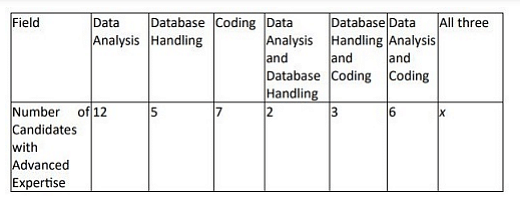
The number of applicants with advanced expertise in all three fields is given as x in the table, where x is a non-negative integer.
- XAT - 2024
- Data Interpretation