Question:medium
KK, an aspiring entrepreneur wanted to set up a pen drive manufacturing unit. Since technology was changing very fast, he wanted to carefully gauge the demand and the likely profits before investing. Market survey indicated that he would be able to sell 1 lac units before customers shifted to different gadgets. KK realized that he had to incur two kinds of costs: fixed costs (the costs which do not change, irrespective of the number of units of pen drives produced) and variable costs (= variable cost per unit multiplied by the number of units). KK expected the fixed cost to be Rs. 40 lac and the variable cost to be Rs. 100 per unit. He expected each pen drive to be sold at Rs. 200.
KK was skeptical that the variable cost per unit might increase by 10 percent, though the demand might remain the same. What will be the expected change in profit in such a case?
KK, an aspiring entrepreneur wanted to set up a pen drive manufacturing unit. Since technology was changing very fast, he wanted to carefully gauge the demand and the likely profits before investing. Market survey indicated that he would be able to sell 1 lac units before customers shifted to different gadgets. KK realized that he had to incur two kinds of costs: fixed costs (the costs which do not change, irrespective of the number of units of pen drives produced) and variable costs (= variable cost per unit multiplied by the number of units). KK expected the fixed cost to be Rs. 40 lac and the variable cost to be Rs. 100 per unit. He expected each pen drive to be sold at Rs. 200.
KK was skeptical that the variable cost per unit might increase by 10 percent, though the demand might remain the same. What will be the expected change in profit in such a case?
KK was skeptical that the variable cost per unit might increase by 10 percent, though the demand might remain the same. What will be the expected change in profit in such a case?
Show Hint
Only the variable cost changes here; find the extra total variable cost from the 10 percent hike and compare it to the original profit to get the percentage fall.
Updated On: Jul 10, 2026
- Profit would decrease by 10.33%
- Profit will increase by 15.75%
- Profit would decrease by 15.75%
- Profit will decrease by 16.67%
Show Solution
The Correct Option is D
Solution and Explanation
Instead of recomputing the full profit figure, this approach tracks only the extra cost the 10 percent hike adds, and compares that directly to the original profit.
- Find the extra variable cost caused by the hike: the variable cost per unit rises by 10% of Rs. 100, which is Rs. 10 per unit. Over 1,00,000 units (demand stays the same), the extra cost is $10 \times 1,00,000 = 10,00,000$ rupees.
- Note that revenue and fixed cost do not change: demand is unchanged, so revenue stays at $1,00,000 \times 200 = 2,00,00,000$, and fixed cost stays at Rs. 40 lac. Only the variable cost line goes up.
- Since profit = revenue minus total cost, and only cost increases, profit falls by exactly the extra cost: new profit = old profit minus Rs. 10,00,000.
- Find the original profit to use as the base for the percentage: original total cost = $40,00,000 + (100)(1,00,000) = 1,40,00,000$, so original profit = $2,00,00,000 - 1,40,00,000 = 60,00,000$.
- Compute the percentage fall: $\dfrac{10,00,000}{60,00,000} \times 100 = 16.67\%$.
So profit falls by 16.67%, which is option D. Options built around 10.33% or 15.75% come from comparing the extra cost to the wrong base, such as revenue instead of the original profit.
Let's summarize:
- When only variable cost changes and demand stays fixed, the drop in profit exactly equals the extra total variable cost.
- The percentage change must always be measured against the original profit, not against revenue or total cost.
So profit will decrease by 16.67%.
Was this answer helpful?
0
Top Questions on Data Interpretation
- The monthly salary for a person who follows the same expense pattern, but has a petrol expense of Rs 500 p.m., is:
- VITEEE - 2024
- General Aptitude
- Data Interpretation
- In a code language, 'TIGER' is written as 'JUISF'. How will 'EQUAL' be written in that language?
- VITEEE - 2025
- General Aptitude
- Data Interpretation
- Read the Passage carefully and answer the following questions.
An air conditioner (AC) unit has three operating modes: Eco, Normal, and Turbo. The power consumption in each mode is as follows: Eco mode consumes 1000 watts, Normal mode consumes 1200 watts, and Turbo mode consumes 1500 watts. Yesterday, the AC was in operation from 2 PM to 10 PM. From 2 PM to 6 PM it ran in Eco mode. From 6 PM to 8 PM, it ran in Normal mode. From 8 PM to 10 PM it ran in Turbo mode.- CAT - 2024
- Data Interpretation & Logical Reasoning (DILR)
- Data Interpretation
- Read the Passage carefully and answer the following questions
A health food store specializing in dietary supplements and whole grains recorded the following sales figures (in kilograms) for various food categories last month: Millets (M) = 500 kg at a cost price of 40/kg and selling price of 50/kg; Protein supplements (P) = 300 kg at a cost price of 80/kg and selling price of 100/kg; Vitamin supplements (V) = 200 kg at a cost price of 60/kg and selling price of 80/kg; Carbohydrates (C) = 600 kg at a cost price of 80/kg and selling price of 100/kg; Fats (F) = 100 kg at a cost price of 120/kg and selling price of 150/kg. Additionally, they sold 50 kg of mixed nuts (N) at a cost price of 100/kg and a selling price of 130/kg- CAT - 2024
- Data Interpretation & Logical Reasoning (DILR)
- Data Interpretation
- Want to practice more? Try solving extra ecology questions todayView All Questions
Questions Asked in XAT exam
Applicants have been shortlisted for interviews for some data analyst positions. Some of the applicants have advanced expertise in one or more fields among the following: data analysis, database handling and coding. The numbers of applicants with different advanced expertise are given in the 2 × 8 table below.
The number of applicants with advanced expertise in all three fields is given as x in the table, where x is a non-negative integer.
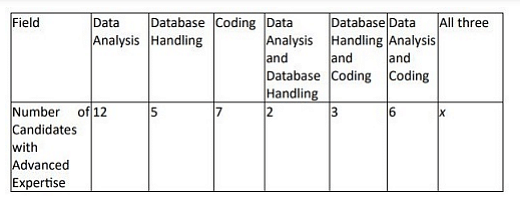
The number of applicants with advanced expertise in all three fields is given as x in the table, where x is a non-negative integer.
- XAT - 2024
- Data Interpretation