For which value of non-negative 'a' will the system \(x^2 - y^2 = 0\), \((x-a)^2 + y^2 = 1\) have exactly three real solutions?
Show Hint
- \(-\sqrt{2}\)
- 1
- \(\sqrt{2}\)
- 2
The Correct Option is B
Solution and Explanation
Here is a more geometric way to see this: the first equation, $x^2-y^2=0$, is a pair of straight lines through the origin ($y=x$ and $y=-x$). The second equation, $(x-a)^2+y^2=1$, is a circle of radius 1 centred at $(a,0)$.
The question is really: for which non-negative $a$ do these two lines cross this circle at exactly 3 points in total?
A line through the centre of a circle always crosses it at exactly 2 points, unless the line just grazes it, which cannot happen for a line through the centre. But here neither line passes through the circle's centre $(a,0)$ in general (only when $a=0$ would the line $y=x$ or $y=-x$ pass through it, and both lines do only at the origin).
Since both lines pass through the origin, the only way to get an odd total (3, instead of the generic 4, 2, or 0) is if the origin itself lies exactly on the circle: then both lines share that one common point on the circle (the origin counts once, not twice), while one of the two lines also crosses the circle again at a second, different point, and the other line does not cross it again.
The origin lies on the circle exactly when $(0-a)^2+0^2=1$, i.e. $a^2=1$, so $a=1$ (taking the non-negative root).
With $a=1$, the circle is centred at $(1,0)$ with radius 1, so it passes through the origin and through $(2,0)$. Substituting $y=x$ into $(x-1)^2+x^2=1$ gives $2x^2-2x=0$, i.e. $x=0$ or $x=1$, so this line meets the circle at $(0,0)$ and $(1,1)$. By symmetry, $y=-x$ meets the circle at $(0,0)$ and $(1,-1)$.
So the full solution set is $(0,0)$, $(1,1)$, $(1,-1)$: three distinct points, exactly as required.
Let's summarize:
- Both lines from the first equation always pass through the origin.
- An odd count of intersection points (3, not 4 or 2 or 0) only happens when the origin itself sits on the circle.
- That forces $a^2=1$, and since $a$ must be non-negative, $a=1$.
So the required value is $a=1$.
Top Questions on Coordinate Geometry
- Given that \( \cot \left( \frac{A+B}{2} \right) \cdot \tan \left( \frac{A-B}{2} \right) = \), and the equation \( \frac{x}{2} + \frac{y}{3} + \frac{2}{6} - 1 = 0 \), find the area of \( \Delta ABC = 2 \).
- MHT CET - 2025
- Mathematics
- Coordinate Geometry
- Given that: \[ \cot \left( \frac{A + B}{2} \right) \cdot \tan \left( \frac{A - B}{2} \right) \] and the equation involving coordinates: \[ \frac{x}{2} + \frac{y}{3} + \frac{2}{6} - 1 = 0 \] Find the area of \( \Delta ABC = 2 \).
- MHT CET - 2025
- Mathematics
- Coordinate Geometry
- Find the distance between the following pairs of points :
(i) (2, 3), (4, 1)
(ii) (– 5, 7), (– 1, 3)
(iii) (a, b), (– a, – b)- CBSE Class X
- Mathematics
- Coordinate Geometry
- Find the distance between the points (0, 0) and (36, 15). Can you now find the distance between the two towns A and B ?
- CBSE Class X
- Mathematics
- Coordinate Geometry
- Want to practice more? Try solving extra ecology questions todayView All Questions
Questions Asked in XAT exam
The number of applicants with advanced expertise in all three fields is given as x in the table, where x is a non-negative integer.
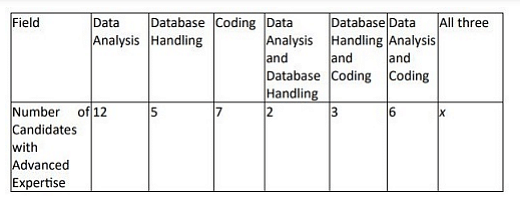
- XAT - 2024
- Data Interpretation