Question:hard
Five numbers A, B, C, D and E are to be arranged in an array in such a manner that they have a common prime factor between two consecutive numbers. These integers are such that:
A has a prime factor P.
B has two prime factors Q and R.
C has two prime factors Q and S.
D has two prime factors P and S.
E has two prime factors P and R.
If B must be arranged at one end in the array, in how many ways can the other four numbers be arranged?
Five numbers A, B, C, D and E are to be arranged in an array in such a manner that they have a common prime factor between two consecutive numbers. These integers are such that:
A has a prime factor P.
B has two prime factors Q and R.
C has two prime factors Q and S.
D has two prime factors P and S.
E has two prime factors P and R.
If B must be arranged at one end in the array, in how many ways can the other four numbers be arranged?
Show Hint
B can only sit next to C or E; branch on each choice and follow the forced chain of shared primes to the end, then add up the valid completions.
Updated On: Jul 13, 2026
- 1
- 2
- 3
- 4
Show Solution
The Correct Option is C
Solution and Explanation
Step 1: Understanding the Question:
B is now pinned down at one end of the row of five numbers. We must count how many different orders the remaining four numbers, A, C, D and E, can take up in the other four spots, while keeping every pair of side-by-side numbers sharing a common prime factor.
Step 2: Key Formula or Approach:
Since B sits at an end, only ONE of the remaining numbers touches B directly, the one right beside it. That number must share a prime with B. From the passage, $B = \{Q, R\}$, so only C, which has Q, or E, which has R, can sit right beside B. We test both choices one at a time and count how many complete, valid rows each choice leads to.
Step 3: Detailed Explanation:
First, place C beside B: row so far is B, C. Now C only has one prime left to offer besides Q, since $C = \{Q, S\}$ and Q is already used against B, so the next number must carry S. Only D carries S, since $D = \{P, S\}$, so the row continues B, C, D.
From D, we can move to A or E, since both carry P, same as D. Trying B, C, D, A: the last spot needs a number sharing a prime with A and it must be E; since A and E both carry P, this works, giving the row B, C, D, A, E.
Trying B, C, D, E instead: the last spot must go to A, and E and A both carry P, so this also works, giving B, C, D, E, A.
So starting with C beside B gives 2 complete valid rows.
Now try E beside B instead: row so far is B, E. Since $E = \{P, R\}$ and R is already used against B, the next number must carry P. Both A and D carry P, so we must check both.
Trying B, E, A: A can lead to D, since they share P, leaving C for the last spot; but C and D share S, so B, E, A, D, C works, a valid row.
Trying B, E, D instead: D can lead to A or C. If it leads to A, the last number is C, but A and C share no prime at all, so this fails. If it leads to C, the last number is A, but C and A again share no prime, so this fails too. So B, E, D gives no valid completion.
So starting with E beside B gives only 1 complete valid row.
Step 4: Final Answer:
Adding the two branches: 2 valid rows starting with C beside B, plus 1 valid row starting with E beside B, gives 3 valid arrangements in total for A, C, D and E.
\[ \boxed{3} \]
B is now pinned down at one end of the row of five numbers. We must count how many different orders the remaining four numbers, A, C, D and E, can take up in the other four spots, while keeping every pair of side-by-side numbers sharing a common prime factor.
Step 2: Key Formula or Approach:
Since B sits at an end, only ONE of the remaining numbers touches B directly, the one right beside it. That number must share a prime with B. From the passage, $B = \{Q, R\}$, so only C, which has Q, or E, which has R, can sit right beside B. We test both choices one at a time and count how many complete, valid rows each choice leads to.
Step 3: Detailed Explanation:
First, place C beside B: row so far is B, C. Now C only has one prime left to offer besides Q, since $C = \{Q, S\}$ and Q is already used against B, so the next number must carry S. Only D carries S, since $D = \{P, S\}$, so the row continues B, C, D.
From D, we can move to A or E, since both carry P, same as D. Trying B, C, D, A: the last spot needs a number sharing a prime with A and it must be E; since A and E both carry P, this works, giving the row B, C, D, A, E.
Trying B, C, D, E instead: the last spot must go to A, and E and A both carry P, so this also works, giving B, C, D, E, A.
So starting with C beside B gives 2 complete valid rows.
Now try E beside B instead: row so far is B, E. Since $E = \{P, R\}$ and R is already used against B, the next number must carry P. Both A and D carry P, so we must check both.
Trying B, E, A: A can lead to D, since they share P, leaving C for the last spot; but C and D share S, so B, E, A, D, C works, a valid row.
Trying B, E, D instead: D can lead to A or C. If it leads to A, the last number is C, but A and C share no prime at all, so this fails. If it leads to C, the last number is A, but C and A again share no prime, so this fails too. So B, E, D gives no valid completion.
So starting with E beside B gives only 1 complete valid row.
Step 4: Final Answer:
Adding the two branches: 2 valid rows starting with C beside B, plus 1 valid row starting with E beside B, gives 3 valid arrangements in total for A, C, D and E.
\[ \boxed{3} \]
Was this answer helpful?
0
Top Questions on Logical Reasoning
- Pointing to a photograph, a man says, "I have no brothers or sisters, but the father of the person in the photograph is my father’s son." Who is the person in the photograph?
- BITSAT - 2025
- Logical Reasoning
- Logical Reasoning
- In a certain code, "CAT" is written as "DBU." How is "DOG" written in that code?
- BITSAT - 2025
- General Aptitude
- Logical Reasoning
Statement: All flowers are beautiful. Some beautiful things are fragile.
Conclusion I: Some flowers are fragile.
Conclusion II: All beautiful things are flowers.- BITSAT - 2025
- Logical Reasoning
- Logical Reasoning
- For a person, whose monthly salary is Rs 6,000 p.m., how many items are there on which he has to spend more than Rs 1,000 p.m.?
- VITEEE - 2024
- General Aptitude
- Logical Reasoning
- Want to practice more? Try solving extra ecology questions todayView All Questions
Questions Asked in XAT exam
Applicants have been shortlisted for interviews for some data analyst positions. Some of the applicants have advanced expertise in one or more fields among the following: data analysis, database handling and coding. The numbers of applicants with different advanced expertise are given in the 2 × 8 table below.
The number of applicants with advanced expertise in all three fields is given as x in the table, where x is a non-negative integer.
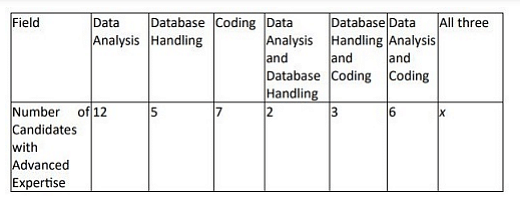
The number of applicants with advanced expertise in all three fields is given as x in the table, where x is a non-negative integer.
- XAT - 2024
- Data Interpretation