Five numbers A, B, C, D and E are to be arranged in an array in such a manner that they have a common prime factor between two consecutive numbers. These integers are such that: A has a prime factor P. B has two prime factors Q and R. C has two prime factors Q and S. D has two prime factors P and S. E has two prime factors P and R.
If the number E is arranged in the middle with two numbers on either side of it, all of the following must be true, EXCEPT:
If the number E is arranged in the middle with two numbers on either side of it, all of the following must be true, EXCEPT:
Show Hint
- A and D are arranged consecutively
- B and C are arranged consecutively
- B and E are arranged consecutively
- A is arranged at one end in the array
The Correct Option is D
Solution and Explanation
This question asks which statement is NOT guaranteed once E is fixed in the middle seat of a row of five, with two numbers sitting on each side of it. Since E's factors are P and R, only A, B and D can ever sit right beside it, because C's factors Q and S share nothing with P or R, so C cannot touch E at all. That pushes C to one of the two end seats of the row. Working through the remaining seats carefully, the only rows that fit every clue turn out to be C, B, E, A, D and C, B, E, D, A, along with their mirror images D, A, E, B, C and A, D, E, B, C, which is C's other end flipped around. Four rows in total, and every option must be checked against all four before it can be called "always true".
- (A) A and D are arranged consecutively: In every one of the four valid rows, A and D sit side by side, forming the pair that occupies one end of the row while C anchors the other end. This always holds, in all four rows without exception.
- (B) B and C are arranged consecutively: In every valid row, B sits directly beside C, since B is the only number besides D that can bridge C over to E, and C already used up its one link to D or B at the end seat. This always holds.
- (C) B and E are arranged consecutively: Since only A, B or D can sit beside E, and the four valid rows always place B in that specific spot right next to E rather than A or D, B and E end up next to each other in every single one of the four rows. This always holds.
- (D) A is arranged at one end in the array: Look closely at the row C, B, E, A, D. Here A sits in the fourth seat, sandwiched between D on one side and E on the other, which is not an end position at all; the two ends of this particular row are occupied by C and D instead. This does not always hold, since this is one of the four valid rows.
Since (A), (B) and (C) hold in every one of the four valid arrangements listed above, but (D) fails in at least one of those same valid arrangements, (D) is the statement that need not be true, making it the required exception to the rule.
Let's summarize:
- C can never sit beside E, because none of C's factors, Q or S, match E's factors, P or R, so C always ends up at an end seat of the row.
- A, however, is more flexible than C and can end up in either a middle seat or an end seat depending on which side C is placed, so the claim "A is always at one end" is not guaranteed to be true.
The exception, the statement that need not always be true, is option (D), A is arranged at one end in the array.
Top Questions on Logical Reasoning
- Pointing to a photograph, a man says, "I have no brothers or sisters, but the father of the person in the photograph is my father’s son." Who is the person in the photograph?
- BITSAT - 2025
- Logical Reasoning
- Logical Reasoning
- In a certain code, "CAT" is written as "DBU." How is "DOG" written in that code?
- BITSAT - 2025
- General Aptitude
- Logical Reasoning
Statement: All flowers are beautiful. Some beautiful things are fragile.
Conclusion I: Some flowers are fragile.
Conclusion II: All beautiful things are flowers.- BITSAT - 2025
- Logical Reasoning
- Logical Reasoning
- For a person, whose monthly salary is Rs 6,000 p.m., how many items are there on which he has to spend more than Rs 1,000 p.m.?
- VITEEE - 2024
- General Aptitude
- Logical Reasoning
- Want to practice more? Try solving extra ecology questions todayView All Questions
Questions Asked in XAT exam
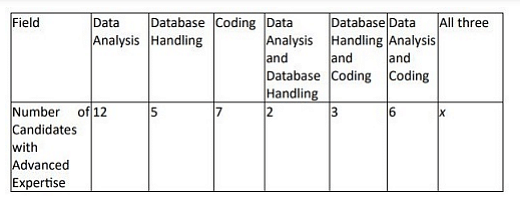
The number of applicants with advanced expertise in all three fields is given as x in the table, where x is a non-negative integer.
- XAT - 2024
- Data Interpretation