Question:hard
Five numbers A, B, C, D and E are to be arranged in an array in such a manner that they have a common prime factor between two consecutive numbers. These integers are such that: A has a prime factor P. B has two prime factors Q and R. C has two prime factors Q and S. D has two prime factors P and S. E has two prime factors P and R.
Which of the following is an acceptable order, from left to right, in which the numbers can be arranged?
Five numbers A, B, C, D and E are to be arranged in an array in such a manner that they have a common prime factor between two consecutive numbers. These integers are such that: A has a prime factor P. B has two prime factors Q and R. C has two prime factors Q and S. D has two prime factors P and S. E has two prime factors P and R.
Which of the following is an acceptable order, from left to right, in which the numbers can be arranged?
Which of the following is an acceptable order, from left to right, in which the numbers can be arranged?
Show Hint
Check each option pair by pair, left to right, and see whether the two numbers in every adjacent pair actually share a letter (P, Q, R or S).
Updated On: Jul 13, 2026
- D, E, B, C, A
- B, A, E, D, C
- B, C, D, E, A
- B, C, E, D, A
Show Solution
The Correct Option is C
Solution and Explanation
Step 1: Turn the clues into a factor list.
A: P. B: Q, R. C: Q, S. D: P, S. E: P, R. Two numbers are allowed to sit next to each other only if their factor lists share a letter.
Step 2: Build the list of allowed neighbor pairs.
Checking every pair of the five numbers: A pairs with D (common P) and with E (common P). B pairs with C (common Q) and with E (common R). C pairs with D (common S). D pairs with E (common P). No other pair shares a letter, so in particular A cannot sit next to B or C, and B cannot sit next to D.
Step 3: Check each option against this allowed-pairs list.
(A) D, E, B, C, A needs the pair C-A at the end, which is not in the allowed list, so it fails.
(B) B, A, E, D, C needs the pair B-A right at the start, which is not allowed, so it fails immediately.
(C) B, C, D, E, A needs the pairs B-C, C-D, D-E and E-A, and every one of these is in the allowed list.
(D) B, C, E, D, A needs the pair C-E, which is not allowed, so it fails at the second step.
Step 4: Pick the order that survives every check.
Only option (C) uses allowed pairs all the way through, so it is the order that works.
Final Answer:
The acceptable order is B, C, D, E, A.
\[ \boxed{\text{B, C, D, E, A}} \]
A: P. B: Q, R. C: Q, S. D: P, S. E: P, R. Two numbers are allowed to sit next to each other only if their factor lists share a letter.
Step 2: Build the list of allowed neighbor pairs.
Checking every pair of the five numbers: A pairs with D (common P) and with E (common P). B pairs with C (common Q) and with E (common R). C pairs with D (common S). D pairs with E (common P). No other pair shares a letter, so in particular A cannot sit next to B or C, and B cannot sit next to D.
Step 3: Check each option against this allowed-pairs list.
(A) D, E, B, C, A needs the pair C-A at the end, which is not in the allowed list, so it fails.
(B) B, A, E, D, C needs the pair B-A right at the start, which is not allowed, so it fails immediately.
(C) B, C, D, E, A needs the pairs B-C, C-D, D-E and E-A, and every one of these is in the allowed list.
(D) B, C, E, D, A needs the pair C-E, which is not allowed, so it fails at the second step.
Step 4: Pick the order that survives every check.
Only option (C) uses allowed pairs all the way through, so it is the order that works.
Final Answer:
The acceptable order is B, C, D, E, A.
\[ \boxed{\text{B, C, D, E, A}} \]
Was this answer helpful?
0
Top Questions on Logical Reasoning
- Pointing to a photograph, a man says, "I have no brothers or sisters, but the father of the person in the photograph is my father’s son." Who is the person in the photograph?
- BITSAT - 2025
- Logical Reasoning
- Logical Reasoning
- In a certain code, "CAT" is written as "DBU." How is "DOG" written in that code?
- BITSAT - 2025
- General Aptitude
- Logical Reasoning
Statement: All flowers are beautiful. Some beautiful things are fragile.
Conclusion I: Some flowers are fragile.
Conclusion II: All beautiful things are flowers.- BITSAT - 2025
- Logical Reasoning
- Logical Reasoning
- For a person, whose monthly salary is Rs 6,000 p.m., how many items are there on which he has to spend more than Rs 1,000 p.m.?
- VITEEE - 2024
- General Aptitude
- Logical Reasoning
- Want to practice more? Try solving extra ecology questions todayView All Questions
Questions Asked in XAT exam
Applicants have been shortlisted for interviews for some data analyst positions. Some of the applicants have advanced expertise in one or more fields among the following: data analysis, database handling and coding. The numbers of applicants with different advanced expertise are given in the 2 × 8 table below.
The number of applicants with advanced expertise in all three fields is given as x in the table, where x is a non-negative integer.
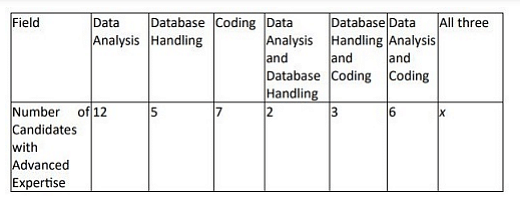
The number of applicants with advanced expertise in all three fields is given as x in the table, where x is a non-negative integer.
- XAT - 2024
- Data Interpretation