Question:medium
Each of the following questions is followed by two statements, I and II. Answer as follows:
Mark option (1) if the question can be answered using statement I alone, but not using statement II alone.
Mark option (2) if the question can be answered using statement II alone, but not using statement I alone.
Mark option (3) if the question can be answered using both statements I and II together, but not by using either statement alone.
Mark option (4) if the question cannot be answered even using both statements I and II together.
What is the value of \(x\)?
I. \( \log_2 2^x = x \)
II. \( \log_3 x = 0 \)
Each of the following questions is followed by two statements, I and II. Answer as follows:
Mark option (1) if the question can be answered using statement I alone, but not using statement II alone.
Mark option (2) if the question can be answered using statement II alone, but not using statement I alone.
Mark option (3) if the question can be answered using both statements I and II together, but not by using either statement alone.
Mark option (4) if the question cannot be answered even using both statements I and II together.
What is the value of \(x\)?
I. \( \log_2 2^x = x \)
II. \( \log_3 x = 0 \)
Mark option (1) if the question can be answered using statement I alone, but not using statement II alone.
Mark option (2) if the question can be answered using statement II alone, but not using statement I alone.
Mark option (3) if the question can be answered using both statements I and II together, but not by using either statement alone.
Mark option (4) if the question cannot be answered even using both statements I and II together.
What is the value of \(x\)?
I. \( \log_2 2^x = x \)
II. \( \log_3 x = 0 \)
Show Hint
Remember that \( \log_a a^k = k \) is always true for any \(x\), so it can never pin down a single value; check whether a statement is a fixed identity before using it as new information.
Updated On: Jul 13, 2026
- The question can be answered using statement I alone, but not using statement II alone.
- The question can be answered using statement II alone, but not using statement I alone.
- The question can be answered using both statements I and II together, but not by using either statement alone.
- The question cannot be answered even using both statements I and II together.
Show Solution
The Correct Option is B
Solution and Explanation
Step 1: Treat statement I as an equation to solve.
Write $y = 2^x$. Statement I becomes $\log_2 y = x$, which is just $y = 2^x$ again.
So statement I simply restates $y = 2^x$ in a different form. It is true no matter what value $x$ takes: put $x = 0$, or $x = 1$, or $x = 5$, and the equation still checks out.
This means statement I places zero restriction on $x$. It cannot pin down a single value.
Step 2: Solve statement II directly.
Statement II gives $\log_3 x = 0$.
By the definition of a logarithm, $\log_3 x = 0$ means $3^0 = x$.
Since $3^0 = 1$, we get $x = 1$, and this is the only value of $x$ that works.
Step 3: Check what each statement tells us.
Statement I is an identity true for every real $x$, so it gives no clue about which particular $x$ the question wants.
Statement II by itself fixes $x$ uniquely as $1$, so we do not need statement I at all.
Step 4: Conclusion.
Statement II alone answers the question; statement I alone does not.
\[ \boxed{\text{Option (2): statement II alone is sufficient}} \]
Write $y = 2^x$. Statement I becomes $\log_2 y = x$, which is just $y = 2^x$ again.
So statement I simply restates $y = 2^x$ in a different form. It is true no matter what value $x$ takes: put $x = 0$, or $x = 1$, or $x = 5$, and the equation still checks out.
This means statement I places zero restriction on $x$. It cannot pin down a single value.
Step 2: Solve statement II directly.
Statement II gives $\log_3 x = 0$.
By the definition of a logarithm, $\log_3 x = 0$ means $3^0 = x$.
Since $3^0 = 1$, we get $x = 1$, and this is the only value of $x$ that works.
Step 3: Check what each statement tells us.
Statement I is an identity true for every real $x$, so it gives no clue about which particular $x$ the question wants.
Statement II by itself fixes $x$ uniquely as $1$, so we do not need statement I at all.
Step 4: Conclusion.
Statement II alone answers the question; statement I alone does not.
\[ \boxed{\text{Option (2): statement II alone is sufficient}} \]
Was this answer helpful?
0
Top Questions on Logarithms
- Find the value of $ \log_2 32 $.
- MHT CET - 2025
- Mathematics
- Logarithms
- If \(x\) and \(y\) are positive real numbers such that \(log_x(x^2+12)=4\) and \(3\;log_yx=1\),then \(x+y\) equals
- CAT - 2023
- Quantitative Aptitude
- Logarithms
- For some positive real number \(x\) , if \(log_{\sqrt 3}(x)+\frac{log_x(25)}{log_x(0.008)}=\frac{16}{3}\), then the value of \(log_3(3x^2)\) is
- CAT - 2023
- Quantitative Aptitude
- Logarithms
- For a real number \(x\) , if \(\frac{1}{2},\frac{log_3(2^x-9)}{log_34}\), and \(\frac{log_5\bigg(2^x+\frac{17}{2}\bigg)}{log_54}\) are in an arithmetic progression, then the common difference is
- CAT - 2023
- Quantitative Aptitude
- Logarithms
- Want to practice more? Try solving extra ecology questions todayView All Questions
Questions Asked in XAT exam
Applicants have been shortlisted for interviews for some data analyst positions. Some of the applicants have advanced expertise in one or more fields among the following: data analysis, database handling and coding. The numbers of applicants with different advanced expertise are given in the 2 × 8 table below.
The number of applicants with advanced expertise in all three fields is given as x in the table, where x is a non-negative integer.
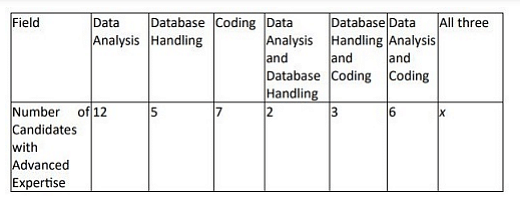
The number of applicants with advanced expertise in all three fields is given as x in the table, where x is a non-negative integer.
- XAT - 2024
- Data Interpretation