
Sohan's average for the first six years was:
I. equal to that of the last six years.
II. equal to that of the middle six years.
III. 225
I. equal to that of the last six years.
II. equal to that of the middle six years.
III. 225
Show Hint
- III only
- I & III
- I, II & III
- II & III
The Correct Option is C
Solution and Explanation
This question is testing whether you actually read the chart before doing algebra. Instead of computing three separate six-year averages from scratch, notice first that Sohan's plotted line forms a perfectly regular shape on the radar chart, every vertex sits on the same ring. That ring is marked 225. Once you see that Sohan scored a flat 225 in every one of the nine years (1981 through 1989), the three statements can be checked directly without repeating any arithmetic.
- Statement I (first six years = last six years): Any group of six values picked from a list where every value is 225 will sum to $225 \times 6 = 1350$ and average to $225$. This is true no matter which six years you pick, so the first-six average and the last-six average are automatically equal. Statement I holds.
- Statement II (first six years = middle six years): By the same logic, the middle six years (1982 to 1987) also sum to $1350$ and average to $225$. So this average matches the first-six average too. Statement II holds.
- Statement III (the value is 225): We already found every one of these averages equals $225$, so statement III is simply confirming the number we calculated. It holds as well.
Since all three statements are individually correct, the only option that can be right is the one listing all three together.
Let's summarize:
- A constant data series has the same average over any subset of its terms, so all three six-year windows give 225.
- Options that keep only two of the three statements (III only, I & III, II & III) are all incomplete once you verify each statement individually.
So the correct choice is option 3, I, II and III are all true, since Sohan's score is a flat 225 across every year on the chart.
When was Mohan's score exactly half of Sohan's in the given nine years?
Show Hint
- 1984
- 1985
- 1986
- never
The Correct Option is D
Solution and Explanation
From the chart, Mohan's score rises by exactly 25 every year, starting at 25 in 1981. If we number the years $k = 1, 2, \ldots, 9$ for 1981 through 1989, Mohan's score in year $k$ is \[ M_k = 25k \]
Step 2: Write Sohan's score as a formula too.
Sohan's line never leaves the 225 ring on the chart for any of the nine years, so \[ S_k = 225 \text{ for every } k \]
Step 3: Turn "Mohan is half of Sohan" into an equation and solve for k.
We want a year where $M_k = \frac{S_k}{2}$, that is \[ 25k = \frac{225}{2} \] \[ k = \frac{225}{50} = 4.5 \]
Step 4: Decide what a non-integer k means here.
The year index $k$ has to be a whole number from 1 to 9, since a year cannot be a fraction. Getting $k = 4.5$ tells us this equality would only happen halfway between year 4 (1984) and year 5 (1985), a point that is not one of the nine actual data years.
Step 5: Confirm with the nearby years.
At $k = 4$ (1984), $M_4 = 100$, while half of Sohan is $112.5$, not equal. At $k = 5$ (1985), $M_5 = 125$, again not equal to $112.5$. Since the crossing point falls strictly between two consecutive years, it can never land exactly on any of them.
Final Answer:
Solving $25k = 112.5$ gives a non-integer year, so the condition is never actually met among the nine given years. \[ \boxed{\text{never}} \]
How can Mohan's scoring pattern be best described?
Show Hint
- It increases by 50% every year.
- It increases by 25% every year.
- It increases by 50 every year.
- It increases by 25 every year.
The Correct Option is D
Solution and Explanation
The quickest way to describe a number pattern is to test whether it grows by a fixed amount each step (an arithmetic progression) or by a fixed multiple each step (a geometric or percentage progression). Mohan's marks from the chart, in order from 1981 to 1989, are 25, 50, 75, 100, 125, 150, 175, 200, 225. Let's test each option against this list.
- It increases by 50% every year: A genuine 50% yearly increase would mean each term is 1.5 times the one before it, so from 25 the next term would be $25 \times 1.5 = 37.5$. The chart actually shows 50 next, not 37.5, so this option is wrong.
- It increases by 25% every year: A steady 25% increase would mean each term is 1.25 times the one before it, giving $25 \times 1.25 = 31.25$ as the second term. The chart shows 50, so this option fails too.
- It increases by 50 every year: This claims a constant jump of 50 marks each year. But $25 + 50 = 75$, while the chart's second value is 50, not 75. So the fixed jump is not 50.
- It increases by 25 every year: Testing $25 + 25 = 50$, then $50 + 25 = 75$, then $75 + 25 = 100$, and so on all the way to $200 + 25 = 225$ for 1989, every single step matches the chart exactly.
Only the fixed jump of 25 marks reproduces the entire nine-year list correctly, so Mohan's pattern is a simple arithmetic progression with common difference 25.
Let's summarize:
- A percentage-based rule (options 1 and 2) would make the gaps between consecutive scores grow larger each year, but the chart's gaps stay flat at 25 the whole way through.
- Testing $25 + 25 = 50$ confirms the correct fixed increase is 25, not 50.
So Mohan's scoring pattern is best described as increasing by 25 every year, matching option 4.
What is the difference between the total scores of Mohan and Sohan?
Show Hint
- 700
- 825
- 900
- 225
The Correct Option is C
Solution and Explanation
Since Sohan is a flat 225 every year, and Mohan's score in year $k$ (where $k = 1$ for 1981 up to $k = 9$ for 1989) is $M_k = 25k$, the gap in year $k$ is \[ D_k = 225 - 25k \]
Step 2: Work out this yearly gap for each of the nine years.
$k=1$ (1981): $225 - 25 = 200$
$k=2$ (1982): $225 - 50 = 175$
$k=3$ (1983): $225 - 75 = 150$
$k=4$ (1984): $225 - 100 = 125$
$k=5$ (1985): $225 - 125 = 100$
$k=6$ (1986): $225 - 150 = 75$
$k=7$ (1987): $225 - 175 = 50$
$k=8$ (1988): $225 - 200 = 25$
$k=9$ (1989): $225 - 225 = 0$
Step 3: Add up these nine yearly gaps.
The gaps themselves, 200, 175, 150, 125, 100, 75, 50, 25, 0, form another arithmetic series, going down by 25 each year until it hits 0 in 1989 (the year the two lines actually meet on the chart). \[ \text{Sum of gaps} = \frac{9}{2} \times (200 + 0) = \frac{9}{2} \times 200 = 900 \]
Step 4: Interpret this sum.
Adding the yearly gap between Sohan and Mohan across all nine years gives exactly the same number as subtracting Mohan's nine-year total from Sohan's nine-year total, since \[ \sum_{k=1}^{9} (S_k - M_k) = \sum S_k - \sum M_k \]
Both routes must agree, and both give 900.
Final Answer:
The running difference between Sohan and Mohan, added up over the nine years, comes to 900, confirming the totals differ by that amount. \[ \boxed{900} \]
In how many of the given years was Sohan's score exactly thrice that of Mohan's score?
Show Hint
- one
- two
- three
- four
The Correct Option is A
Solution and Explanation
Instead of testing every year one at a time, we can turn this into a single equation and solve for the year directly. Number the years $k = 1$ for 1981 up to $k = 9$ for 1989. From the chart, Sohan's score stays fixed at $S_k = 225$ for every $k$, while Mohan's score climbs as $M_k = 25k$ (an increase of 25 each year, starting at 25 in 1981). We want the years where Sohan is exactly three times Mohan.
- Setting up the equation: We need $S_k = 3 \times M_k$, which becomes $225 = 3 \times 25k = 75k$.
- Solving for k: Dividing both sides by 75 gives $k = \frac{225}{75} = 3$.
- Checking that k = 3 is a valid year: Since $k$ must be a whole number between 1 and 9 to correspond to an actual year on the chart, and $k = 3$ fits that range exactly, this points to a single valid year: year 3, which is 1983.
- Confirming there is no second solution: Because $S_k$ stays constant at 225 while $M_k$ increases steadily with $k$, the equation $75k = 225$ is a straight-line equation in $k$ with exactly one solution. There is no other value of $k$ from 1 to 9 that can satisfy it, so no second or third year can repeat this exact 3:1 ratio.
So there is exactly one year, 1983, where Sohan's score of 225 is exactly three times Mohan's score of 75.
Let's summarize:
- Writing Mohan's score as $25k$ turns nine separate checks into one equation, $75k = 225$, which has only one whole-number solution in the valid range.
- That solution, $k = 3$, corresponds to the year 1983, and no other year in the chart repeats this exact ratio.
Therefore, the number of years where Sohan's score was exactly thrice Mohan's is one, matching option 1.
Top Questions on Data Interpretation
- The monthly salary for a person who follows the same expense pattern, but has a petrol expense of Rs 500 p.m., is:
- VITEEE - 2024
- General Aptitude
- Data Interpretation
- In a code language, 'TIGER' is written as 'JUISF'. How will 'EQUAL' be written in that language?
- VITEEE - 2025
- General Aptitude
- Data Interpretation
- Read the Passage carefully and answer the following questions.
An air conditioner (AC) unit has three operating modes: Eco, Normal, and Turbo. The power consumption in each mode is as follows: Eco mode consumes 1000 watts, Normal mode consumes 1200 watts, and Turbo mode consumes 1500 watts. Yesterday, the AC was in operation from 2 PM to 10 PM. From 2 PM to 6 PM it ran in Eco mode. From 6 PM to 8 PM, it ran in Normal mode. From 8 PM to 10 PM it ran in Turbo mode.- CAT - 2024
- Data Interpretation & Logical Reasoning (DILR)
- Data Interpretation
- Read the Passage carefully and answer the following questions
A health food store specializing in dietary supplements and whole grains recorded the following sales figures (in kilograms) for various food categories last month: Millets (M) = 500 kg at a cost price of 40/kg and selling price of 50/kg; Protein supplements (P) = 300 kg at a cost price of 80/kg and selling price of 100/kg; Vitamin supplements (V) = 200 kg at a cost price of 60/kg and selling price of 80/kg; Carbohydrates (C) = 600 kg at a cost price of 80/kg and selling price of 100/kg; Fats (F) = 100 kg at a cost price of 120/kg and selling price of 150/kg. Additionally, they sold 50 kg of mixed nuts (N) at a cost price of 100/kg and a selling price of 130/kg- CAT - 2024
- Data Interpretation & Logical Reasoning (DILR)
- Data Interpretation
- Want to practice more? Try solving extra ecology questions todayView All Questions
Questions Asked in XAT exam
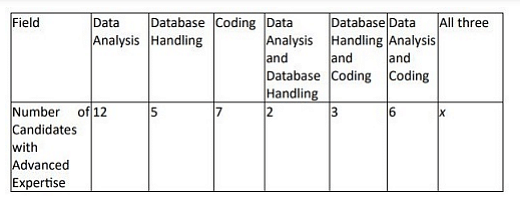
The number of applicants with advanced expertise in all three fields is given as x in the table, where x is a non-negative integer.
- XAT - 2024
- Data Interpretation