Directions: Seven integers A, B, C, D, E, F and G are to be arranged in increasing order such that:
(i) The first four numbers (in this increasing order) are in arithmetic progression.
(ii) The last four numbers (in this increasing order) are in geometric progression.
(iii) There is exactly one number between E and G.
(iv) There is no number between A and B.
(v) D is the smallest number and E is the greatest.
(vi) \( \dfrac{A}{D} = \dfrac{G}{C} = \dfrac{F}{A} > 1 \)
(vii) E = 960
The position and value of A is:
(i) The first four numbers (in this increasing order) are in arithmetic progression.
(ii) The last four numbers (in this increasing order) are in geometric progression.
(iii) There is exactly one number between E and G.
(iv) There is no number between A and B.
(v) D is the smallest number and E is the greatest.
(vi) \( \dfrac{A}{D} = \dfrac{G}{C} = \dfrac{F}{A} > 1 \)
(vii) E = 960
The position and value of A is:
Show Hint
- 5th highest and 100
- 4th highest and 100
- 4th highest and 110
- None of the above
The Correct Option is D
Solution and Explanation
Here is a second way to pin down the seven numbers, working with the ratio "k" directly instead of a rank-by-rank guess.
Write the AP part as $D,\ D+d,\ D+2d,\ D+3d$ and the GP part, sharing the last AP term, as $D+3d,\ (D+3d)r,\ (D+3d)r^2,\ (D+3d)r^3$. The seventh (largest) term is $E=960$, so $(D+3d)r^3=960$.
From "no number lies between A and B", A and B must be two consecutive terms of this seven-term chain. From "exactly one number lies between E and G", G must be the fifth term, two steps below the largest term E.
Since $A/D=G/C=F/A=k$ for some $k>1$, and A is one of $D+2d$ or $D+3d$ (the only spots that keep an integer, positive ratio with D), testing $A=D+3d$ (the last AP term) works out cleanly: $k=A/D=1+3d/D$.
Since F is the GP term that plays $F/A=k$, and F sits two steps after A in the chain (the sixth term), $F=A\cdot r^2$, so $r^2=k$.
Since C is the AP term right after D, $C=D+d$, and G is the GP term right after A, $G=Ar$, the relation $G/C=k$ becomes $\dfrac{Ar}{D+d}=k$. Substituting $A=Dk$ and $D+d=D(k+2)/3$ (from $d=D(k-1)/3$) gives:
\[ 3\sqrt{k}=k+2 \]which factors as $(\sqrt{k}-1)(\sqrt{k}-2)=0$. Since $k$ must exceed $1$, $\sqrt{k}=2$, so $k=4$ and the GP ratio $r=2$.
Now every term is a multiple of $D$: the AP gives $D, 2D, 3D, 4D$ and the GP (starting at $4D$, ratio $2$) gives $4D, 8D, 16D, 32D$. Matching $32D=E=960$ gives $D=30$.
So the seven numbers, smallest to largest, are $30, 60, 90, 120, 240, 480, 960$, i.e. $D=30,\ C=60,\ B=90,\ A=120,\ G=240,\ F=480,\ E=960$.
Let's summarize:
- The ratio condition forces $k=4$ and the GP ratio $r=2$, which fixes every number as a multiple of $D=30$.
- Counting down from the top, A (value 120) is the 4th highest of the seven numbers.
Since neither "4th highest and 100" nor "4th highest and 110" gives the correct value 120, the only option that fits is "None of the above".
It's worth double-checking every clue against these final numbers, since a puzzle with this many conditions is easy to get wrong in one spot:
- AP check: $30, 60, 90, 120$ increase by a constant $30$ each time, so clue (i) holds.
- GP check: $120, 240, 480, 960$ each double the one before, so clue (ii) holds with ratio $2$.
- "One number between E and G": E $=960$ is rank 7 and G $=240$ is rank 5, with F $=480$ (rank 6) sitting between them, so clue (iii) holds.
- "No number between A and B": A $=120$ is rank 4 and B $=90$ is rank 3, right next to each other, so clue (iv) holds.
- D $=30$ is indeed the smallest and E $=960$ is indeed the largest, so clue (v) holds.
- $A/D = 120/30 = 4$, $G/C = 240/60 = 4$, $F/A = 480/120 = 4$: all three ratios equal $4$, which is greater than $1$, so clue (vi) holds.
- $E = 960$ exactly, so clue (vii) holds.
Every one of the seven conditions checks out, which confirms this is genuinely the unique set of values the problem is describing, and not just one solution among several.
\[ \boxed{\text{None of the above}} \]Top Questions on Arithmetic and Geometric Progressions
- In a school, the number of students in each class, from Class I to X, in that order, are in an arithmetic progression. The total number of students from Class I to V is twice the total number of students from Class VI to X.
If the total number of students from Class I to IV is 462, how many students are there in Class VI?- XAT - 2024
- Quantitative Ability and Data Interpretation
- Arithmetic and Geometric Progressions
- Based on the given pattern find the next term of the given series: 5, 6, 16, 57, 244, 1245, ?
- SNAP - 2024
- Quantitative Ability and Data Interpretation
- Arithmetic and Geometric Progressions
- Let \( T_r \) be the \( r^{th} \) term of an A.P. If for some \( m \), \( T_m = \frac{1}{25} \), \( T_{25} = \frac{1}{20} \), and \( \sum_{r=1}^{25} T_r = 13 \), then
\[ 5m \sum_{r=m}^{2m} T_r \text{ is equal to:} \]
- JEE Main - 2025
- Mathematics
- Arithmetic and Geometric Progressions
- The value of \[ \lim_{n \to \infty} \left( \sum_{k=1}^{n} \frac{k^3 + 6k^2 + 11k + 5}{(k + 3)!} \right) \] is:
- JEE Main - 2025
- Mathematics
- Arithmetic and Geometric Progressions
- Want to practice more? Try solving extra ecology questions todayView All Questions
Questions Asked in XAT exam
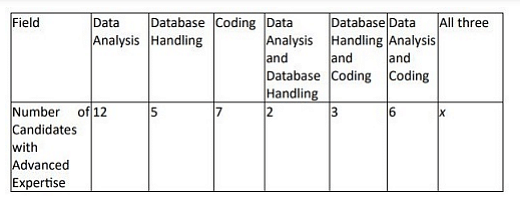
The number of applicants with advanced expertise in all three fields is given as x in the table, where x is a non-negative integer.
- XAT - 2024
- Data Interpretation