In a school, the number of students in each class, from Class I to X, in that order, are in an arithmetic progression. The total number of students from Class I to V is twice the total number of students from Class VI to X.
If the total number of students from Class I to IV is 462, how many students are there in Class VI?
If the total number of students from Class I to IV is 462, how many students are there in Class VI?
- 93
- . 88
- 83
- 77
- None of the remaining options is correct
The Correct Option is D
Solution and Explanation
Let a represent the number of students in Class I, and let d be the common difference of the arithmetic progression.
Step 1: Formulate equations for the total number of students. The total number of students from Class I to IV is:
S4 = a + (a + d) + (a + 2d) + (a + 3d) = 4a + 6d
Given S4 = 462:
4a + 6d = 462
Simplifying the equation yields:
2a + 3d = 231 (1)
The total number of students from Class I to V is:
S5 = a + (a + d) + (a + 2d) + (a + 3d) + (a + 4d) = 5a + 10d
The total number of students from Class VI to X is:
S5-10 = (a + 5d) + (a + 6d) + (a + 7d) + (a + 8d) + (a + 9d) = 5a + 35d
Given the condition S5 = 2S5-10:
5a + 10d = 2(5a + 35d)
Simplifying this equation:
5a + 10d = 10a + 70d
Rearranging terms, we get:
5a = −60d, which simplifies to a = −12d (2)
Step 2: Solve the system of equations. Substitute the expression for a from equation (2) into equation (1):
2(−12d) + 3d = 231
−24d + 3d = 231
−21d = 231
Solving for d:
d = −11
Substitute the value of d = −11 back into the equation a = −12d:
a = −12(−11) = 132
Step 3: Determine the number of students in Class VI. The number of students in Class VI is given by the formula a + 5d:
a + 5d = 132 + 5(−11) = 132 − 55 = 88
Answer: 88
Top Questions on Arithmetic and Geometric Progressions
- Based on the given pattern find the next term of the given series: 5, 6, 16, 57, 244, 1245, ?
- SNAP - 2024
- Quantitative Ability and Data Interpretation
- Arithmetic and Geometric Progressions
- Let \( T_r \) be the \( r^{th} \) term of an A.P. If for some \( m \), \( T_m = \frac{1}{25} \), \( T_{25} = \frac{1}{20} \), and \( \sum_{r=1}^{25} T_r = 13 \), then
\[ 5m \sum_{r=m}^{2m} T_r \text{ is equal to:} \]
- JEE Main - 2025
- Mathematics
- Arithmetic and Geometric Progressions
- The value of \[ \lim_{n \to \infty} \left( \sum_{k=1}^{n} \frac{k^3 + 6k^2 + 11k + 5}{(k + 3)!} \right) \] is:
- JEE Main - 2025
- Mathematics
- Arithmetic and Geometric Progressions
- If \( 7 = 5 + \frac{1}{7}(5 + \alpha) + \frac{1}{7^2}(5 + 2\alpha) + \frac{1}{7^3}(5 + 3\alpha) + \cdots \), then the value of \( \alpha \) is:
- JEE Main - 2025
- Mathematics
- Arithmetic and Geometric Progressions
- Want to practice more? Try solving extra ecology questions todayView All Questions
Questions Asked in XAT exam
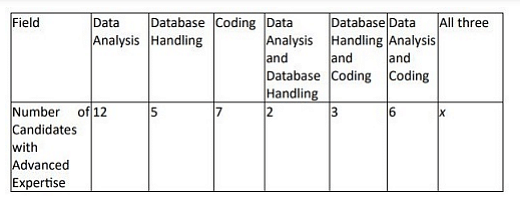
The number of applicants with advanced expertise in all three fields is given as x in the table, where x is a non-negative integer.
- XAT - 2024
- Data Interpretation