Directions for questions 67 to 70: Seven integers A, B, C, D, E, F and G are to be arranged in increasing order such that:
(i) The first four numbers, in this increasing order, are in arithmetic progression (A.P.).
(ii) The last four numbers, in this increasing order, are in geometric progression (G.P.).
(iii) There is exactly one number between E and G, in the increasing order.
(iv) There is no number between A and B, in the increasing order.
(v) D is the smallest number and E is the greatest number.
(vi) \[ \frac{A}{D}=\frac{G}{C}=\frac{F}{A}>1 \]
(vii) E = 960
68. D = ?
(i) The first four numbers, in this increasing order, are in arithmetic progression (A.P.).
(ii) The last four numbers, in this increasing order, are in geometric progression (G.P.).
(iii) There is exactly one number between E and G, in the increasing order.
(iv) There is no number between A and B, in the increasing order.
(v) D is the smallest number and E is the greatest number.
(vi) \[ \frac{A}{D}=\frac{G}{C}=\frac{F}{A}>1 \]
(vii) E = 960
68. D = ?
Show Hint
- 30
- 25
- 22
- 20
The Correct Option is A
Solution and Explanation
A quicker route to the same seven numbers is to first solve the puzzle in "ratio units," ignoring the actual size of D, and only bring in E = 960 at the very end.
Assume for a moment that D = 1 (any positive starting value works, since the whole picture just scales up or down together). The seven numbers sit in the order D, C, B, A, G, F, E, with D and E at the two ends, and A/D = G/C = F/A all equal to one number k, where A is also the fourth term of the A.P. and the first term of the G.P.
- With D = 1 and A.P. common difference d, the A.P. reads 1, 1+d, 1+2d, 1+3d, so A = 1+3d.
- The G.P. starts at A with ratio r, so G = Ar, F = Ar^2, E = Ar^3, and F/A = r^2 must equal A/D = A.
- Matching A/D with G/C also ties d and r together, and solving the two relations at once (exactly as in the direct method) gives d = 1 and r = 2, so A = 1+3(1) = 4 and k = r^2 = 4.
So in ratio units: D = 1, C = 2, B = 3, A = 4, G = 8, F = 16, E = 32.
Before scaling up, it is worth checking that these seven ratio-unit numbers already satisfy every condition in the directions, since scaling by a positive constant never breaks an order relation, a common difference/ratio relation, or a ratio like A/D:
- Increasing order: 1, 2, 3, 4, 8, 16, 32, which is D, C, B, A, G, F, E in that order.
- First four (D, C, B, A) = 1, 2, 3, 4: common difference 1, a genuine A.P.
- Last four (A, G, F, E) = 4, 8, 16, 32: common ratio 2, a genuine G.P.
- Exactly one number, F = 16, sits between G = 8 and E = 32.
- No number sits between A = 4 and B = 3, they are next-door values.
- A/D = 4/1 = 4, G/C = 8/2 = 4, F/A = 16/4 = 4: all equal and above 1, exactly as condition (vi) needs.
Every condition holds in ratio units, so scaling the whole picture by a single positive number keeps every condition true. Now scale everything so E matches the real value 960. Since E = 32 in ratio units and E = 960 in real units, the scale factor is 960/32 = 30. Multiplying every ratio-unit value by 30 gives:
\[ D=30,\ C=60,\ B=90,\ A=120,\ G=240,\ F=480,\ E=960 \]These match the direct method exactly, and since every condition already held true in ratio units, it automatically still holds true after scaling by 30.
D, in real units, is 30.
Let's summarize:
- In ratio units D = 1, and the scale factor to make E match 960 is 30.
- Multiplying D = 1 by the scale factor 30 gives D = 30.
- No other option (25, 22 or 20) keeps \(E=32D=960\) true.
Top Questions on Arithmetic and Geometric Progressions
- In a school, the number of students in each class, from Class I to X, in that order, are in an arithmetic progression. The total number of students from Class I to V is twice the total number of students from Class VI to X.
If the total number of students from Class I to IV is 462, how many students are there in Class VI?- XAT - 2024
- Quantitative Ability and Data Interpretation
- Arithmetic and Geometric Progressions
- Based on the given pattern find the next term of the given series: 5, 6, 16, 57, 244, 1245, ?
- SNAP - 2024
- Quantitative Ability and Data Interpretation
- Arithmetic and Geometric Progressions
- Let \( T_r \) be the \( r^{th} \) term of an A.P. If for some \( m \), \( T_m = \frac{1}{25} \), \( T_{25} = \frac{1}{20} \), and \( \sum_{r=1}^{25} T_r = 13 \), then
\[ 5m \sum_{r=m}^{2m} T_r \text{ is equal to:} \]
- JEE Main - 2025
- Mathematics
- Arithmetic and Geometric Progressions
- The value of \[ \lim_{n \to \infty} \left( \sum_{k=1}^{n} \frac{k^3 + 6k^2 + 11k + 5}{(k + 3)!} \right) \] is:
- JEE Main - 2025
- Mathematics
- Arithmetic and Geometric Progressions
- Want to practice more? Try solving extra ecology questions todayView All Questions
Questions Asked in XAT exam
The number of applicants with advanced expertise in all three fields is given as x in the table, where x is a non-negative integer.
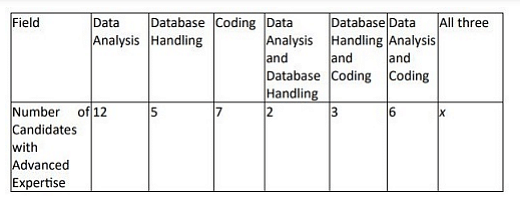
- XAT - 2024
- Data Interpretation