Directions for questions 41 to 44: Ghosh Babu's new interest is psychology. He has identified various personality patterns and given them names. These personality patterns are inter-related as follows:
- All Alessandras, Belissimas, Cassandras, Desdemonas, Elissimas and Firdauses are Queens.
- All Alessandras are Belissimas.
- No Belissima that is not an Alessandra is a Firdaus.
- Some Cassandras are Alessandras.
- All Desdemonas are Cassandras.
- Some Cassandras are not Belissimas.
- No Desdemona is an Alessandra.
- All Queens and only Queens that are neither Belissimas nor Cassandras are Elissimas.
Which of the following cannot be said to be true or false?
I. No Belissima or Cassandra is an Elissima.
II. Some Cassandras are Belissimas but not Alessandras.
III. No Belissima is both an Alessandra and a Desdemona.
- All Alessandras, Belissimas, Cassandras, Desdemonas, Elissimas and Firdauses are Queens.
- All Alessandras are Belissimas.
- No Belissima that is not an Alessandra is a Firdaus.
- Some Cassandras are Alessandras.
- All Desdemonas are Cassandras.
- Some Cassandras are not Belissimas.
- No Desdemona is an Alessandra.
- All Queens and only Queens that are neither Belissimas nor Cassandras are Elissimas.
Which of the following cannot be said to be true or false?
I. No Belissima or Cassandra is an Elissima.
II. Some Cassandras are Belissimas but not Alessandras.
III. No Belissima is both an Alessandra and a Desdemona.
Show Hint
- I only
- II only
- III only
- I & II
The Correct Option is B
Solution and Explanation
A clean way to handle 'cannot be said true or false' questions is to build two different worlds that both fit every clue, and see if a statement flips between them.
Statement I says a Belissima or Cassandra can never be an Elissima. This is not a matter of which world we pick, it is baked into the definition given for Elissima, 'neither Belissima nor Cassandra'. Every possible world must obey this, so I is always true, no world can break it.
Statement III says no one is Belissima, Alessandra, and Desdemona all at once. Since the clues already say no one is Alessandra and Desdemona together, adding 'and Belissima' on top only shrinks an already empty group, so it stays empty in every world. III is always true too.
Now try statement II, 'some Cassandras are Belissimas but not Alessandras', using two worlds:
- World 1: Let the only Cassandras that are also Belissimas be exactly the ones that are Alessandras, no extra Cassandra is a Belissima outside of that. This fits every clue given, and here statement II is false, there are no Cassandras that are Belissima without being Alessandra.
- World 2: Now let a few extra Cassandras be Belissimas without being Alessandras, alongside the required overlaps. This also fits every clue given, and here statement II is true.
Since both worlds obey every clue in the passage, but statement II flips between true and false across them, the passage simply does not fix its truth value. Statements I and III, by contrast, hold in both worlds because they follow directly from the definitions and the 'no Desdemona is Alessandra' clue.
Let's summarize:
- I and III are forced true by the definitions and clues in every possible world.
- II depends on an unstated detail, how much of the Cassandra-Belissima overlap comes from Alessandra, so it can go either way.
So the statement that cannot be judged true or false is II only, option (2).
Top Questions on Logical Reasoning
- Pointing to a photograph, a man says, "I have no brothers or sisters, but the father of the person in the photograph is my father’s son." Who is the person in the photograph?
- BITSAT - 2025
- Logical Reasoning
- Logical Reasoning
- In a certain code, "CAT" is written as "DBU." How is "DOG" written in that code?
- BITSAT - 2025
- General Aptitude
- Logical Reasoning
Statement: All flowers are beautiful. Some beautiful things are fragile.
Conclusion I: Some flowers are fragile.
Conclusion II: All beautiful things are flowers.- BITSAT - 2025
- Logical Reasoning
- Logical Reasoning
- For a person, whose monthly salary is Rs 6,000 p.m., how many items are there on which he has to spend more than Rs 1,000 p.m.?
- VITEEE - 2024
- General Aptitude
- Logical Reasoning
- Want to practice more? Try solving extra ecology questions todayView All Questions
Questions Asked in XAT exam
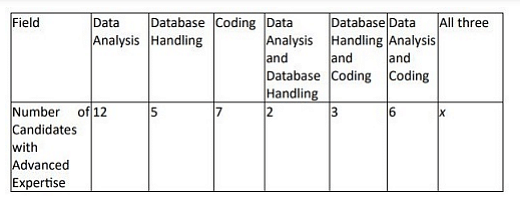
The number of applicants with advanced expertise in all three fields is given as x in the table, where x is a non-negative integer.
- XAT - 2024
- Data Interpretation