Directions: Each of the following questions is followed by two statements. As the answer, mark (1) if the question can be answered with the help of statement I alone, mark (2) if the question can be answered with the help of statement II alone, mark (3) if both statement I and statement II together are needed to answer the question, and mark (4) if the question cannot be answered even with the help of both the statements.
Is line MN perpendicular to the X-axis?
I. M = (5, 12)
II. N lies on the X-axis at a distance of 5 units from the origin.
Is line MN perpendicular to the X-axis?
I. M = (5, 12)
II. N lies on the X-axis at a distance of 5 units from the origin.
Show Hint
- The question can be answered with the help of statement I alone.
- The question can be answered with the help of statement II alone.
- Both statement I and statement II together are needed to answer the question.
- The question cannot be answered even with the help of both the statements.
The Correct Option is D
Solution and Explanation
Here's another way to check this, using slope instead of coordinates directly. A line is perpendicular to the X-axis when its slope is undefined, which happens only when the two points have equal x-coordinates and different y-coordinates, giving a zero denominator in the slope formula.
Statement I alone gives M = (5, 12). Nothing is known about N, so there is no way to compute a slope or compare x-coordinates. This statement by itself settles nothing.
Statement II alone says N sits on the X-axis, 5 units from the origin. Distance from the origin only fixes how far N is, not which direction, so N could be at (5, 0) or at (-5, 0). Without knowing M's coordinates at all, this statement by itself also settles nothing.
Now combine them. With M = (5, 12) fixed by statement I, check both possible positions of N from statement II:
- If N = (5, 0), the slope of MN is $\frac{12 - 0}{5 - 5} = \frac{12}{0}$, undefined, so the line is vertical and perpendicular to the X-axis.
- If N = (-5, 0), the slope of MN is $\frac{12 - 0}{5 - (-5)} = \frac{12}{10}$, a defined, finite slope, so the line is not vertical and not perpendicular to the X-axis.
Both positions of N are equally allowed by statement II, and they lead to opposite answers. So even after combining both statements, we cannot pin down a single answer.
Let's summarize:
- Perpendicular to the X-axis means a vertical line, which needs matching x-coordinates.
- '5 units from the origin on the X-axis' is a distance, not a direction, so it hides two possible points, and neither statement alone gives a way to check the other point.
Since the two allowed cases for N give different answers, the correct choice is that the question cannot be answered even with both statements together.
Top Questions on Coordinate Geometry
- Given that \( \cot \left( \frac{A+B}{2} \right) \cdot \tan \left( \frac{A-B}{2} \right) = \), and the equation \( \frac{x}{2} + \frac{y}{3} + \frac{2}{6} - 1 = 0 \), find the area of \( \Delta ABC = 2 \).
- MHT CET - 2025
- Mathematics
- Coordinate Geometry
- Given that: \[ \cot \left( \frac{A + B}{2} \right) \cdot \tan \left( \frac{A - B}{2} \right) \] and the equation involving coordinates: \[ \frac{x}{2} + \frac{y}{3} + \frac{2}{6} - 1 = 0 \] Find the area of \( \Delta ABC = 2 \).
- MHT CET - 2025
- Mathematics
- Coordinate Geometry
- Find the distance between the following pairs of points :
(i) (2, 3), (4, 1)
(ii) (– 5, 7), (– 1, 3)
(iii) (a, b), (– a, – b)- CBSE Class X
- Mathematics
- Coordinate Geometry
- Find the distance between the points (0, 0) and (36, 15). Can you now find the distance between the two towns A and B ?
- CBSE Class X
- Mathematics
- Coordinate Geometry
- Want to practice more? Try solving extra ecology questions todayView All Questions
Questions Asked in XAT exam
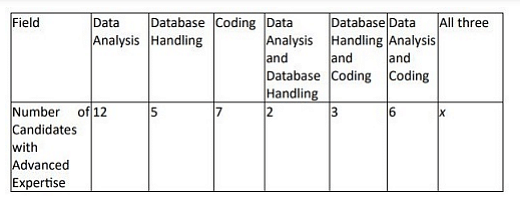
The number of applicants with advanced expertise in all three fields is given as x in the table, where x is a non-negative integer.
- XAT - 2024
- Data Interpretation