Directions: Each of the following questions is followed by two statements, labelled (A) and (B). Decide whether the statements are sufficient to conclusively answer the question, and choose:
(A) if Statement (A) alone is sufficient but Statement (B) alone is not.
(B) if Statement (B) alone is sufficient but Statement (A) alone is not.
(C) if Statement (A) and Statement (B) together are sufficient, but neither alone is sufficient.
(D) if either Statement (A) alone or Statement (B) alone is sufficient.
(E) if both statements together are still not sufficient.
Five integers A, B, C, D and E are arranged in such a way that there are two integers between B and C, and B is not the greatest. There exists one integer between D and E, and D is smaller than E. A is not the smallest integer. Which one is the smallest?
(A) E is the greatest.
(B) There exists no integer between B and E.
(A) if Statement (A) alone is sufficient but Statement (B) alone is not.
(B) if Statement (B) alone is sufficient but Statement (A) alone is not.
(C) if Statement (A) and Statement (B) together are sufficient, but neither alone is sufficient.
(D) if either Statement (A) alone or Statement (B) alone is sufficient.
(E) if both statements together are still not sufficient.
Five integers A, B, C, D and E are arranged in such a way that there are two integers between B and C, and B is not the greatest. There exists one integer between D and E, and D is smaller than E. A is not the smallest integer. Which one is the smallest?
(A) E is the greatest.
(B) There exists no integer between B and E.
Show Hint
- (A) Statement (A) alone is sufficient, but Statement (B) alone is not sufficient.
- (B) Statement (B) alone is sufficient, but Statement (A) alone is not sufficient.
- (C) Statement (A) and Statement (B) together are sufficient, but neither alone is sufficient.
- (E) Both Statement (A) and Statement (B) together are not sufficient to answer the question.
The Correct Option is D
Solution and Explanation
A useful way to see why this data sufficiency question resists both statements is to try building an actual example and see how much freedom is left over.
The base clues place A, B, C, D, E into 5 slots of an arrangement (think of 5 chairs in a row), with: two people seated between B and C, one person seated between D and E (with D before E), B not in the last chair, and A not in the first chair.
Suppose we seat them as: B, D, C, ?, E is not fixed just from these clues; there are, in fact, several different valid seatings consistent with the spacing rules alone (for example, B and C three seats apart works whether B is in seat 1 and C in seat 4, or B in seat 4 and C in seat 1, and similarly D and E can be placed two seats apart in more than one way once B and C are fixed).
Statement (A), "E is the greatest", tells us E's value is the largest of the five, but the original clues describe seating, not value order. Nothing connects a person's seat number to how large their integer is. So even after using Statement (A), we cannot say which of A, B, C, D holds the smallest value; we only know it's not E.
Statement (B), "no integer between B and E", again only restricts where B and E sit relative to each other, not their values, and definitely not the values of A, C, D.
Using both together still only nails down: E is the largest value, and B, E are seated next to each other. That leaves A, B, C, D as candidates for the smallest value, with nothing in either statement (or both together) telling us how their actual sizes compare.
Let's summarize:
- The original clues are about seating positions in an arrangement, not about the numeric order of the five integers.
- Statement (A) fixes only which integer is largest; Statement (B) fixes only a seating adjacency; neither, nor both together, fixes which of the remaining four is smallest.
So even with both statements, the smallest integer cannot be pinned down, matching "both statements together are not sufficient".
Top Questions on Logical Reasoning
- Pointing to a photograph, a man says, "I have no brothers or sisters, but the father of the person in the photograph is my father’s son." Who is the person in the photograph?
- BITSAT - 2025
- Logical Reasoning
- Logical Reasoning
- In a certain code, "CAT" is written as "DBU." How is "DOG" written in that code?
- BITSAT - 2025
- General Aptitude
- Logical Reasoning
Statement: All flowers are beautiful. Some beautiful things are fragile.
Conclusion I: Some flowers are fragile.
Conclusion II: All beautiful things are flowers.- BITSAT - 2025
- Logical Reasoning
- Logical Reasoning
- For a person, whose monthly salary is Rs 6,000 p.m., how many items are there on which he has to spend more than Rs 1,000 p.m.?
- VITEEE - 2024
- General Aptitude
- Logical Reasoning
- Want to practice more? Try solving extra ecology questions todayView All Questions
Questions Asked in XAT exam
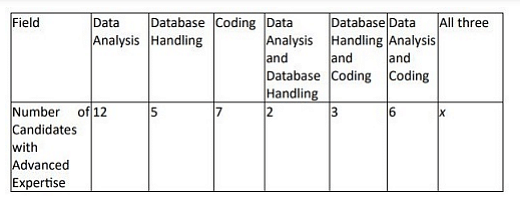
The number of applicants with advanced expertise in all three fields is given as x in the table, where x is a non-negative integer.
- XAT - 2024
- Data Interpretation