Question:medium
An ideal gas (\(0.5\) mol), initially at \(2\) bar pressure, is compressed at a constant temperature of \(600\ \text{K}\) in two steps: first, against a constant external pressure of \(P\) bar \((2 < P < 8)\), and then against constant external pressure of \(8\) bar. At each step, the compression is stopped only when the pressure of the gas becomes equal to the external pressure. The total work done on the gas in these steps is \(W\). Considering all possible values of \(P\ (2 < P < 8)\) and taking the gas constant as \(R\) (in \(\text{J K}^{-1}\text{mol}^{-1}\)), the minimum value of \(|W|\) (in J) is equal to:
An ideal gas (\(0.5\) mol), initially at \(2\) bar pressure, is compressed at a constant temperature of \(600\ \text{K}\) in two steps: first, against a constant external pressure of \(P\) bar \((2 < P < 8)\), and then against constant external pressure of \(8\) bar. At each step, the compression is stopped only when the pressure of the gas becomes equal to the external pressure. The total work done on the gas in these steps is \(W\). Considering all possible values of \(P\ (2 < P < 8)\) and taking the gas constant as \(R\) (in \(\text{J K}^{-1}\text{mol}^{-1}\)), the minimum value of \(|W|\) (in J) is equal to:
Show Hint
For irreversible compression against constant external pressure,
\[
W = -P_{\text{ext}}(V_f - V_i)
\]
In multi-step isothermal processes, first use
\[
PV = nRT
\]
to determine intermediate volumes, then calculate work separately for each step.
For minimization problems involving expressions of the form
\[
aP + \frac{b}{P},
\]
the minimum occurs when
\[
P = \sqrt{\frac{b}{a}}
\]
which follows from differentiation or the AM-GM inequality.
Updated On: Jun 30, 2026
- \(207R\)
- \(600R\)
- \(630R\)
- \(900R\)
Show Solution
The Correct Option is B
Solution and Explanation
Step 1: Understanding the Concept:
Work done in an irreversible compression (against constant external pressure) is given by: \[ W = -P_{\text{ext}}(V_{\text{final}} - V_{\text{initial}}) \] Since work is done *on* the gas, \(W\) will be positive. We are compressing 0.5 mol of an ideal gas from 2 bar to 8 bar in two discrete stages. We want to find the intermediate pressure \(P\) that minimizes the total work.
Step 2: Key Formula or Approach:
Initial state: \(P_1 = 2\) bar, \(V_1 = \frac{nRT}{P_1} = \frac{0.5RT}{2} = \frac{RT}{4}\).
Intermediate state: \(P_{\text{int}} = P\) bar, \(V_{\text{int}} = \frac{0.5RT}{P}\).
Final state: \(P_2 = 8\) bar, \(V_2 = \frac{0.5RT}{8} = \frac{RT}{16}\).
Total work \(W = W_1 + W_2 = P(V_1 - V_{\text{int}}) + 8(V_{\text{int}} - V_2)\).
Step 3: Detailed Explanation:
Substitute the volumes into the work expression: \[ W = P\left(\frac{RT}{4} - \frac{RT}{2P}\right) + 8\left(\frac{RT}{2P} - \frac{RT}{16}\right) \] \[ W = RT \left[ \frac{P}{4} - \frac{1}{2} + \frac{4}{P} - \frac{1}{2} \right] \] \[ W = RT \left[ \frac{P}{4} + \frac{4}{P} - 1 \right] \] To find the minimum \(W\), differentiate with respect to \(P\) and set to zero: \[ \frac{dW}{dP} = RT \left[ \frac{1}{4} - \frac{4}{P^2} \right] = 0 \] \[ \frac{1}{4} = \frac{4}{P^2} \implies P^2 = 16 \implies P = 4 \text{ bar} \] Note that \(P=4\) lies in the given range \(2<P<8\). Now calculate the minimum work at \(P=4\) and \(T=600\) K: \[ W_{\text{min}} = R(600) \left[ \frac{4}{4} + \frac{4}{4} - 1 \right] \] \[ W_{\text{min}} = 600R [1 + 1 - 1] = 600R \]
Step 4: Final Answer:
The intermediate pressure that minimizes the work is the geometric mean of the initial and final pressures. The minimum work done is 600R.
Work done in an irreversible compression (against constant external pressure) is given by: \[ W = -P_{\text{ext}}(V_{\text{final}} - V_{\text{initial}}) \] Since work is done *on* the gas, \(W\) will be positive. We are compressing 0.5 mol of an ideal gas from 2 bar to 8 bar in two discrete stages. We want to find the intermediate pressure \(P\) that minimizes the total work.
Step 2: Key Formula or Approach:
Initial state: \(P_1 = 2\) bar, \(V_1 = \frac{nRT}{P_1} = \frac{0.5RT}{2} = \frac{RT}{4}\).
Intermediate state: \(P_{\text{int}} = P\) bar, \(V_{\text{int}} = \frac{0.5RT}{P}\).
Final state: \(P_2 = 8\) bar, \(V_2 = \frac{0.5RT}{8} = \frac{RT}{16}\).
Total work \(W = W_1 + W_2 = P(V_1 - V_{\text{int}}) + 8(V_{\text{int}} - V_2)\).
Step 3: Detailed Explanation:
Substitute the volumes into the work expression: \[ W = P\left(\frac{RT}{4} - \frac{RT}{2P}\right) + 8\left(\frac{RT}{2P} - \frac{RT}{16}\right) \] \[ W = RT \left[ \frac{P}{4} - \frac{1}{2} + \frac{4}{P} - \frac{1}{2} \right] \] \[ W = RT \left[ \frac{P}{4} + \frac{4}{P} - 1 \right] \] To find the minimum \(W\), differentiate with respect to \(P\) and set to zero: \[ \frac{dW}{dP} = RT \left[ \frac{1}{4} - \frac{4}{P^2} \right] = 0 \] \[ \frac{1}{4} = \frac{4}{P^2} \implies P^2 = 16 \implies P = 4 \text{ bar} \] Note that \(P=4\) lies in the given range \(2<P<8\). Now calculate the minimum work at \(P=4\) and \(T=600\) K: \[ W_{\text{min}} = R(600) \left[ \frac{4}{4} + \frac{4}{4} - 1 \right] \] \[ W_{\text{min}} = 600R [1 + 1 - 1] = 600R \]
Step 4: Final Answer:
The intermediate pressure that minimizes the work is the geometric mean of the initial and final pressures. The minimum work done is 600R.
Was this answer helpful?
1
Top Questions on Work done in Thermodynamics
- A gas undergoes a process \( PV^2 = \text{constant} \). Initially, pressure = 2 atm, volume = 1 L. It expands to 2 L. Find the work done by the gas in joules.
- MHT CET - 2025
- Physics
- Work done in Thermodynamics
- A gas in a cylinder is compressed from an initial volume of \( 5 \, \text{m}^3 \) to a final volume of \( 2 \, \text{m}^3 \) while maintaining a constant pressure of \( 1 \times 10^5 \, \text{Pa} \). Calculate the work done by the gas during the compression.
- MHT CET - 2025
- Physics
- Work done in Thermodynamics
- A gas expands from an initial volume of \( V_1 = 1 \, \text{m}^3 \) to a final volume of \( V_2 = 3 \, \text{m}^3 \) under constant pressure of \( P = 2 \, \text{atm} \). What is the work done by the gas during this expansion?
- MHT CET - 2025
- Physics
- Work done in Thermodynamics
- For a system of particles in thermal equilibrium, what is the probability that a particle will have energy greater than \( E_0 \) according to the Boltzmann distribution?
- MHT CET - 2025
- Physics
- Work done in Thermodynamics
- Want to practice more? Try solving extra ecology questions todayView All Questions
Questions Asked in JEE Advanced exam
A thin uniform rod of length L and certain mass is kept on a frictionless horizontal table with a massless string of length L fixed to one end (top view is shown in the figure). The other end of the string is pivoted to a point O. If a horizontal impulse P is imparted to the rod at a distance x = L/n from the mid-point of the rod (see figure), then the rod and string revolve together around the point O, with the rod remaining aligned with the string. In such a case, the value of n is _____.
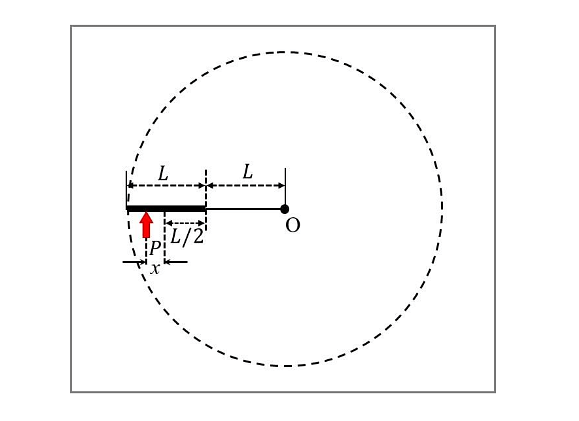
- JEE Advanced - 2024
- Friction