Question:medium
Consider the function
\[
f:(0,\infty)\to(-\infty,\infty)
\]
given by
\[
f(x)=\sqrt{x}\log_e(x)-x+1
\]
Then which one of the following statements is TRUE?
Consider the function
\[
f:(0,\infty)\to(-\infty,\infty)
\]
given by
\[
f(x)=\sqrt{x}\log_e(x)-x+1
\]
Then which one of the following statements is TRUE?
Show Hint
If:
\[
f'(x)
\]
changes from positive to negative at a point, then the function has a local maximum there.
Updated On: Aug 18, 2026
- The derivative of the function \(f\) is decreasing in the interval \((0,1)\)
- The function \(f\) has a local maximum at some point \(a \in (0,\infty)\)
- The function \(f\) has a local minimum at some point \(b \in (0,\infty)\)
- The function \(f\) has neither a point of local maximum nor a point of local minimum in \((0,\infty)\)
Show Solution
The Correct Option is D
Solution and Explanation
Step 1: Understanding the Concept:
To analyze the local extrema of a function, we must investigate its first derivative \( f'(x) \) to find critical points and then use the second derivative \( f''(x) \) or the sign change of \( f'(x) \) to determine their nature. A local extremum occurs only if the first derivative changes sign at a point where it is zero. Additionally, the monotonicity of the derivative is determined by the sign of the second derivative.
Step 2: Key Formula or Approach:
We will differentiate \( f(x) = x^{1/2} \ln x - x + 1 \) twice.
The product rule for differentiation: \( \frac{d}{dx}[u(x)v(x)] = u'(x)v(x) + u(x)v'(x) \).
The condition for a critical point: \( f'(x) = 0 \).
The nature of the derivative (increasing/decreasing) is given by the sign of \( f''(x) \).
Step 3: Detailed Explanation:
First, let's find the first derivative \( f'(x) \):
\[ f'(x) = \frac{d}{dx}(x^{1/2} \ln x) - \frac{d}{dx}(x) + \frac{d}{dx}(1) \]
\[ f'(x) = \left( \frac{1}{2}x^{-1/2} \ln x + x^{1/2} \cdot \frac{1}{x} \right) - 1 \]
\[ f'(x) = \frac{\ln x}{2\sqrt{x}} + \frac{1}{\sqrt{x}} - 1 = \frac{\ln x + 2}{2\sqrt{x}} - 1 \]
Next, let's find the second derivative \( f''(x) \):
\[ f''(x) = \frac{d}{dx} \left( \frac{\ln x + 2}{2x^{1/2}} - 1 \right) \]
Using the quotient rule:
\[ f''(x) = \frac{(1/x)(2\sqrt{x}) - (\ln x + 2)(x^{-1/2})}{4x} \]
\[ f''(x) = \frac{2/\sqrt{x} - (\ln x + 2)/\sqrt{x}}{4x} = \frac{2 - \ln x - 2}{4x\sqrt{x}} = \frac{-\ln x}{4x^{3/2}} \]
Now, let's analyze the statements:
(A) Monotonicity of \( f'(x) \) in \( (0, 1) \):
For \( x \in (0, 1) \), \( \ln x<0 \).
Thus, \( f''(x) = \frac{-\ln x}{4x^{3/2}}>0 \).
Since \( f''(x)>0 \), the derivative \( f'(x) \) is increasing in the interval \( (0, 1) \). Statement (A) is false.
(B), (C), (D) Local Extrema:
Critical points occur where \( f'(x) = 0 \).
\[ \frac{\ln x + 2}{2\sqrt{x}} - 1 = 0 \implies \ln x + 2 = 2\sqrt{x} \]
Let \( g(x) = 2\sqrt{x} - \ln x - 2 \).
Checking \( g(1) = 2(1) - 0 - 2 = 0 \). So \( x=1 \) is a root.
Check \( g'(x) = \frac{1}{\sqrt{x}} - \frac{1}{x} = \frac{\sqrt{x} - 1}{x} \).
For \( x<1 \), \( g'(x)<0 \) (decreasing); for \( x>1 \), \( g'(x)>0 \) (increasing).
This means \( g(x) \) has a global minimum at \( x=1 \), where \( g(1)=0 \).
For all other \( x \neq 1 \), \( g(x)>0 \).
Consequently, \( f'(x) = \frac{-g(x)}{2\sqrt{x}} \). Since \( g(x) \geq 0 \), \( f'(x) \leq 0 \) for all \( x \).
The derivative \( f'(x) \) is zero only at \( x=1 \) and is negative everywhere else.
Since \( f'(x) \) does not change sign (it goes from negative to zero to negative), \( x=1 \) is a point of inflection for \( f(x) \), not an extremum.
Therefore, there are no local maxima or minima.
Step 4: Final Answer:
The function \( f(x) \) has no local maximum and no local minimum in \( (0, \infty) \). Statement (D) is true.
To analyze the local extrema of a function, we must investigate its first derivative \( f'(x) \) to find critical points and then use the second derivative \( f''(x) \) or the sign change of \( f'(x) \) to determine their nature. A local extremum occurs only if the first derivative changes sign at a point where it is zero. Additionally, the monotonicity of the derivative is determined by the sign of the second derivative.
Step 2: Key Formula or Approach:
We will differentiate \( f(x) = x^{1/2} \ln x - x + 1 \) twice.
The product rule for differentiation: \( \frac{d}{dx}[u(x)v(x)] = u'(x)v(x) + u(x)v'(x) \).
The condition for a critical point: \( f'(x) = 0 \).
The nature of the derivative (increasing/decreasing) is given by the sign of \( f''(x) \).
Step 3: Detailed Explanation:
First, let's find the first derivative \( f'(x) \):
\[ f'(x) = \frac{d}{dx}(x^{1/2} \ln x) - \frac{d}{dx}(x) + \frac{d}{dx}(1) \]
\[ f'(x) = \left( \frac{1}{2}x^{-1/2} \ln x + x^{1/2} \cdot \frac{1}{x} \right) - 1 \]
\[ f'(x) = \frac{\ln x}{2\sqrt{x}} + \frac{1}{\sqrt{x}} - 1 = \frac{\ln x + 2}{2\sqrt{x}} - 1 \]
Next, let's find the second derivative \( f''(x) \):
\[ f''(x) = \frac{d}{dx} \left( \frac{\ln x + 2}{2x^{1/2}} - 1 \right) \]
Using the quotient rule:
\[ f''(x) = \frac{(1/x)(2\sqrt{x}) - (\ln x + 2)(x^{-1/2})}{4x} \]
\[ f''(x) = \frac{2/\sqrt{x} - (\ln x + 2)/\sqrt{x}}{4x} = \frac{2 - \ln x - 2}{4x\sqrt{x}} = \frac{-\ln x}{4x^{3/2}} \]
Now, let's analyze the statements:
(A) Monotonicity of \( f'(x) \) in \( (0, 1) \):
For \( x \in (0, 1) \), \( \ln x<0 \).
Thus, \( f''(x) = \frac{-\ln x}{4x^{3/2}}>0 \).
Since \( f''(x)>0 \), the derivative \( f'(x) \) is increasing in the interval \( (0, 1) \). Statement (A) is false.
(B), (C), (D) Local Extrema:
Critical points occur where \( f'(x) = 0 \).
\[ \frac{\ln x + 2}{2\sqrt{x}} - 1 = 0 \implies \ln x + 2 = 2\sqrt{x} \]
Let \( g(x) = 2\sqrt{x} - \ln x - 2 \).
Checking \( g(1) = 2(1) - 0 - 2 = 0 \). So \( x=1 \) is a root.
Check \( g'(x) = \frac{1}{\sqrt{x}} - \frac{1}{x} = \frac{\sqrt{x} - 1}{x} \).
For \( x<1 \), \( g'(x)<0 \) (decreasing); for \( x>1 \), \( g'(x)>0 \) (increasing).
This means \( g(x) \) has a global minimum at \( x=1 \), where \( g(1)=0 \).
For all other \( x \neq 1 \), \( g(x)>0 \).
Consequently, \( f'(x) = \frac{-g(x)}{2\sqrt{x}} \). Since \( g(x) \geq 0 \), \( f'(x) \leq 0 \) for all \( x \).
The derivative \( f'(x) \) is zero only at \( x=1 \) and is negative everywhere else.
Since \( f'(x) \) does not change sign (it goes from negative to zero to negative), \( x=1 \) is a point of inflection for \( f(x) \), not an extremum.
Therefore, there are no local maxima or minima.
Step 4: Final Answer:
The function \( f(x) \) has no local maximum and no local minimum in \( (0, \infty) \). Statement (D) is true.
Was this answer helpful?
0
Top Questions on Application of derivatives
- If the function \( f(x) \), defined below, is continuous on the interval \([0,8]\), then: \[ f(x) = \begin{cases} x^2 + ax + b, & 0 \leq x < 2 \\ 3x + 2, & 2 \leq x \leq 4 \\ 2ax + 5b, & 4 < x \leq 8 \end{cases} \]
- BITSAT - 2024
- Mathematics
- Application of derivatives
- If \( x\sqrt{1 + y} + y\sqrt{1 + x} = 0 \), then find \( \frac{dy}{dx} \).
- BITSAT - 2024
- Mathematics
- Application of derivatives
- If \( y = \tan^{-1}\left( \frac{\sqrt{x} - x}{1 + x^{3/2}} \right) \), then \( y'(1) \) is equal to:
- BITSAT - 2024
- Mathematics
- Application of derivatives
- At \( x = \frac{\pi^2}{4} \), \( \frac{d}{dx} \left( \tan^{-1}(\cos\sqrt{x}) + \sec^{-1}(e^x) \right) = \)
- BITSAT - 2024
- Mathematics
- Application of derivatives
- Want to practice more? Try solving extra ecology questions todayView All Questions
Questions Asked in JEE Advanced exam
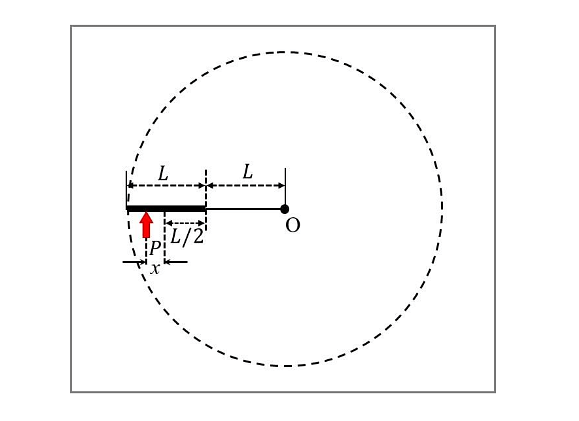
A thin uniform rod of length L and certain mass is kept on a frictionless horizontal table with a massless string of length L fixed to one end (top view is shown in the figure). The other end of the string is pivoted to a point O. If a horizontal impulse P is imparted to the rod at a distance x = L/n from the mid-point of the rod (see figure), then the rod and string revolve together around the point O, with the rod remaining aligned with the string. In such a case, the value of n is _____.
- JEE Advanced - 2024
- Friction