Question:medium
Let \(P\) be the point on the parabola \(y=x^2\) such that the slope of the tangent to the parabola at the point \(P\) is \(4\). Let \(Q\) be the point in the first quadrant lying on the circle
\[
x^2+y^2=2
\]
such that the slope of the tangent to the circle at the point \(Q\) is \(-1\). Let \(R\) be the point in the first quadrant lying on the ellipse
\[
x^2+4y^2=8
\]
such that the slope of the tangent to the ellipse at the point \(R\) is \(-\frac12\). Then the radius of the circle passing through the points \(P\), \(Q\) and \(R\) is:
Let \(P\) be the point on the parabola \(y=x^2\) such that the slope of the tangent to the parabola at the point \(P\) is \(4\). Let \(Q\) be the point in the first quadrant lying on the circle
\[
x^2+y^2=2
\]
such that the slope of the tangent to the circle at the point \(Q\) is \(-1\). Let \(R\) be the point in the first quadrant lying on the ellipse
\[
x^2+4y^2=8
\]
such that the slope of the tangent to the ellipse at the point \(R\) is \(-\frac12\). Then the radius of the circle passing through the points \(P\), \(Q\) and \(R\) is:
Show Hint
Find the three points P, Q and R one at a time using the given slope at each point, this only needs basic differentiation on the parabola, the circle and the ellipse in turn. Once you have all three coordinates, look closely at the three given slopes, 4, -1 and -1 over 2, and check whether any two of the three connecting lines have a special relationship with each other before jumping into the general circumcircle formula. Checking the slopes first can save a lot of algebra compared to writing out the full equation of a circle through three points.
Updated On: Aug 14, 2026
- \(\sqrt{10}\)
- \(\sqrt5\)
- \(\sqrt{\frac52}\)
- \(2\sqrt5\)
Show Solution
The Correct Option is C
Approach Solution - 1
Step 1: Understanding the Concept:
We need to find the specific coordinates of points \( P, Q, \) and \( R \) based on the slope conditions provided for each conic section. Once the coordinates are found, we can identify the geometric relationship between them. Often in such problems, the points form a right-angled triangle, which simplifies finding the circumradius significantly.
Step 2: Key Formula or Approach:
For any curve \( f(x, y) = 0 \), the slope of the tangent is \( m = \frac{dy}{dx} \).
Circumradius of a right triangle is half of its hypotenuse.
Distance formula: \( d = \sqrt{(x_2-x_1)^2 + (y_2-y_1)^2} \).
Step 3: Detailed Explanation:
1. Point \( P \):
Parabola: \( y = x^2 \implies \frac{dy}{dx} = 2x \).
Given slope \( m = 4 \implies 2x = 4 \implies x = 2 \).
Then \( y = 2^2 = 4 \).
So, \( P = (2, 4) \).
2. Point \( Q \):
Circle: \( x^2 + y^2 = 2 \). Differentiating implicitly: \( 2x + 2y y' = 0 \implies y' = -x/y \).
Given slope \( m = -1 \implies -x/y = -1 \implies x = y \).
Substitute into circle: \( x^2 + x^2 = 2 \implies 2x^2 = 2 \implies x = 1 \) (since \( Q \) is in 1st quadrant).
So, \( Q = (1, 1) \).
3. Point \( R \):
Ellipse: \( x^2 + 4y^2 = 8 \). Differentiating implicitly: \( 2x + 8y y' = 0 \implies y' = -x/4y \).
Given slope \( m = -1/2 \implies -x/4y = -1/2 \implies 2x = 4y \implies x = 2y \).
Substitute into ellipse: \( (2y)^2 + 4y^2 = 8 \implies 4y^2 + 4y^2 = 8 \implies 8y^2 = 8 \implies y = 1 \).
Then \( x = 2(1) = 2 \).
So, \( R = (2, 1) \).
4. Geometry of Triangle \( PQR \):
Coordinates: \( P(2, 4), Q(1, 1), R(2, 1) \).
Observe that \( P \) and \( R \) share the same x-coordinate (\( x=2 \)), meaning the side \( PR \) is vertical.
Observe that \( Q \) and \( R \) share the same y-coordinate (\( y=1 \)), meaning the side \( QR \) is horizontal.
Thus, \( \triangle PQR \) is a right-angled triangle at vertex \( R(2, 1) \).
5. Calculation of Radius:
The hypotenuse of this right triangle is \( PQ \).
Length of \( PQ = \sqrt{(2-1)^2 + (4-1)^2} = \sqrt{1^2 + 3^2} = \sqrt{10} \).
The radius of the circumcircle \( r = \frac{1}{2} \text{hypotenuse} = \frac{\sqrt{10}}{2} = \sqrt{\frac{10}{4}} = \sqrt{\frac{5}{2}} \).
Step 4: Final Answer:
The radius is \( \sqrt{5/2} \).
We need to find the specific coordinates of points \( P, Q, \) and \( R \) based on the slope conditions provided for each conic section. Once the coordinates are found, we can identify the geometric relationship between them. Often in such problems, the points form a right-angled triangle, which simplifies finding the circumradius significantly.
Step 2: Key Formula or Approach:
For any curve \( f(x, y) = 0 \), the slope of the tangent is \( m = \frac{dy}{dx} \).
Circumradius of a right triangle is half of its hypotenuse.
Distance formula: \( d = \sqrt{(x_2-x_1)^2 + (y_2-y_1)^2} \).
Step 3: Detailed Explanation:
1. Point \( P \):
Parabola: \( y = x^2 \implies \frac{dy}{dx} = 2x \).
Given slope \( m = 4 \implies 2x = 4 \implies x = 2 \).
Then \( y = 2^2 = 4 \).
So, \( P = (2, 4) \).
2. Point \( Q \):
Circle: \( x^2 + y^2 = 2 \). Differentiating implicitly: \( 2x + 2y y' = 0 \implies y' = -x/y \).
Given slope \( m = -1 \implies -x/y = -1 \implies x = y \).
Substitute into circle: \( x^2 + x^2 = 2 \implies 2x^2 = 2 \implies x = 1 \) (since \( Q \) is in 1st quadrant).
So, \( Q = (1, 1) \).
3. Point \( R \):
Ellipse: \( x^2 + 4y^2 = 8 \). Differentiating implicitly: \( 2x + 8y y' = 0 \implies y' = -x/4y \).
Given slope \( m = -1/2 \implies -x/4y = -1/2 \implies 2x = 4y \implies x = 2y \).
Substitute into ellipse: \( (2y)^2 + 4y^2 = 8 \implies 4y^2 + 4y^2 = 8 \implies 8y^2 = 8 \implies y = 1 \).
Then \( x = 2(1) = 2 \).
So, \( R = (2, 1) \).
4. Geometry of Triangle \( PQR \):
Coordinates: \( P(2, 4), Q(1, 1), R(2, 1) \).
Observe that \( P \) and \( R \) share the same x-coordinate (\( x=2 \)), meaning the side \( PR \) is vertical.
Observe that \( Q \) and \( R \) share the same y-coordinate (\( y=1 \)), meaning the side \( QR \) is horizontal.
Thus, \( \triangle PQR \) is a right-angled triangle at vertex \( R(2, 1) \).
5. Calculation of Radius:
The hypotenuse of this right triangle is \( PQ \).
Length of \( PQ = \sqrt{(2-1)^2 + (4-1)^2} = \sqrt{1^2 + 3^2} = \sqrt{10} \).
The radius of the circumcircle \( r = \frac{1}{2} \text{hypotenuse} = \frac{\sqrt{10}}{2} = \sqrt{\frac{10}{4}} = \sqrt{\frac{5}{2}} \).
Step 4: Final Answer:
The radius is \( \sqrt{5/2} \).
Was this answer helpful?
0
Show Solution
Approach Solution -2
Concept:
Step 1: Find points $P$, $Q$, $R$ exactly as before.
$P=(2,4)$ from the parabola, $Q=(1,1)$ from the circle, $R=(2,1)$ from the ellipse.
Step 2: Find the perpendicular bisector of $QR$.
$Q=(1,1)$, $R=(2,1)$ — this side is horizontal, so its perpendicular bisector is the vertical line through the midpoint $(1.5,1)$:
$x = 1.5$
Step 3: Find the perpendicular bisector of $PR$.
$P=(2,4)$, $R=(2,1)$ — this side is vertical, so its perpendicular bisector is the horizontal line through the midpoint $(2, 2.5)$:
$y = 2.5$
Step 4: Intersect the two bisectors to get the circumcenter.
Circumcenter $= (1.5,\ 2.5)$
Step 5: Compute the distance from the circumcenter to any vertex, say $R=(2,1)$.
$R_{\text{circle}} = \sqrt{(2-1.5)^2+(1-2.5)^2} = \sqrt{0.25+2.25} = \sqrt{2.5} = \sqrt{\dfrac52}$
Final Answer: $\sqrt{\dfrac52}$
- The circumcenter is the point equidistant from all three vertices. Find it by intersecting the perpendicular bisectors of two sides, then the circumradius is just its distance to any one vertex.
Step 1: Find points $P$, $Q$, $R$ exactly as before.
$P=(2,4)$ from the parabola, $Q=(1,1)$ from the circle, $R=(2,1)$ from the ellipse.
Step 2: Find the perpendicular bisector of $QR$.
$Q=(1,1)$, $R=(2,1)$ — this side is horizontal, so its perpendicular bisector is the vertical line through the midpoint $(1.5,1)$:
$x = 1.5$
Step 3: Find the perpendicular bisector of $PR$.
$P=(2,4)$, $R=(2,1)$ — this side is vertical, so its perpendicular bisector is the horizontal line through the midpoint $(2, 2.5)$:
$y = 2.5$
Step 4: Intersect the two bisectors to get the circumcenter.
Circumcenter $= (1.5,\ 2.5)$
Step 5: Compute the distance from the circumcenter to any vertex, say $R=(2,1)$.
$R_{\text{circle}} = \sqrt{(2-1.5)^2+(1-2.5)^2} = \sqrt{0.25+2.25} = \sqrt{2.5} = \sqrt{\dfrac52}$
Final Answer: $\sqrt{\dfrac52}$
Was this answer helpful?
0
Top Questions on Application of derivatives
- If the function \( f(x) \), defined below, is continuous on the interval \([0,8]\), then: \[ f(x) = \begin{cases} x^2 + ax + b, & 0 \leq x < 2 \\ 3x + 2, & 2 \leq x \leq 4 \\ 2ax + 5b, & 4 < x \leq 8 \end{cases} \]
- BITSAT - 2024
- Mathematics
- Application of derivatives
- If \( x\sqrt{1 + y} + y\sqrt{1 + x} = 0 \), then find \( \frac{dy}{dx} \).
- BITSAT - 2024
- Mathematics
- Application of derivatives
- If \( y = \tan^{-1}\left( \frac{\sqrt{x} - x}{1 + x^{3/2}} \right) \), then \( y'(1) \) is equal to:
- BITSAT - 2024
- Mathematics
- Application of derivatives
- At \( x = \frac{\pi^2}{4} \), \( \frac{d}{dx} \left( \tan^{-1}(\cos\sqrt{x}) + \sec^{-1}(e^x) \right) = \)
- BITSAT - 2024
- Mathematics
- Application of derivatives
- Want to practice more? Try solving extra ecology questions todayView All Questions
Questions Asked in JEE Advanced exam
A thin uniform rod of length L and certain mass is kept on a frictionless horizontal table with a massless string of length L fixed to one end (top view is shown in the figure). The other end of the string is pivoted to a point O. If a horizontal impulse P is imparted to the rod at a distance x = L/n from the mid-point of the rod (see figure), then the rod and string revolve together around the point O, with the rod remaining aligned with the string. In such a case, the value of n is _____.
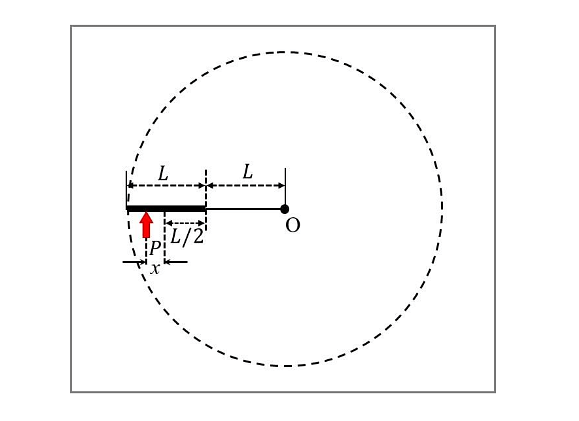
- JEE Advanced - 2024
- Friction