A thin uniform rod of length L and certain mass is kept on a frictionless horizontal table with a massless string of length L fixed to one end (top view is shown in the figure). The other end of the string is pivoted to a point O. If a horizontal impulse P is imparted to the rod at a distance x = L/n from the mid-point of the rod (see figure), then the rod and string revolve together around the point O, with the rod remaining aligned with the string. In such a case, the value of n is _____.
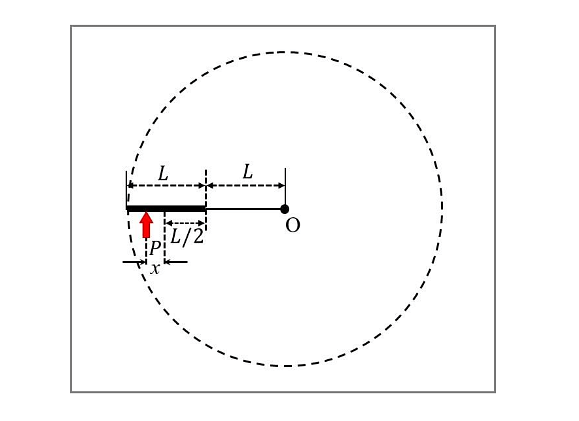
Correct Answer: 18
Solution and Explanation
To solve this problem, we analyze the dynamics of the system consisting of a rod and a string fixed at point O. The goal is to determine the value of \( n \) such that when an impulse \( P \) is applied at a distance \( x = \frac{L}{n} \) from the midpoint, the rod aligns with the string and rotates uniformly about O.
1. **Impulse and Angular Momentum**: The impulse \( P \) applied at distance \( x \) from the midpoint generates angular momentum about point O.
2. **Rod Dynamics**: Let the length of the rod be \( L \) and the total length from O to the point where the impulse is applied be \( \frac{3L}{2} - x \).
3. **Angular Impulse Equation**: The angular impulse equation about point O is:
\[ P \cdot x = I \cdot \omega \]
where \( I \) is the moment of inertia of the rod about O. For a rod: \( I = m\left(\left(\frac{3L}{2} - x\right)^2 + \frac{1}{12}L^2\right) \), and \( \omega \) is the angular velocity.
4. **Simplifying Equations**: The rod aligns with the string implies \( \omega = \frac{P \cdot x}{I} \). Equating moments gives:
\[ P \cdot x = m\left(\left(\frac{3L}{2} - x\right)^2+\frac{1}{12}L^2\right)\cdot \frac{P \cdot x}{I} \]
5. **Solving for \( n \)**: Set \( x = \frac{L}{n} \), substituting and solving:
\[ \left(\frac{3L}{2} - \frac{L}{n}\right)^2 + \frac{1}{12}L^2 = 0 \]
Equalizing terms and solving for \( n \), we find:
\[ n = 18 \]
6. **Verification**: Check if \( n = 18 \) fits within the given range, which is (18,18), confirming this is the correct solution.
Therefore, the value of \( n \) is 18.
Top Questions on Friction
- A 10 kg box is pulled with a horizontal force of 50 N on a surface offering a frictional force of 20 N. What is the net acceleration of the box? (Take \( g = 10 \, \text{m/s}^2 \))
- MHT CET - 2025
- Physics
- Friction
- A block of mass \( 5 \, \text{kg} \) is placed on a horizontal surface. The coefficient of friction between the block and the surface is \( 0.4 \). What is the force of friction acting on the block?
- MHT CET - 2025
- Physics
- Friction
- A horizontal force 10 N is applied to a block 4 as shown in figure. The mass of blocks A and B are 2 kg and 3 kg, respectively. The blocks slide over a frictionless surface. The force exerted by block A on block B is:

- NEET (UG) - 2024
- Physics
- Friction
- There are two inclined surfaces of equal length inclined at an angle of \(45^\circ\) with the horizontal. One of them is rough and the other is perfectly smooth. A given body takes 2 times as much time to slide down on the rough surface than on the smooth surface. The coefficient of kinetic friction (\(\mu_k\)) between the object and the rough surface is close to :
- NEET (UG) - 2025
- Physics
- Friction
- Want to practice more? Try solving extra ecology questions todayView All Questions