Question:medium
Which one of the following matrices can be obtained by performing elementary row transformations on the \(3\times3\) identity matrix?
Which one of the following matrices can be obtained by performing elementary row transformations on the \(3\times3\) identity matrix?
Show Hint
A matrix reachable from the identity matrix by row operations must have full rank, meaning none of its rows can be written as a combination of the other two. Before jumping to a determinant calculation, check quickly whether one row is an obvious sum or scaled combination of the other two rows; if it is, that matrix is ruled out right away.
Updated On: Aug 17, 2026
- \[ \begin{bmatrix} 1&1&1 1&1&1 1&1&1 \end{bmatrix} \]
- \[ \begin{bmatrix} 1&1&1 2&3&4 1&2&1 \end{bmatrix} \]
- \[ \begin{bmatrix} 1&1&1 2&3&4 2&5&8 \end{bmatrix} \]
- \[ \begin{bmatrix} 1&1&1 -1&1&2 0&2&3 \end{bmatrix} \]
Show Solution
The Correct Option is B
Solution and Explanation
Step 1: Understanding the Concept:
Elementary row transformations (ERTs) performed on a matrix preserve its rank and the property of being non-singular. If we start with the identity matrix \( I \), which has a determinant of \( 1 \) (non-zero), any matrix obtained from it via ERTs must also have a non-zero determinant. Conversely, any non-singular (invertible) matrix can be transformed into the identity matrix using Gaussian elimination.
Step 2: Key Formula or Approach:
We evaluate the determinant \( \Delta \) of each matrix. The matrix obtained from \( I \) will be the one for which \( \Delta \neq 0 \).
Step 3: Detailed Explanation:
1. Matrix (A):
\[ \Delta = \begin{vmatrix} 1 & 1 & 1
1 & 1 & 1
1 & 1 & 1 \end{vmatrix} \]
All rows are identical. Therefore, \( \text{rank} = 1 \) and \( \Delta = 0 \). This matrix is singular and cannot be obtained from \( I \).
2. Matrix (B):
\[ \Delta = 1(3 \cdot 1 - 2 \cdot 4) - 1(2 \cdot 1 - 1 \cdot 4) + 1(2 \cdot 2 - 1 \cdot 3) \]
\[ \Delta = 1(3 - 8) - 1(2 - 4) + 1(4 - 3) = -5 + 2 + 1 = -2 \]
Since \( \Delta = -2 \neq 0 \), this matrix is non-singular. It can be obtained from \( I \) through row operations.
3. Matrix (C):
\[ \Delta = 1(3 \cdot 8 - 5 \cdot 4) - 1(2 \cdot 8 - 2 \cdot 4) + 1(2 \cdot 5 - 2 \cdot 3) \]
\[ \Delta = 1(24 - 20) - 1(16 - 8) + 1(10 - 6) = 4 - 8 + 4 = 0 \]
The matrix is singular (\( R_3 = 2R_2 - 2R_1 \)). Cannot be obtained from \( I \).
4. Matrix (D):
\[ \Delta = 1(1 \cdot 3 - 2 \cdot 2) - 1(-1 \cdot 3 - 0) + 1(-1 \cdot 2 - 0) \]
\[ \Delta = 1(3 - 4) - 1(-3) + 1(-2) = -1 + 3 - 2 = 0 \]
The matrix is singular (\( R_2 = R_3 - R_1 \)). Cannot be obtained from \( I \).
Step 4: Final Answer:
Only matrix (B) is invertible.
Elementary row transformations (ERTs) performed on a matrix preserve its rank and the property of being non-singular. If we start with the identity matrix \( I \), which has a determinant of \( 1 \) (non-zero), any matrix obtained from it via ERTs must also have a non-zero determinant. Conversely, any non-singular (invertible) matrix can be transformed into the identity matrix using Gaussian elimination.
Step 2: Key Formula or Approach:
We evaluate the determinant \( \Delta \) of each matrix. The matrix obtained from \( I \) will be the one for which \( \Delta \neq 0 \).
Step 3: Detailed Explanation:
1. Matrix (A):
\[ \Delta = \begin{vmatrix} 1 & 1 & 1
1 & 1 & 1
1 & 1 & 1 \end{vmatrix} \]
All rows are identical. Therefore, \( \text{rank} = 1 \) and \( \Delta = 0 \). This matrix is singular and cannot be obtained from \( I \).
2. Matrix (B):
\[ \Delta = 1(3 \cdot 1 - 2 \cdot 4) - 1(2 \cdot 1 - 1 \cdot 4) + 1(2 \cdot 2 - 1 \cdot 3) \]
\[ \Delta = 1(3 - 8) - 1(2 - 4) + 1(4 - 3) = -5 + 2 + 1 = -2 \]
Since \( \Delta = -2 \neq 0 \), this matrix is non-singular. It can be obtained from \( I \) through row operations.
3. Matrix (C):
\[ \Delta = 1(3 \cdot 8 - 5 \cdot 4) - 1(2 \cdot 8 - 2 \cdot 4) + 1(2 \cdot 5 - 2 \cdot 3) \]
\[ \Delta = 1(24 - 20) - 1(16 - 8) + 1(10 - 6) = 4 - 8 + 4 = 0 \]
The matrix is singular (\( R_3 = 2R_2 - 2R_1 \)). Cannot be obtained from \( I \).
4. Matrix (D):
\[ \Delta = 1(1 \cdot 3 - 2 \cdot 2) - 1(-1 \cdot 3 - 0) + 1(-1 \cdot 2 - 0) \]
\[ \Delta = 1(3 - 4) - 1(-3) + 1(-2) = -1 + 3 - 2 = 0 \]
The matrix is singular (\( R_2 = R_3 - R_1 \)). Cannot be obtained from \( I \).
Step 4: Final Answer:
Only matrix (B) is invertible.
Was this answer helpful?
0
Top Questions on Algebra
- Let \( n(A) = m \) and \( n(B) = n \), if the number of subsets of \( A \) is 56 more than that of subsets of \( B \), then \( m + n \) is equal to:
- VITEEE - 2024
- Mathematics
- Algebra
- Solve the quadratic equation: \[ x^2 - 5x + 6 = 0 \]
- VITEEE - 2025
- Mathematics
- Algebra
- Find the value of \( x \) in the following equation: \[ \frac{2}{x} + \frac{3}{x + 1} = 1 \]
- VITEEE - 2025
- Mathematics
- Algebra
- Find the value of \( x \) in the equation \( 2x + 3 = 7x - 8 \).
- VITEEE - 2025
- Mathematics
- Algebra
- Want to practice more? Try solving extra ecology questions todayView All Questions
Questions Asked in JEE Advanced exam
A thin uniform rod of length L and certain mass is kept on a frictionless horizontal table with a massless string of length L fixed to one end (top view is shown in the figure). The other end of the string is pivoted to a point O. If a horizontal impulse P is imparted to the rod at a distance x = L/n from the mid-point of the rod (see figure), then the rod and string revolve together around the point O, with the rod remaining aligned with the string. In such a case, the value of n is _____.
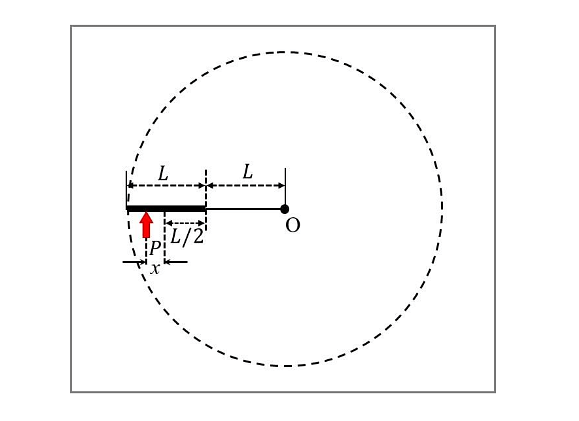
- JEE Advanced - 2024
- Friction