Question:medium
ABCD is a square whose side is 2 cm each. Taking AB and AD as axes, the equation of the circle circumscribing the square is:
ABCD is a square whose side is 2 cm each. Taking AB and AD as axes, the equation of the circle circumscribing the square is:
Show Hint
Place A at the origin with AB and AD as the x and y axes, find the fourth vertex C, and use the midpoint of diagonal AC as the circle's centre.
Updated On: Jul 13, 2026
- \(x^2+y^2=(x+y)\)
- \(x^2+y^2=2(x+y)\)
- \(x^2+y^2=4\)
- \(x^2+y^2=16\)
Show Solution
The Correct Option is B
Solution and Explanation
Step 1: Set up coordinates and the general circle equation.
Take $A$ at the origin, AB along the x-axis and AD along the y-axis, so $A=(0,0)$, $B=(2,0)$, $D=(0,2)$ and $C=(2,2)$ (side 2 cm).
Any circle in the plane can be written in the general form
\[ x^2+y^2+2gx+2fy+c=0 \]
where $g$, $f$, $c$ are constants we need to find using three points on the circle. A circle has exactly three independent constants like this, which is why three points (here A, B, D) are enough to pin it down completely.
Step 2: Use point A to find c.
Put $A(0,0)$ into the general equation:
\[ 0+0+0+0+c=0 \implies c=0 \]
So the equation simplifies to $x^2+y^2+2gx+2fy=0$ from here on.
Step 3: Use point B to find g.
Put $B(2,0)$ in, with $c=0$:
\[ 4+0+4g+0+0=0 \implies 4g=-4 \implies g=-1 \]
Step 4: Use point D to find f.
Put $D(0,2)$ in:
\[ 0+4+0+4f+0=0 \implies 4f=-4 \implies f=-1 \]
Step 5: Write the final equation and check with C.
With $g=-1$, $f=-1$, $c=0$, the circle is
\[ x^2+y^2-2x-2y=0 \]
which rearranges to $x^2+y^2=2x+2y=2(x+y)$.
Checking with $C(2,2)$: $4+4-4-4=0$, so C also lies on this circle, confirming it passes through all four corners even though C was never used to build the equation.
Step 6: Rule out the other listed equations using this same result.
Option (A), $x^2+y^2=x+y$, would need $2g=-1$ and $2f=-1$, but we found $g=f=-1$, so it does not match.
Options (C) and (D), the constants $x^2+y^2=4$ and $x^2+y^2=16$, have no $x$ or $y$ terms at all (that is, $g=f=0$), but our derivation clearly needed $g=-1$ and $f=-1$ to pass through B and D, so a pure constant equation cannot be right.
Final Answer:
The circle circumscribing the square is $x^2+y^2=2(x+y)$, option (B).
$\boxed{x^2+y^2=2(x+y)}$
Take $A$ at the origin, AB along the x-axis and AD along the y-axis, so $A=(0,0)$, $B=(2,0)$, $D=(0,2)$ and $C=(2,2)$ (side 2 cm).
Any circle in the plane can be written in the general form
\[ x^2+y^2+2gx+2fy+c=0 \]
where $g$, $f$, $c$ are constants we need to find using three points on the circle. A circle has exactly three independent constants like this, which is why three points (here A, B, D) are enough to pin it down completely.
Step 2: Use point A to find c.
Put $A(0,0)$ into the general equation:
\[ 0+0+0+0+c=0 \implies c=0 \]
So the equation simplifies to $x^2+y^2+2gx+2fy=0$ from here on.
Step 3: Use point B to find g.
Put $B(2,0)$ in, with $c=0$:
\[ 4+0+4g+0+0=0 \implies 4g=-4 \implies g=-1 \]
Step 4: Use point D to find f.
Put $D(0,2)$ in:
\[ 0+4+0+4f+0=0 \implies 4f=-4 \implies f=-1 \]
Step 5: Write the final equation and check with C.
With $g=-1$, $f=-1$, $c=0$, the circle is
\[ x^2+y^2-2x-2y=0 \]
which rearranges to $x^2+y^2=2x+2y=2(x+y)$.
Checking with $C(2,2)$: $4+4-4-4=0$, so C also lies on this circle, confirming it passes through all four corners even though C was never used to build the equation.
Step 6: Rule out the other listed equations using this same result.
Option (A), $x^2+y^2=x+y$, would need $2g=-1$ and $2f=-1$, but we found $g=f=-1$, so it does not match.
Options (C) and (D), the constants $x^2+y^2=4$ and $x^2+y^2=16$, have no $x$ or $y$ terms at all (that is, $g=f=0$), but our derivation clearly needed $g=-1$ and $f=-1$ to pass through B and D, so a pure constant equation cannot be right.
Final Answer:
The circle circumscribing the square is $x^2+y^2=2(x+y)$, option (B).
$\boxed{x^2+y^2=2(x+y)}$
Was this answer helpful?
0
Top Questions on Coordinate Geometry
- Given that \( \cot \left( \frac{A+B}{2} \right) \cdot \tan \left( \frac{A-B}{2} \right) = \), and the equation \( \frac{x}{2} + \frac{y}{3} + \frac{2}{6} - 1 = 0 \), find the area of \( \Delta ABC = 2 \).
- MHT CET - 2025
- Mathematics
- Coordinate Geometry
- Given that: \[ \cot \left( \frac{A + B}{2} \right) \cdot \tan \left( \frac{A - B}{2} \right) \] and the equation involving coordinates: \[ \frac{x}{2} + \frac{y}{3} + \frac{2}{6} - 1 = 0 \] Find the area of \( \Delta ABC = 2 \).
- MHT CET - 2025
- Mathematics
- Coordinate Geometry
- Find the distance between the following pairs of points :
(i) (2, 3), (4, 1)
(ii) (– 5, 7), (– 1, 3)
(iii) (a, b), (– a, – b)- CBSE Class X
- Mathematics
- Coordinate Geometry
- Find the distance between the points (0, 0) and (36, 15). Can you now find the distance between the two towns A and B ?
- CBSE Class X
- Mathematics
- Coordinate Geometry
- Want to practice more? Try solving extra ecology questions todayView All Questions
Questions Asked in XAT exam
Applicants have been shortlisted for interviews for some data analyst positions. Some of the applicants have advanced expertise in one or more fields among the following: data analysis, database handling and coding. The numbers of applicants with different advanced expertise are given in the 2 × 8 table below.
The number of applicants with advanced expertise in all three fields is given as x in the table, where x is a non-negative integer.
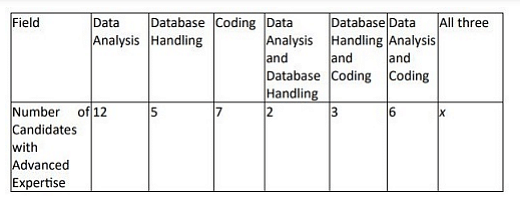
The number of applicants with advanced expertise in all three fields is given as x in the table, where x is a non-negative integer.
- XAT - 2024
- Data Interpretation