A person travels through 5 cities, A, B, C, D and E. City E is 2 km west of D. D is 3 km north-east of A. C is 5 km north of B and 4 km west of A. If this person visits these cities in the sequence B - C - A - E - D, what is the effective distance covered between cities B and D?
Show Hint
- 13 km
- 9 km
- 10 km
- 11 km
The Correct Option is A
Solution and Explanation
Here is another way to reach the same total, using triangle geometry instead of plotting coordinates.
From the question, B to C is 5 km (since C is 5 km due north of B) and C to A is 4 km (since C is 4 km due west of A). Both of these legs are given directly, with no computation needed, because "north of" and "west of" describe movement along a single direction only.
The tricky part is finding the leg from A to E, since neither distance is given directly. We know two things about the small triangle formed by A, D and E: the distance from A to D is 3 km (D is north-east of A), and the distance from D to E is 2 km (E is due west of D).
To use these two sides, we need the angle between them at vertex D. The direction from D back to A is south-west (the exact opposite of north-east), and the direction from D to E is due west. The angle between south-west and due west is \(45^{\circ}\), since south-west sits exactly halfway between south and west.
Now apply the law of cosines in triangle ADE, with \(DA=3\), \(DE=2\), and the included angle \(45^{\circ}\):
\[ AE^2 = DA^2 + DE^2 - 2\cdot DA\cdot DE\cdot\cos 45^{\circ} \] \[ AE^2 = 9 + 4 - 2(3)(2)(0.71) = 13 - 8.49 = 4.51 \] \[ AE \approx 2.12 \text{ km} \]This matches the coordinate calculation exactly. Now add up the full route the person actually travels: B to C is 5 km, C to A is 4 km, A to E is about 2.12 km, and E to D is 2 km:
\[ 5+4+2.12+2 = 13.12 \approx 13 \text{ km} \]The other options, 9 km, 10 km and 11 km, are all too small to account for every leg of the trip through C, A and E, so 13 km is the only figure that matches the full route.
\[ \boxed{13 \text{ km}} \]Top Questions on Logical Reasoning
- Pointing to a photograph, a man says, "I have no brothers or sisters, but the father of the person in the photograph is my father’s son." Who is the person in the photograph?
- BITSAT - 2025
- Logical Reasoning
- Logical Reasoning
- In a certain code, "CAT" is written as "DBU." How is "DOG" written in that code?
- BITSAT - 2025
- General Aptitude
- Logical Reasoning
Statement: All flowers are beautiful. Some beautiful things are fragile.
Conclusion I: Some flowers are fragile.
Conclusion II: All beautiful things are flowers.- BITSAT - 2025
- Logical Reasoning
- Logical Reasoning
- For a person, whose monthly salary is Rs 6,000 p.m., how many items are there on which he has to spend more than Rs 1,000 p.m.?
- VITEEE - 2024
- General Aptitude
- Logical Reasoning
- Want to practice more? Try solving extra ecology questions todayView All Questions
Questions Asked in XAT exam
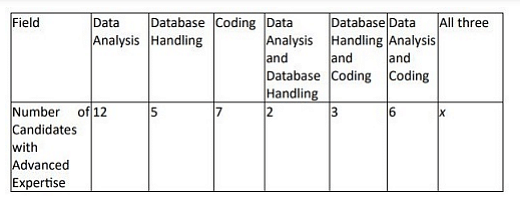
The number of applicants with advanced expertise in all three fields is given as x in the table, where x is a non-negative integer.
- XAT - 2024
- Data Interpretation