A can finish a piece of work in 36 days, B can finish it in 54 days, and C can finish it in 72 days. All three start the work together, but A leaves 8 days before the work is completed, and B leaves 12 days before the work is completed. For how many days in all did C work, till the entire work was finished?
Show Hint
- 48 days
- 24 days
- 12 days
- None
The Correct Option is B
Solution and Explanation
Let's solve the same problem using total "work units" instead of fractions, which avoids fractions until the very end.
Take the total work as 216 units (the LCM of 36, 54 and 72), so that each person's daily output is a whole number.
A completes 216 units in 36 days, so A does \(216/36 = 6\) units a day. B completes 216 units in 54 days, so B does \(216/54 = 4\) units a day. C completes 216 units in 72 days, so C does \(216/72 = 3\) units a day.
Let the whole job take \(T\) days to finish. A works for \((T-8)\) days since A stops 8 days before the finish, and B works for \((T-12)\) days since B stops 12 days before the finish. C works right through, so C puts in \(T\) days, exactly the number we need to find.
The total units of work done by all three must add up to 216:
\[ 6(T-8) + 4(T-12) + 3T = 216 \]Expand each bracket:
\[ 6T - 48 + 4T - 48 + 3T = 216 \] \[ 13T - 96 = 216 \] \[ 13T = 312 \] \[ T = 24 \]So the entire job takes 24 days from start to finish, and since C is present for the whole job, C works for all 24 of those days. This confirms option (2). Option (1), 48 days, is exactly double the correct value, and option (3), 12 days, is too small to let A even put in a positive number of working days once we subtract the 8-day early exit, so both are ruled out.
\[ \boxed{24 \text{ days}} \]Top Questions on Time and Work
- Rahul, Rakshita and Gurmeet, working together, would have taken more than 7 days to finish a job. On the other hand, Rahul and Gurmeet, working together would have taken less than 15 days to finish the job. However, they all worked together for 6 days, followed by Rakshita, who worked alone for 3 more days to finish the job. If Rakshita had worked alone on the job then the number of days she would have taken to finish the job, cannot be
- CAT - 2023
- Quantitative Aptitude
- Time and Work
- Gautam and Suhani, working together, can finish a job in 20 days. If Gautam does only 60% of his usual work on a day, Suhani must do 150% of her usual work on that day to exactly make up for it. Then, the number of days required by the faster worker to complete the job working alone is
- CAT - 2023
- Quantitative Aptitude
- Time and Work
- The amount of job that Amal, Sunil and Kamal can individually do in a day, are in harmonic progression. Kamal takes twice as much time as Amal to do the same amount of job. If Amal and Sunil work for 4 days and 9 days, respectively, Kamal needs to work for 16 days to finish the remaining job. Then the number of days Sunil will take to finish the job working alone, is
- CAT - 2023
- Quantitative Aptitude
- Time and Work
- The amount of job that Amal, Sunil and Kamal can individually do in a day, are in harmonic progression. Kamal takes twice as much time as Amal to do the same amount of job. If Amal and Sunil work for 4 days and 9 days, respectively, Kamal needs to work for 16 days to finish the remaining job. Then the number of days Sunil will take to finish the job working alone, is [This question was asked as TITA]
- CAT - 2023
- Quantitative Aptitude
- Time and Work
- Want to practice more? Try solving extra ecology questions todayView All Questions
Questions Asked in XAT exam
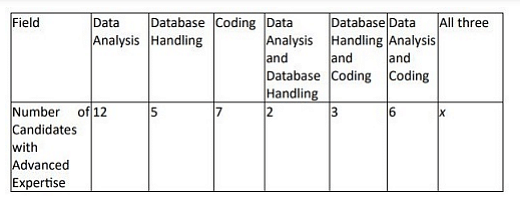
The number of applicants with advanced expertise in all three fields is given as x in the table, where x is a non-negative integer.
- XAT - 2024
- Data Interpretation