Question:medium
Which revision best combines ideas without losing out on information?
There are still ample physical reminders of the history of the Ao tribe in Meghalaya. Impressive burial mounds, dating back hundreds of years, can be found along many of the rivers, for instance.
Which revision best combines ideas without losing out on information?
There are still ample physical reminders of the history of the Ao tribe in Meghalaya. Impressive burial mounds, dating back hundreds of years, can be found along many of the rivers, for instance.
There are still ample physical reminders of the history of the Ao tribe in Meghalaya. Impressive burial mounds, dating back hundreds of years, can be found along many of the rivers, for instance.
Show Hint
Look for the option that keeps the original order and meaning and simply joins the two sentences with a semicolon, without adding a cause or contrast word.
Updated On: Jul 13, 2026
- Impressive burial mounds, dating back hundreds of years, can be found along many of the rivers, for instance; there are still ample physical reminders of the history of the Ao tribe in Meghalaya.
- Since there are still ample physical reminders of the history of the Ao tribe in Meghalaya, impressive burial mounds, dating back hundreds of years, can be found along many of the rivers, for instance.
- Although impressive burial mounds, dating back hundreds of years, can be found along many of the rivers, for instance, there are still ample physical reminders of the history of the Ao tribe in Meghalaya.
- There are still ample physical reminders of the history of the Ao tribe in Meghalaya; impressive burial mounds, dating back hundreds of years, can be found along many of the rivers, for instance.
Show Solution
The Correct Option is D
Solution and Explanation
Step 1: Understanding the Concept.
We are given two separate sentences and asked which single revised sentence keeps every fact from both, without dropping information or changing what the sentences actually mean. The two original sentences make a general claim, then follow it with one specific example marked by the phrase "for instance". Any good combination has to respect that structure.
Step 2: Key Approach.
Read each option and ask two questions: does it drop any fact, and does it add a relationship, cause, contrast, or condition, between the two ideas that the original text never stated? A correct combination only needs a neutral connector that joins two related sentences, such as a semicolon, not a word that changes how the reader understands the link between them. It also has to keep the general claim before its specific example, since "for instance" only works pointing forward.
Step 3: Detailed Explanation.
Option 1 keeps all the facts but reverses their order, putting the specific burial-mound example first and the general reminders claim second. This leaves "for instance" stranded at the very end, pointing back at a claim that has not been made yet in the sentence, which weakens the logic even though no fact is missing.
Option 2 inserts the word "Since" in front of the reminders sentence, which reframes the burial mounds as the cause of the reminders existing. That is a brand new idea; the original two sentences never claimed one caused the other, only that the mounds are an example of the reminders.
Option 3 inserts "Although", which sets up a contrast, as if the burial mounds argue against the existence of reminders. That is the opposite of the truth: the mounds are an example that supports the claim, not a counterpoint to it.
Option 4 changes nothing about the wording, the facts, or the order of the two ideas. It only replaces the full stop between the two original sentences with a semicolon, which is precisely the correct way to combine two closely related, independent sentences without adding meaning that was not there before.
Step 4: Final Answer.
Since option 4 keeps every fact, keeps the original general-to-example order, and adds no cause or contrast that the source text never stated, it is the best combination of the two sentences.
We are given two separate sentences and asked which single revised sentence keeps every fact from both, without dropping information or changing what the sentences actually mean. The two original sentences make a general claim, then follow it with one specific example marked by the phrase "for instance". Any good combination has to respect that structure.
Step 2: Key Approach.
Read each option and ask two questions: does it drop any fact, and does it add a relationship, cause, contrast, or condition, between the two ideas that the original text never stated? A correct combination only needs a neutral connector that joins two related sentences, such as a semicolon, not a word that changes how the reader understands the link between them. It also has to keep the general claim before its specific example, since "for instance" only works pointing forward.
Step 3: Detailed Explanation.
Option 1 keeps all the facts but reverses their order, putting the specific burial-mound example first and the general reminders claim second. This leaves "for instance" stranded at the very end, pointing back at a claim that has not been made yet in the sentence, which weakens the logic even though no fact is missing.
Option 2 inserts the word "Since" in front of the reminders sentence, which reframes the burial mounds as the cause of the reminders existing. That is a brand new idea; the original two sentences never claimed one caused the other, only that the mounds are an example of the reminders.
Option 3 inserts "Although", which sets up a contrast, as if the burial mounds argue against the existence of reminders. That is the opposite of the truth: the mounds are an example that supports the claim, not a counterpoint to it.
Option 4 changes nothing about the wording, the facts, or the order of the two ideas. It only replaces the full stop between the two original sentences with a semicolon, which is precisely the correct way to combine two closely related, independent sentences without adding meaning that was not there before.
Step 4: Final Answer.
Since option 4 keeps every fact, keeps the original general-to-example order, and adds no cause or contrast that the source text never stated, it is the best combination of the two sentences.
Was this answer helpful?
0
Top Questions on Sentence Correction
- Choose the best alternative to improve the sentence:
Despite of being tired, she continued working.- BITSAT - 2025
- English
- Sentence Correction
- Choose the best alternative to improve the underlined part:
"She gave a beautiful speech, which everyone enjoyed it."- BITSAT - 2025
- English
- Sentence Correction
- Identify the part of the sentence which contains a grammatical error:
"Each of the students have submitted their assignments on time."- BITSAT - 2025
- English
- Sentence Correction
- Identify the grammatically correct version of the sentence:
"The manager explained that the new policy would be beneficial for the employees, as well as improving productivity."- NMAT - 2025
- English Language Comprehension
- Sentence Correction
- Want to practice more? Try solving extra ecology questions todayView All Questions
Questions Asked in XAT exam
Applicants have been shortlisted for interviews for some data analyst positions. Some of the applicants have advanced expertise in one or more fields among the following: data analysis, database handling and coding. The numbers of applicants with different advanced expertise are given in the 2 × 8 table below.
The number of applicants with advanced expertise in all three fields is given as x in the table, where x is a non-negative integer.
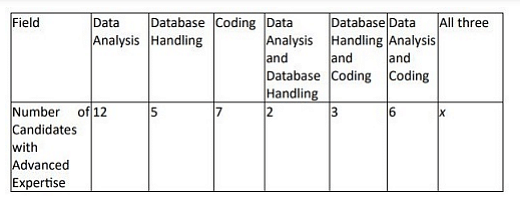
The number of applicants with advanced expertise in all three fields is given as x in the table, where x is a non-negative integer.
- XAT - 2024
- Data Interpretation