Question:medium
We define a function \(f\) on the integers: \(f(x) = \dfrac{x}{10}\) if \(x\) is divisible by 10, and \(f(x) = x+1\) if \(x\) is not divisible by 10.
If \(A_0 = 1994\) and \(A_{n+1} = f(A_n)\), what is the smallest \(n\) such that \(A_n = 2\)?
We define a function \(f\) on the integers: \(f(x) = \dfrac{x}{10}\) if \(x\) is divisible by 10, and \(f(x) = x+1\) if \(x\) is not divisible by 10.
If \(A_0 = 1994\) and \(A_{n+1} = f(A_n)\), what is the smallest \(n\) such that \(A_n = 2\)?
If \(A_0 = 1994\) and \(A_{n+1} = f(A_n)\), what is the smallest \(n\) such that \(A_n = 2\)?
Show Hint
Split the journey into an 'add 1 until a multiple of 10' phase and a 'divide by 10' phase.
Updated On: Jul 13, 2026
- 9
- 18
- 128
- 1993
Show Solution
The Correct Option is A
Solution and Explanation
Step 1: Split the journey into two phases.
Phase 1: keep adding 1 until we reach a multiple of 10, since only a multiple of 10 can be divided.
Phase 2: keep dividing by 10 until we reach the target value 2.
Step 2: Count the steps in Phase 1 using the last digit.
\(A_0 = 1994\) ends in 4, so we are \(10 - 4 = 6\) steps away, in units of add 1, from the next multiple of 10.
Adding 1 six times: \(1994 \to 1995 \to 1996 \to 1997 \to 1998 \to 1999 \to 2000\). This uses steps \(n=1\) through \(n=6\), landing on \(A_6 = 2000\).
Step 3: Count the steps in Phase 2 by counting trailing zeros.
\(2000 = 2 \times 10^3\), so it takes exactly 3 divisions by 10 to strip away the three zeros and reach 2:
\(2000 \to 200 \to 20 \to 2\).
This uses 3 more steps, taking us from \(n=6\) to \(n=9\).
Step 4: Add the two phases.
Total steps \(= 6 + 3 = 9\). Since every intermediate value in both phases is different from 2, and only the last division reaches it, n = 9 is indeed the smallest such index.
\[ \boxed{n = 9} \]
Phase 1: keep adding 1 until we reach a multiple of 10, since only a multiple of 10 can be divided.
Phase 2: keep dividing by 10 until we reach the target value 2.
Step 2: Count the steps in Phase 1 using the last digit.
\(A_0 = 1994\) ends in 4, so we are \(10 - 4 = 6\) steps away, in units of add 1, from the next multiple of 10.
Adding 1 six times: \(1994 \to 1995 \to 1996 \to 1997 \to 1998 \to 1999 \to 2000\). This uses steps \(n=1\) through \(n=6\), landing on \(A_6 = 2000\).
Step 3: Count the steps in Phase 2 by counting trailing zeros.
\(2000 = 2 \times 10^3\), so it takes exactly 3 divisions by 10 to strip away the three zeros and reach 2:
\(2000 \to 200 \to 20 \to 2\).
This uses 3 more steps, taking us from \(n=6\) to \(n=9\).
Step 4: Add the two phases.
Total steps \(= 6 + 3 = 9\). Since every intermediate value in both phases is different from 2, and only the last division reaches it, n = 9 is indeed the smallest such index.
\[ \boxed{n = 9} \]
Was this answer helpful?
0
Top Questions on Number System
- Find the number of integers \(n\) such that \(1 \leq n \leq 100\) and \(n^2 + 3n + 2\) is divisible by 5.
- BITSAT - 2025
- Mathematics
- Number System
- Find the smallest number between 2000 and 3000 that is exactly divisible by 21, 24 and 28.
- SNAP - 2024
- Quantitative Aptitude
- Number System
- Based on the given pattern find the next term of the given series: 5, 6, 16, 57, 244, 1245, ?
- SNAP - 2024
- Quantitative Aptitude
- Number System
- There are 3 different types of rice weighing \(435,\ 493,\) and \(551\) kg respectively. The rice is packed in bags so that no two types are mixed and all bags are of equal size. Find the least number of bags.
- SNAP - 2024
- Quantitative Aptitude
- Number System
- Want to practice more? Try solving extra ecology questions todayView All Questions
Questions Asked in XAT exam
Applicants have been shortlisted for interviews for some data analyst positions. Some of the applicants have advanced expertise in one or more fields among the following: data analysis, database handling and coding. The numbers of applicants with different advanced expertise are given in the 2 × 8 table below.
The number of applicants with advanced expertise in all three fields is given as x in the table, where x is a non-negative integer.
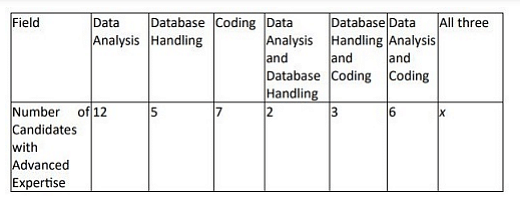
The number of applicants with advanced expertise in all three fields is given as x in the table, where x is a non-negative integer.
- XAT - 2024
- Data Interpretation