Question:medium
Two charges $Q_1 = q$ and $Q_2 = mq$ are placed at the points $P_1(a, b)$ and $P_2(ma, mb)$, respectively, in the $XY$ plane, where $a, b \neq 0$ and $m \neq 0, 1$. If $V_1$ is the potential at a point in the $XY$ plane due to charge $Q_1$ and $V_2$ is the potential at that point due to charge $Q_2$. Correct statement(s) for the points at which $|V_1| = |V_2|$ is/are:
Two charges $Q_1 = q$ and $Q_2 = mq$ are placed at the points $P_1(a, b)$ and $P_2(ma, mb)$, respectively, in the $XY$ plane, where $a, b \neq 0$ and $m \neq 0, 1$. If $V_1$ is the potential at a point in the $XY$ plane due to charge $Q_1$ and $V_2$ is the potential at that point due to charge $Q_2$. Correct statement(s) for the points at which $|V_1| = |V_2|$ is/are:
Show Hint
|V1| = |V2| gives r2 = |m| r1, which is an Apollonius circle (a line only when m = -1). Find the centre and radius for each m.
Updated On: Nov 19, 2026
- For $m = -1$, locus of these points is $ax + by = 0$.
- For $m = 2$, the locus of these points is a circle of radius $\frac{2}{3}\sqrt{a^2 + b^2}$ centered at $(\frac{2}{3}a, \frac{2}{3}b)$.
- For $m = -2$, the locus of these points is a circle of radius $2\sqrt{a^2 + b^2}$ centered at $(2a, 2b)$.
- For $m = -3$, locus of these points is $3ax + 3by = 0$.
Show Solution
The Correct Option is A, B, C
Solution and Explanation
Step 1: Reduce to a one-line picture:
Both charges lie on the line through the origin with direction $\vec u = (a, b)$. Write $P_1 = \vec u$ and $P_2 = m\vec u$.
The condition $|V_1| = |V_2|$ means $\dfrac{|q|}{r_1} = \dfrac{|mq|}{r_2}$, so $r_2 : r_1 = |m| : 1$.
The set of points with a fixed distance ratio from two points is a circle (Apollonius circle), unless the ratio is 1. Then it is a line.
Step 2: Find the diameter ends on the line:
The circle meets the line of the two charges at two points $t\vec u$. The distances are $r_1 = |t - 1||u|$ and $r_2 = |t - m||u|$.
So $|t - m| = |m|\,|t - 1|$, which means $t - m = \pm m(t - 1)$.
With the plus sign: $t - m = mt - m$, so $t(1 - m) = 0$ and $t = 0$.
With the minus sign: $t - m = -mt + m$, so $t(1 + m) = 2m$ and $t = \dfrac{2m}{m + 1}$.
These two points are the ends of a diameter, by symmetry about the line of centres.
Step 3: Case m = -1:
The ratio is 1, so the locus is the perpendicular bisector of $P_1P_2$. The midpoint of $P_1(a,b)$ and $P_2(-a,-b)$ is the origin.
The line through the origin perpendicular to $(a, b)$ is $ax + by = 0$. So (A) is correct.
Step 4: Case m = 2:
$t = 0$ and $t = \dfrac{4}{3}$. The diameter runs from $0$ to $\tfrac43\vec u$.
Centre $\tfrac23\vec u = \left(\tfrac23 a, \tfrac23 b\right)$ and radius $\tfrac23|u|$. So (B) is correct.
Step 5: Case m = -2:
$t = 0$ and $t = \dfrac{-4}{-1} = 4$. The diameter runs from $0$ to $4\vec u$.
Centre $2\vec u = (2a, 2b)$ and radius $2|u|$. So (C) is correct.
Step 6: Case m = -3:
$t = 0$ and $t = \dfrac{-6}{-2} = 3$. The diameter runs from $0$ to $3\vec u$.
This is a circle of centre $\tfrac32\vec u$ and radius $\tfrac32|u|$. It is a circle, not the line $3ax + 3by = 0$. So (D) is incorrect.
Final Answer:
Options (A), (B) and (C) are correct. \[ \boxed{\text{(A), (B), (C)}} \]
Was this answer helpful?
0
Top Questions on Electrostatics
A 10 $\mu\text{C}$ charge is placed in an electric field of $ 5 \times 10^3 \text{N/C} $. What is the force experienced by the charge?
- MHT CET - 2025
- Physics
- Electrostatics
- A capacitor has a capacitance of $ 5 \, \mu\text{F} $ and a potential difference of $ 10 \, \text{V} $ is applied across it. What is the charge on the capacitor?
- MHT CET - 2025
- Physics
- Electrostatics
- Two charges of +3 μC and –3 μC are placed 2 cm apart in air. What is the electric potential energy of the system? (Take \( k = 9 \times 10^9 \) Nm\(^2\)/C\(^2\))
- BITSAT - 2025
- Physics
- Electrostatics
- A uniformly charged ring of radius \( R \) carries total charge \( Q \). Find the electric field at a point on the axis at a distance \( x = \frac{R}{\sqrt{2}} \) from the center.
- BITSAT - 2025
- Physics
- Electrostatics
- Want to practice more? Try solving extra ecology questions todayView All Questions
Questions Asked in JEE Advanced exam
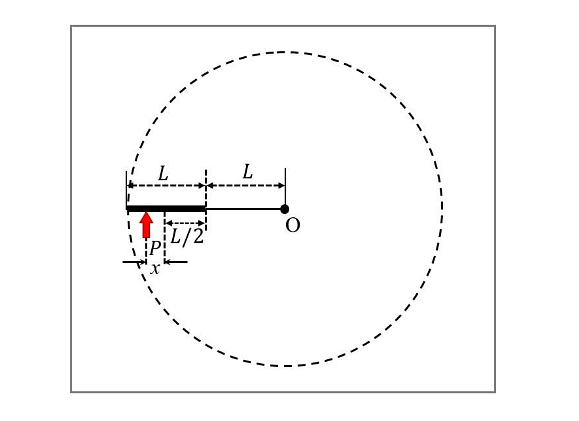
A thin uniform rod of length L and certain mass is kept on a frictionless horizontal table with a massless string of length L fixed to one end (top view is shown in the figure). The other end of the string is pivoted to a point O. If a horizontal impulse P is imparted to the rod at a distance x = L/n from the mid-point of the rod (see figure), then the rod and string revolve together around the point O, with the rod remaining aligned with the string. In such a case, the value of n is _____.
- JEE Advanced - 2024
- Friction