There are five sets of digits, Set A, Set B, Set C, Set D and Set E, arranged in a row as shown below. Set A holds one digit, Set B holds two digits, Set C holds three digits, Set D holds two digits and Set E holds one digit.
Set A: 7, Set B: 28, Set C: 196, Set D: 34, Set E: 5.
A rearrangement means picking one digit out of one set and swapping it with one digit from a different set. The goal is to keep making such swaps, one at a time, until the three-digit number in Set C becomes an exact multiple of the numbers formed by every other set, that is, of Set A, Set B, Set D and Set E, all at once. In the starting arrangement above, Set C (196) is already a multiple of Set A (77) and of Set B (28), since \(196 = 7 \times 28\), but it is not a multiple of Set D (34) or of Set E (55).What is the minimum number of rearrangements needed to reach an arrangement where Set C is a multiple of Set A, Set B, Set D and Set E together? Each rearrangement is one swap of a single digit between two of the five sets; for instance, swapping the 1 in Set C with the 5 in Set E would count as one rearrangement.
Set A: 7, Set B: 28, Set C: 196, Set D: 34, Set E: 5.
A rearrangement means picking one digit out of one set and swapping it with one digit from a different set. The goal is to keep making such swaps, one at a time, until the three-digit number in Set C becomes an exact multiple of the numbers formed by every other set, that is, of Set A, Set B, Set D and Set E, all at once. In the starting arrangement above, Set C (196) is already a multiple of Set A (77) and of Set B (28), since \(196 = 7 \times 28\), but it is not a multiple of Set D (34) or of Set E (55).
Show Hint
- 2
- 5
- 8
- 3
The Correct Option is D
Solution and Explanation
This puzzle asks for the fewest single-digit swaps between the five sets so that the 3-digit number in Set C divides evenly with every one of Set A, Set B, Set D and Set E. Instead of jumping straight to one sequence of swaps, look at how many sets are broken at the start and reason about the least number of moves that could ever fix all of them.
At the start, Set A = 7, Set B = 28, Set C = 196, Set D = 34 and Set E = 5. Checking each relationship with Set C:
- Set A (77): $196/7 = 28$, exact, so Set A is already fine.
- Set B (28): $196/28 = 7$, exact, so Set B is already fine too.
- Set D (34): $196/34$ is not a whole number, so Set D is broken.
- Set E (55): $196/5$ is not a whole number, so Set E is broken too.
So two of the four side sets are already correct, and two, D and E, are not. Fixing a broken set usually needs one digit to leave it and a different digit to enter it, and because Set C has to stay consistent with A and B while this happens, a single swap cannot touch both D and E at once and still keep everything working.
- Can 2 swaps be enough? Two swaps touch at most four set slots, just enough to involve Set D and Set E once each, but every such attempt ends up breaking the earlier good match between Set C and Set A or Set B, because Set C's own digits do not change in a way that keeps three separate divisions exact at the same time. So 2 swaps is not enough.
- Does a 3-swap path exist? Yes: swap 7 (Set A) with 2 (Set B) to get A = 2, B = 78; swap 4 (Set D) with 5 (Set E) to get D = 35, E = 4; then swap 9 (Set C) with 5 (now in Set D) to get C = 156, D = 39. Check: $156/2=78$, $156/78=2$, $156/39=4$, $156/4=39$. All four hold at once.
- Do the larger options matter? Since a valid path already exists in 3 swaps, any bigger number, such as 5, 7 or 8, cannot be the minimum; those only describe slower ways of eventually reaching the goal.
So the smallest number of swaps for which a fully working arrangement exists is 3.
Let's summarize:
- Two of the four side sets are correct from the start; only Set D and Set E need fixing.
- A concrete 3-swap sequence, an A/B swap, a D/E swap and a C/D swap, makes Set C a multiple of all four other sets at once.
- Fewer than 3 swaps cannot fix both broken sets while keeping the two good ones intact.
The minimum number of rearrangements required is therefore 3.
Top Questions on Data Arrangement
Sundaram Stores operated in a gated community, situated about 30 Kilometers away from the main town. The store owner Mr. Sundareswaran Pichaimuthu, or Sundaram as he was called by everyone, secured a space in the gated society through a competitive bidding process. The residents’ association, led by Mr. Thangamoorthy Selvaganapathy, selected Sundaram over three other bidders, based on his willingness to pay the highest rent. Desperate to augment his post-retirement income, Sundaram agreed to pay a very high rent, banking on the prospect of generating exceptional revenue from the gated community.
Sundaram was awarded the contract to establish the store, with provisions for a review every three years. Feeling elated during the meeting with the residents’ association to finalize the contract, he enthusiastically committed to offering a 15% discount on all groceries and stationary, cementing goodwill and reinforcing the partnership established through the contract. The association was delightedly taken aback by his generous assurance. Sundaram hoped to make up the difference through volume.
Although his sales were strong during the initial months, he soon realized that the SUV-owning residents of the gated community primarily made their purchases at large, branded retail chains in the main town. These stores offered deeper discounts, which he could not afford to compete with. However, gradually, Sundaram store became their go-to store for daily essentials and occasional urgent big purchases such as replacing a broken mixer-grinder.- XAT - 2025
- Decision Making
- Data Arrangement
TrueColor, an event management company in eastern India, had been in a business of inviting Tollywood singers to a city called Tivanna, and made money out of selling tickets of their concerts. The stars were paid a xed fee regardless of the number of tickets sold. The company had a specialized team that negotiated the singers’ fee with their managers. However, for selling the tickets of such events, they were reliant on an external media agency called Zedius. Zedius had a long-standing relationship with TrueColor, and had been instrumental in achieving a target of 50,000 tickets for each of the agship events..
Mr. Sukanta Rao joined TrueColor as an inhouse sales and marketing manager, a position exclusively created for him. The CEO, Mr. Adil Banerjee, had assigned a task of increasing the sales of tickets to 100,000. In Sukanta’s earlier stint, he had seen that similar cities sell more than 75,000 tickets for such events. He felt that, over time, reaching 100,000 was plausible for TrueColor- XAT - 2025
- Decision Making
- Data Arrangement
- Refer to the given letter, number and symbol string and answer the question that follows.
(Left) * 5 U £ 2 W @ 3 K 9 + \# 6 M & 4 A a 5 G 8 7 B % R O (Right)
If the sequence of the middle nine elements in the given string is reversed, then which of the following will be seventh to the right of the twenty-first element from the right end?- SRCC GBO - 2026
- Logical Ability
- Data Arrangement
- Refer to the given letter, number and symbol series and answer the question that follows.
(Left) H 0 L $\Omega$ Y & 4 Z 2 * 3 M & 7 S W # 8 2 p H * L (Right)
If all the numbers are dropped from the series, then which of the following will be seventh from the right?- SRCC GBO - 2026
- Logical Ability
- Data Arrangement
- Want to practice more? Try solving extra ecology questions todayView All Questions
Questions Asked in XAT exam
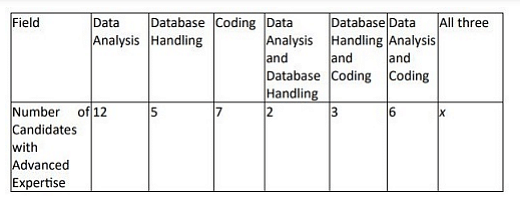
The number of applicants with advanced expertise in all three fields is given as x in the table, where x is a non-negative integer.
- XAT - 2024
- Data Interpretation