TrueColor, an event management company in eastern India, had been in a business of inviting Tollywood singers to a city called Tivanna, and made money out of selling tickets of their concerts. The stars were paid a xed fee regardless of the number of tickets sold. The company had a specialized team that negotiated the singers’ fee with their managers. However, for selling the tickets of such events, they were reliant on an external media agency called Zedius. Zedius had a long-standing relationship with TrueColor, and had been instrumental in achieving a target of 50,000 tickets for each of the agship events..
Mr. Sukanta Rao joined TrueColor as an inhouse sales and marketing manager, a position exclusively created for him. The CEO, Mr. Adil Banerjee, had assigned a task of increasing the sales of tickets to 100,000. In Sukanta’s earlier stint, he had seen that similar cities sell more than 75,000 tickets for such events. He felt that, over time, reaching 100,000 was plausible for TrueColor
Sukanta felt that the aspirational target can be achieved only if Zedius is replaced. However, he is not sure if he should make any major changes in his first year.
.
Which of the following reasons will BEST help Sukanta NOT to start making major changes immediately?
Which of the following reasons will BEST help Sukanta NOT to start making major changes immediately?
Show Hint
- The owners of Zedius are respected citizens of Tivanna.
- TrueColor recruited Sukanta specifically to increase ticket sales by whatever means necessary.
- Zedius has managed TrueColor’s marketing for the last five years.
- Sukanta needs more time to learn about the dynamics of the eastern market.
- For around a decade, ticket sales have consistently hovered at 50,000.
The Correct Option is D
Solution and Explanation
Sukanta's objective at TrueColor is to boost ticket sales to 100,000. He is considering replacing Zedius, the established media partner, but recognizes that a hasty decision without local market knowledge would be unwise.
Phase 2: Assess each choice.
- Choice A: Zedius's owners' personal reputations are not pertinent to Sukanta's business judgment. - Choice B: The mandate to increase sales does not justify impulsive actions; strategic choices necessitate context. - Choice C: A history with TrueColor indicates stability but is insufficient justification for postponing necessary changes. - Choice D: This option presents the most sensible rationale. As a newcomer, Sukanta should first familiarize himself with the local market and competitive landscape before implementing significant alterations. - Choice E: Declining sales signal a need for action, not a reason for further delay.
Phase 3: Determine the optimal selection.
Choice D is the most appropriate because it underscores the necessity of research and evaluation prior to execution, a prudent strategy for a new manager.
Conclusive Response: \[\boxed{\text{D}}\]
Just two weeks before the flagship event, Adil received a few emails from competing media agencies that accused Zedius of selling phony tickets in the “black” market. When Adil enquired with the security agency in charge of gatekeeping the events, they told him that they had no mechanism to check the authenticity of tickets.
Which of the following options will BEST help Adil to ignore the accusations from the competing media agencies, and maintain status quo?
Which of the following options will BEST help Adil to ignore the accusations from the competing media agencies, and maintain status quo?
Show Hint
- In Tivanna, the competing media agencies keep defaming each other out of fierce competition.
- Tivanna being a small city, a few prominent personalities have to be allowed in without tickets.
- Zedius is the largest media agency in Tivanna.
- Some attendees admitted to paying cash to gate keepers to get in.
The Correct Option is A
Solution and Explanation
Adil faces significant accusations leveled against Zedius, his long-term partner, immediately prior to a major event. The validity of these accusations is uncertain, potentially stemming from genuine issues or competitive rivalries. Adil requires justification to disregard these claims and maintain the current course of action.
Step 2: Option Evaluation.
- Option A: If the industry is characterized by frequent slander among competing agencies, these accusations can be dismissed as typical competitive strategies. This provides Adil with a valid basis to ignore the allegations. - Option B: The admission of VIPs without tickets is unrelated to the problem of illegal ticket sales. - Option C: Zedius's considerable size does not confirm its innocence; being the largest agency does not preclude the possibility of misconduct. - Option D: Proof of financial transactions with gatekeepers suggests improper conduct, necessitating an inquiry rather than dismissal.
Step 3: Optimal Justification.
Option A offers the most compelling argument for continuing with the status quo, as the accusations can be reasonably attributed to competitive defamation.
Final Answer: \[\boxed{\text{A}}\]
The following year, Sukanta discussed with Adil that unless they got into the ticket selling process, they might not be able to improve the ticket numbers. However, this would mean moving away from Zedius, and the transition could cause short-term pains since TrueColor would be entering into unchartered territory. Further, Sukanta added that TrueColor would achieve self-sufficiency over couple of years.
Adil was concerned about the risk of taking over an activity that the organization was not competent at, but understood Sukanta’s point. In the interest of building long-term competencies, he authorized Sukanta to take it forward. Sukanta did not renew Zedius’s contract in the following year; instead, he recruited a skeletal team of three freshers from a premier business school as his support staff.
As the event approached, the team dedicated themselves to executing their plan. However, by the time the ticket sales window closed, they managed to sell only 40,000 tickets. This shift in strategy provoked considerable dissent within the company, challenging Sukanta’s decision. Disturbed by the situation, witnessing the internal turmoil, Adil must now navigate the company’s immediate reaction.
Which of the following should now be Adil’s BEST course of action?
Adil was concerned about the risk of taking over an activity that the organization was not competent at, but understood Sukanta’s point. In the interest of building long-term competencies, he authorized Sukanta to take it forward. Sukanta did not renew Zedius’s contract in the following year; instead, he recruited a skeletal team of three freshers from a premier business school as his support staff.
As the event approached, the team dedicated themselves to executing their plan. However, by the time the ticket sales window closed, they managed to sell only 40,000 tickets. This shift in strategy provoked considerable dissent within the company, challenging Sukanta’s decision. Disturbed by the situation, witnessing the internal turmoil, Adil must now navigate the company’s immediate reaction.
Which of the following should now be Adil’s BEST course of action?
Show Hint
- He should make Sukanta and his team to go back to Zedius immediately.
- He should dismiss Sukanta’s team and let the earlier media agency to take over.
- He should threaten Sukanta that if sales do not improve by next year, he and his team will be fired.
- He should engage a different media agency which is working for TrueColor’s main competitor.
- He should wait and watch as the investment in Sukanta may need more time to bear result.
The Correct Option is
Solution and Explanation
Adil sanctioned Sukanta's internal ticket sales strategy, deviating from Zedius. Initial results were poor, with only 40,000 tickets sold, causing internal unrest. The critical question: should Adil revoke the decision immediately or grant Sukanta an extension?
Phase 2: Option Evaluation.
- Option A: Reverting to Zedius immediately would undermine Sukanta and signal an inability to develop internal capabilities. This is premature. - Option B: Terminating Sukanta's team after a single setback would stifle innovation and severely damage morale. - Option C: Threatening Sukanta would foster fear, not accountability, and fail to build sustainable capacity. - Option D: Employing a rival's media agency introduces potential conflicts and escalates risks. - Option E: This is the optimal selection. Developing new organizational capabilities requires time for fruition. Patience and support for Sukanta provide the initiative a legitimate opportunity while preserving the long-term strategic outlook.
Phase 3: Decision Selection.
Option E harmonizes patience with strategic vision. Adil ought to oversee developments while allowing Sukanta sufficient time to improve his methodology.
Concluding Response: \[\boxed{\text{E}}\]
Top Questions on Data Arrangement
Sundaram Stores operated in a gated community, situated about 30 Kilometers away from the main town. The store owner Mr. Sundareswaran Pichaimuthu, or Sundaram as he was called by everyone, secured a space in the gated society through a competitive bidding process. The residents’ association, led by Mr. Thangamoorthy Selvaganapathy, selected Sundaram over three other bidders, based on his willingness to pay the highest rent. Desperate to augment his post-retirement income, Sundaram agreed to pay a very high rent, banking on the prospect of generating exceptional revenue from the gated community.
Sundaram was awarded the contract to establish the store, with provisions for a review every three years. Feeling elated during the meeting with the residents’ association to finalize the contract, he enthusiastically committed to offering a 15% discount on all groceries and stationary, cementing goodwill and reinforcing the partnership established through the contract. The association was delightedly taken aback by his generous assurance. Sundaram hoped to make up the difference through volume.
Although his sales were strong during the initial months, he soon realized that the SUV-owning residents of the gated community primarily made their purchases at large, branded retail chains in the main town. These stores offered deeper discounts, which he could not afford to compete with. However, gradually, Sundaram store became their go-to store for daily essentials and occasional urgent big purchases such as replacing a broken mixer-grinder.- XAT - 2025
- Decision Making
- Data Arrangement
- Refer to the given letter, number and symbol string and answer the question that follows.
(Left) * 5 U £ 2 W @ 3 K 9 + \# 6 M & 4 A a 5 G 8 7 B % R O (Right)
If the sequence of the middle nine elements in the given string is reversed, then which of the following will be seventh to the right of the twenty-first element from the right end?- SRCC GBO - 2026
- Logical Ability
- Data Arrangement
- Refer to the given letter, number and symbol series and answer the question that follows.
(Left) H 0 L $\Omega$ Y & 4 Z 2 * 3 M & 7 S W # 8 2 p H * L (Right)
If all the numbers are dropped from the series, then which of the following will be seventh from the right?- SRCC GBO - 2026
- Logical Ability
- Data Arrangement
Five people joined different engineering colleges. Their first names were Sarah (Ms.), Swati (Ms.), Jackie, Mohan and Priya (Ms.). The surnames were Reddy, Gupta, Sanyal, Kumar and Chatterjee. Except for one college which was rated as 3 star, all other colleges were rated either 4 star or 5 star.
The 'Techno Institute' had a higher rating than the college where Priya studied. The three-star college was not 'Deccan College.' Mohan's last name was Gupta, but he did not study at 'Barla College.' Sarah, whose last name was not Sanyal, joined 'Techno Institute.' Ms. Kumar and Jackie both studied at four-star colleges. Ms. Reddy studied at the 'Anipal Institute,' which was not a five-star college. The 'Barla College' was a five-star college. Swati's last name was not Chatterjee. The 'Chemical College' was rated one star less than the college where Sanyal studied. Only one college was rated five star.
81. Which is the correct combination of first names and surnames?
- XAT - 2009
- Decision Making
- Data Arrangement
- Want to practice more? Try solving extra ecology questions todayView All Questions
Questions Asked in XAT exam
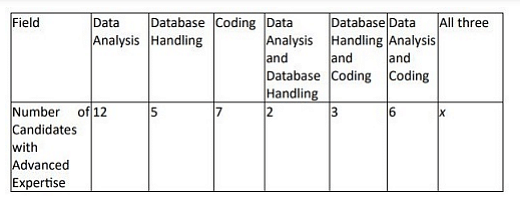
The number of applicants with advanced expertise in all three fields is given as x in the table, where x is a non-negative integer.
- XAT - 2024
- Data Interpretation