Question:medium
The sides of a rhombus ABCD measure 2 cm each, and the difference between two of its angles is \(90^{\circ}\). Then the area of the rhombus is:
The sides of a rhombus ABCD measure 2 cm each, and the difference between two of its angles is \(90^{\circ}\). Then the area of the rhombus is:
Show Hint
A rhombus has only two distinct angles that add up to 180 degrees; use their given difference to find each one, then apply Area = side squared times sine of the angle.
Updated On: Jul 13, 2026
- \(\sqrt{2}\) sq cm
- \(2\sqrt{2}\) sq cm
- \(3\sqrt{2}\) sq cm
- \(4\sqrt{2}\) sq cm
Show Solution
The Correct Option is B
Solution and Explanation
Step 1: Find the two distinct angles of the rhombus.
Adjacent angles of a rhombus add up to $180^{\circ}$, so if one angle is $\theta$, the next one is $180^{\circ}-\theta$. Their difference is given as $90^{\circ}$:
\[ (180^{\circ}-\theta)-\theta = 90^{\circ} \]
\[ \theta = 45^{\circ} \]
So the rhombus has angles of $45^{\circ}$ and $135^{\circ}$.
Step 2: Recall how the diagonals relate to the side and the angle.
The diagonals of a rhombus bisect each other at right angles and also bisect the vertex angles. At the vertex with angle $45^{\circ}$, the diagonal through it splits that angle into two parts of $22.5^{\circ}$ each. In the right triangle formed by half of each diagonal and a side of length $2$ cm:
\[ \frac{p}{2} = 2\sin(22.5^{\circ}), \qquad \frac{q}{2} = 2\cos(22.5^{\circ}) \]
where $p$ and $q$ are the lengths of the two diagonals.
Step 3: Write the diagonals explicitly.
\[ p = 4\sin(22.5^{\circ}), \qquad q = 4\cos(22.5^{\circ}) \]
Step 4: Use the diagonal formula for the area of a rhombus.
\[ \text{Area} = \frac{1}{2}pq = \frac{1}{2}\times 4\sin(22.5^{\circ}) \times 4\cos(22.5^{\circ}) = 8\sin(22.5^{\circ})\cos(22.5^{\circ}) \]
Step 5: Apply the double angle identity to simplify.
Using $2\sin\alpha\cos\alpha = \sin(2\alpha)$ with $\alpha = 22.5^{\circ}$:
\[ 8\sin(22.5^{\circ})\cos(22.5^{\circ}) = 4 \times \big(2\sin(22.5^{\circ})\cos(22.5^{\circ})\big) = 4\sin(45^{\circ}) \]
\[ = 4 \times \frac{\sqrt{2}}{2} = 2\sqrt{2} \]
Step 6: Confirm against the options.
This diagonal-based route lands on exactly the same value as the direct side-angle area formula, confirming the area is $2\sqrt{2}$ sq cm and ruling out the other three options.
Final Answer:
\[ \boxed{2\sqrt{2} \text{ sq cm}} \]
Adjacent angles of a rhombus add up to $180^{\circ}$, so if one angle is $\theta$, the next one is $180^{\circ}-\theta$. Their difference is given as $90^{\circ}$:
\[ (180^{\circ}-\theta)-\theta = 90^{\circ} \]
\[ \theta = 45^{\circ} \]
So the rhombus has angles of $45^{\circ}$ and $135^{\circ}$.
Step 2: Recall how the diagonals relate to the side and the angle.
The diagonals of a rhombus bisect each other at right angles and also bisect the vertex angles. At the vertex with angle $45^{\circ}$, the diagonal through it splits that angle into two parts of $22.5^{\circ}$ each. In the right triangle formed by half of each diagonal and a side of length $2$ cm:
\[ \frac{p}{2} = 2\sin(22.5^{\circ}), \qquad \frac{q}{2} = 2\cos(22.5^{\circ}) \]
where $p$ and $q$ are the lengths of the two diagonals.
Step 3: Write the diagonals explicitly.
\[ p = 4\sin(22.5^{\circ}), \qquad q = 4\cos(22.5^{\circ}) \]
Step 4: Use the diagonal formula for the area of a rhombus.
\[ \text{Area} = \frac{1}{2}pq = \frac{1}{2}\times 4\sin(22.5^{\circ}) \times 4\cos(22.5^{\circ}) = 8\sin(22.5^{\circ})\cos(22.5^{\circ}) \]
Step 5: Apply the double angle identity to simplify.
Using $2\sin\alpha\cos\alpha = \sin(2\alpha)$ with $\alpha = 22.5^{\circ}$:
\[ 8\sin(22.5^{\circ})\cos(22.5^{\circ}) = 4 \times \big(2\sin(22.5^{\circ})\cos(22.5^{\circ})\big) = 4\sin(45^{\circ}) \]
\[ = 4 \times \frac{\sqrt{2}}{2} = 2\sqrt{2} \]
Step 6: Confirm against the options.
This diagonal-based route lands on exactly the same value as the direct side-angle area formula, confirming the area is $2\sqrt{2}$ sq cm and ruling out the other three options.
Final Answer:
\[ \boxed{2\sqrt{2} \text{ sq cm}} \]
Was this answer helpful?
0
Top Questions on Mensuration
- A triangle is drawn with its vertices on the circle C such that one of its sides is a diameter of C and the other two sides have their lengths in the ratio a:b. If the radius of the circle is r, then the area of the triangle is
- CAT - 2023
- Quantitative Aptitude
- Mensuration
- The area of the quadrilateral bounded by the \(Y\) -axis, the line \(x = 5\) , and the lines \(|x-y|-|x-5|=2\), is
- CAT - 2023
- Quantitative Aptitude
- Mensuration
- ABCD is a rectangle with sides AB = 56 cm and BC = 45 cm, and E is the midpoint of side CD. Then, the length, in cm, of radius of incircle of \(\triangle ADE\) is
- CAT - 2024
- Quantitative Aptitude
- Mensuration
- The surface area of a closed rectangular box, which is inscribed in a sphere, is 846 sq cm, and the sum of the lengths of all its edges is 144 cm. The volume, in cubic cm, of the sphere is ?
- CAT - 2024
- Quantitative Aptitude
- Mensuration
- Want to practice more? Try solving extra ecology questions todayView All Questions
Questions Asked in XAT exam
Applicants have been shortlisted for interviews for some data analyst positions. Some of the applicants have advanced expertise in one or more fields among the following: data analysis, database handling and coding. The numbers of applicants with different advanced expertise are given in the 2 × 8 table below.
The number of applicants with advanced expertise in all three fields is given as x in the table, where x is a non-negative integer.
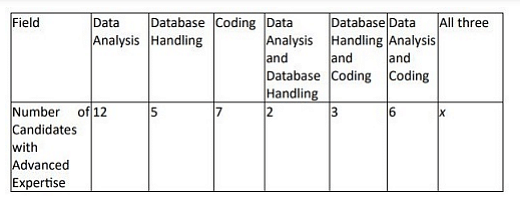
The number of applicants with advanced expertise in all three fields is given as x in the table, where x is a non-negative integer.
- XAT - 2024
- Data Interpretation