The instructions below apply to this question and the previous one.
In the figure below, the seven letters correspond to seven unique digits chosen from 0 to 9. The relation among the digits is such that:
\(P \times Q \times R = X \times Y \times Z = Q \times A \times Y\)
P X Q A Y R Z
The sum of the digits which are not used is:
The instructions below apply to this question and the previous one.
In the figure below, the seven letters correspond to seven unique digits chosen from 0 to 9. The relation among the digits is such that:
\(P \times Q \times R = X \times Y \times Z = Q \times A \times Y\)
| P | X | |
| Q | A | Y |
| R | Z |
The sum of the digits which are not used is:
Show Hint
- 8
- 10
- 14
- None of the above
The Correct Option is D
Solution and Explanation
Add up every digit from 0 to 9 first: $0+1+2+3+4+5+6+7+8+9 = 45$.
The seven digits actually used in the puzzle, found from solving the product condition $P \times Q \times R = X \times Y \times Z = Q \times A \times Y$, are $1, 2, 3, 4, 6, 8, 9$, with $A=2$, $Q=9$, $Y=4$, $\{P,R\}=\{1,8\}$, $\{X,Z\}=\{3,6\}$, common product $72$.
Add up just these seven used digits: $1+2+3+4+6+8+9 = 33$.
Subtracting the used digits' sum from the total of all ten digits gives the sum of the unused ones: $45 - 33 = 12$.
Checking the options: 8, 10 and 14 are all too far off, and 12 is not 15 either, so none of the first four choices equal 12.
So the correct answer is None of the above.
Top Questions on Number System
- Find the number of integers \(n\) such that \(1 \leq n \leq 100\) and \(n^2 + 3n + 2\) is divisible by 5.
- BITSAT - 2025
- Mathematics
- Number System
- Find the smallest number between 2000 and 3000 that is exactly divisible by 21, 24 and 28.
- SNAP - 2024
- Quantitative Aptitude
- Number System
- Based on the given pattern find the next term of the given series: 5, 6, 16, 57, 244, 1245, ?
- SNAP - 2024
- Quantitative Aptitude
- Number System
- There are 3 different types of rice weighing \(435,\ 493,\) and \(551\) kg respectively. The rice is packed in bags so that no two types are mixed and all bags are of equal size. Find the least number of bags.
- SNAP - 2024
- Quantitative Aptitude
- Number System
- Want to practice more? Try solving extra ecology questions todayView All Questions
Questions Asked in XAT exam
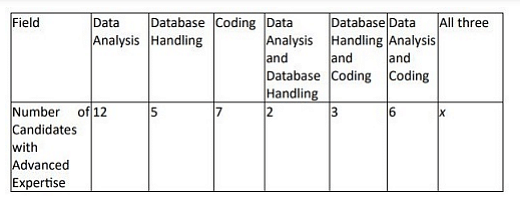
The number of applicants with advanced expertise in all three fields is given as x in the table, where x is a non-negative integer.
- XAT - 2024
- Data Interpretation