Question:medium
The electric field associated with an electromagnetic wave travelling in vacuum is given by
\[
\vec E
=
E_0\sin(3y+4z+\omega t)\,\hat i
\]
where \(\omega\) is the angular frequency. All quantities are in SI units. The correct statement(s) about this wave is/are:
\[
[\text{Given: speed of light in vacuum }c=3\times10^8\ \text{m s}^{-1}]
\]
Show Hint
Compare the phase 3y + 4z + wt with k.r + wt: the wave moves along -k and |k| = 5. Then omega = ck and B = (n x E)/c.
Updated On: Nov 19, 2026
- The wave is travelling in \(-\dfrac15(3\hat j+4\hat k)\) direction.
- The magnitude of wave vector is \(0.5\ \mathrm{m^{-1}}\)
- The value of \(\omega\) is \(1.5\times10^9\ \mathrm{rad\,s^{-1}}\)
- The magnetic field associated with this wave is given by \[ \vec B= \frac{E_0}{c} \sin(3y+4z+\omega t)\, (4\hat j-3\hat k) \]
Show Solution
The Correct Option is A, C
Solution and Explanation
Step 1: Compare with the standard wave form:
A travelling wave has the form $\sin(\vec k\cdot\vec r \mp \omega t)$. The sign in front of $\omega t$ tells the direction.
Here the phase is $3y + 4z + \omega t$. A plus sign means the wave travels in the negative direction of its wave vector.
So the wave vector is $3\hat j + 4\hat k$ and the wave moves along $-\dfrac{3\hat j + 4\hat k}{5}$. So (A) is TRUE.
Step 2: Size of $k$ and the value of $\omega$:
$|\vec k| = \sqrt{9 + 16} = 5\ \text{m}^{-1}$. So the claim in (B), $0.5\ \text{m}^{-1}$, is FALSE.
Light in vacuum has $\omega = c|\vec k| = (3\times10^8)(5) = 1.5\times10^9\ \text{rad s}^{-1}$. So (C) is TRUE.
Step 3: Find the magnetic field using the cross product rule:
For an EM wave, $\vec B = \dfrac{\hat n\times\vec E}{c}$, where $\hat n$ is the direction of travel.
Here $\hat n = -\dfrac{3\hat j + 4\hat k}{5}$ and $\vec E = E_0\sin(\cdot)\,\hat i$.
Use $\hat j\times\hat i = -\hat k$ and $\hat k\times\hat i = \hat j$:
\[ \hat n\times\hat i = -\frac15\left(3\hat j\times\hat i + 4\hat k\times\hat i\right) = -\frac15\left(-3\hat k + 4\hat j\right) = -\frac15\left(4\hat j - 3\hat k\right) \]
\[ \vec B = -\frac{E_0}{5c}\sin(3y + 4z + \omega t)\,(4\hat j - 3\hat k) \]
Option (D) differs by a sign and by a factor of 5. So (D) is FALSE.
Final Answer:
Only (A) and (C) are correct. \[ \boxed{\text{A, C}} \]
Was this answer helpful?
0
Top Questions on Electromagnetic waves
- A wheel of diameter 20 cm is rotating at 600 rpm. The linear velocity of a particle at its rim is:
- MHT CET - 2024
- Physics
- Electromagnetic waves
- Find the ratio of K.E. and P.E. when a particle performs SHM and is at \( \frac{1}{n} \) times its amplitude from the mean position.
- MHT CET - 2024
- Physics
- Electromagnetic waves
- Electromagnetic waves travel in a medium with speed \( 1.5 \times 10^8 \) m/s. The relative permeability of the medium is \( 2.0 \). The relative permittivity will be:
- BITSAT - 2024
- Physics
- Electromagnetic waves
- The property which is not of an electromagnetic wave travelling in free space is that :
- NEET (UG) - 2024
- Physics
- Electromagnetic waves
- Want to practice more? Try solving extra ecology questions todayView All Questions
Questions Asked in JEE Advanced exam
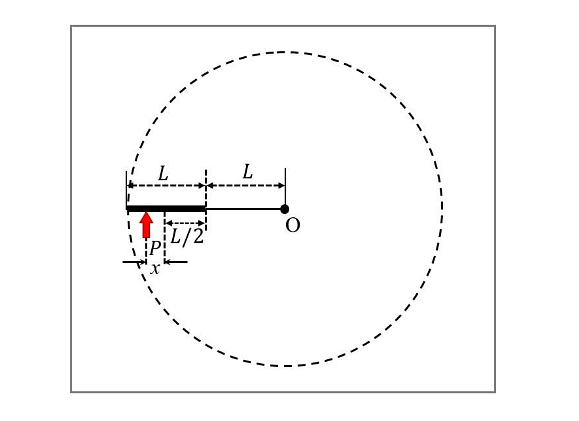
A thin uniform rod of length L and certain mass is kept on a frictionless horizontal table with a massless string of length L fixed to one end (top view is shown in the figure). The other end of the string is pivoted to a point O. If a horizontal impulse P is imparted to the rod at a distance x = L/n from the mid-point of the rod (see figure), then the rod and string revolve together around the point O, with the rod remaining aligned with the string. In such a case, the value of n is _____.
- JEE Advanced - 2024
- Friction