Question:medium
The electric field associated with an electromagnetic wave travelling in vacuum is given by
\[
\vec E
=
E_0\sin(3y+4z+\omega t)\,\hat i
\]
where \(\omega\) is the angular frequency. All quantities are in SI units. The correct statement(s) about this wave is/are:
\[
[\text{Given: speed of light in vacuum }c=3\times10^8\ \text{m s}^{-1}]
\]
The electric field associated with an electromagnetic wave travelling in vacuum is given by
\[
\vec E
=
E_0\sin(3y+4z+\omega t)\,\hat i
\]
where \(\omega\) is the angular frequency. All quantities are in SI units. The correct statement(s) about this wave is/are:
\[
[\text{Given: speed of light in vacuum }c=3\times10^8\ \text{m s}^{-1}]
\]
Show Hint
For electromagnetic waves:
\[
\omega=ck
\]
and:
\[
\vec E\times\vec B
\]
gives the direction of propagation.
Updated On: Jun 4, 2026
- The wave is travelling in \(-\dfrac15(3\hat j+4\hat k)\) direction.
- The magnitude of wave vector is \(5\ \mathrm{m^{-1}}\)
- The value of \(\omega\) is \(1.5\times10^9\ \mathrm{rad\,s^{-1}}\)
- The magnetic field associated with this wave is given by \[ \vec B= \frac{E_0}{c} \sin(3y+4z+\omega t)\, (4\hat j-3\hat k) \]
Show Solution
The Correct Option is A
Solution and Explanation
Step 1: Understanding the Concept:
An electromagnetic wave in vacuum is a transverse wave where the electric field \( \vec{E} \), magnetic field \( \vec{B} \), and propagation direction \( \hat{n} \) are mutually perpendicular. The phase of the wave is given by \( (\vec{k} \cdot \vec{r} + \omega t) \). The wave vector \( \vec{k} \) points in the direction of propagation if the time term has a negative sign (\( \vec{k} \cdot \vec{r} - \omega t \)). If both have the same sign, the wave travels in the \( -\hat{k} \) direction.
Step 2: Key Formula or Approach:
1. Wave vector: \( \vec{k} \) is the vector of spatial coefficients.
2. Direction of propagation: \( \hat{n} = -\vec{k}/|\vec{k}| \) (when signs are same).
3. Relation between \( \omega, c, k \): \( \omega = c |\vec{k}| \).
4. Magnetic field relation: \( \vec{B} = \frac{1}{c} (\hat{n} \times \vec{E}) \).
Step 3: Detailed Explanation:
From the expression \( 3y + 4z + \omega t \), the spatial part is \( \vec{k} \cdot \vec{r} = 0x + 3y + 4z \).
Thus, \( \vec{k} = 3\hat{j} + 4\hat{k} \).
The magnitude is \( k = \sqrt{3^2 + 4^2} = 5 \text{ m}^{-1} \). (Statement B is incorrect).
Direction of propagation: Since the signs of spatial and time terms are both positive, the wave travels in the \( -\vec{k} \) direction.
Unit vector \( \hat{n} = -\frac{1}{5}(3\hat{j} + 4\hat{k}) \). (Statement A is correct).
Angular frequency:
\[ \omega = c k = (3 \times 10^8 \text{ ms}^{-1})(5 \text{ m}^{-1}) = 15 \times 10^8 = 1.5 \times 10^9 \text{ rad s}^{-1} \]
(Statement C is correct).
Magnetic Field:
\[ \vec{B} = \frac{1}{c} (\hat{n} \times \vec{E}) = \frac{1}{c} \left[ -\frac{1}{5}(3\hat{j} + 4\hat{k}) \times E_0 \sin(\dots) \hat{i} \right] \]
Using cross products: \( \hat{j} \times \hat{i} = -\hat{k} \) and \( \hat{k} \times \hat{i} = \hat{j} \).
\[ \vec{B} = -\frac{E_0 \sin(\dots)}{5c} [3(-\hat{k}) + 4(\hat{j})] = \frac{E_0 \sin(\dots)}{5c} (3\hat{k} - 4\hat{j}) \]
Statement (D) gives \( \frac{E_0}{c} \dots (4\hat{j} - 3\hat{k}) \), which is in the opposite direction (and missing the factor of \( 1/5 \)). Thus, (D) is incorrect.
Step 4: Final Answer:
The wave propagation vector is determined by the coefficients of spatial variables. The direction is the negative unit vector because of identical signs in the phase. The frequency relates to the wave vector magnitude via the speed of light.
An electromagnetic wave in vacuum is a transverse wave where the electric field \( \vec{E} \), magnetic field \( \vec{B} \), and propagation direction \( \hat{n} \) are mutually perpendicular. The phase of the wave is given by \( (\vec{k} \cdot \vec{r} + \omega t) \). The wave vector \( \vec{k} \) points in the direction of propagation if the time term has a negative sign (\( \vec{k} \cdot \vec{r} - \omega t \)). If both have the same sign, the wave travels in the \( -\hat{k} \) direction.
Step 2: Key Formula or Approach:
1. Wave vector: \( \vec{k} \) is the vector of spatial coefficients.
2. Direction of propagation: \( \hat{n} = -\vec{k}/|\vec{k}| \) (when signs are same).
3. Relation between \( \omega, c, k \): \( \omega = c |\vec{k}| \).
4. Magnetic field relation: \( \vec{B} = \frac{1}{c} (\hat{n} \times \vec{E}) \).
Step 3: Detailed Explanation:
From the expression \( 3y + 4z + \omega t \), the spatial part is \( \vec{k} \cdot \vec{r} = 0x + 3y + 4z \).
Thus, \( \vec{k} = 3\hat{j} + 4\hat{k} \).
The magnitude is \( k = \sqrt{3^2 + 4^2} = 5 \text{ m}^{-1} \). (Statement B is incorrect).
Direction of propagation: Since the signs of spatial and time terms are both positive, the wave travels in the \( -\vec{k} \) direction.
Unit vector \( \hat{n} = -\frac{1}{5}(3\hat{j} + 4\hat{k}) \). (Statement A is correct).
Angular frequency:
\[ \omega = c k = (3 \times 10^8 \text{ ms}^{-1})(5 \text{ m}^{-1}) = 15 \times 10^8 = 1.5 \times 10^9 \text{ rad s}^{-1} \]
(Statement C is correct).
Magnetic Field:
\[ \vec{B} = \frac{1}{c} (\hat{n} \times \vec{E}) = \frac{1}{c} \left[ -\frac{1}{5}(3\hat{j} + 4\hat{k}) \times E_0 \sin(\dots) \hat{i} \right] \]
Using cross products: \( \hat{j} \times \hat{i} = -\hat{k} \) and \( \hat{k} \times \hat{i} = \hat{j} \).
\[ \vec{B} = -\frac{E_0 \sin(\dots)}{5c} [3(-\hat{k}) + 4(\hat{j})] = \frac{E_0 \sin(\dots)}{5c} (3\hat{k} - 4\hat{j}) \]
Statement (D) gives \( \frac{E_0}{c} \dots (4\hat{j} - 3\hat{k}) \), which is in the opposite direction (and missing the factor of \( 1/5 \)). Thus, (D) is incorrect.
Step 4: Final Answer:
The wave propagation vector is determined by the coefficients of spatial variables. The direction is the negative unit vector because of identical signs in the phase. The frequency relates to the wave vector magnitude via the speed of light.
Was this answer helpful?
0
Top Questions on Electromagnetic waves
- A wheel of diameter 20 cm is rotating at 600 rpm. The linear velocity of a particle at its rim is:
- MHT CET - 2024
- Physics
- Electromagnetic waves
- Find the ratio of K.E. and P.E. when a particle performs SHM and is at \( \frac{1}{n} \) times its amplitude from the mean position.
- MHT CET - 2024
- Physics
- Electromagnetic waves
- Electromagnetic waves travel in a medium with speed \( 1.5 \times 10^8 \) m/s. The relative permeability of the medium is \( 2.0 \). The relative permittivity will be:
- BITSAT - 2024
- Physics
- Electromagnetic waves
- The property which is not of an electromagnetic wave travelling in free space is that :
- NEET (UG) - 2024
- Physics
- Electromagnetic waves
- Want to practice more? Try solving extra ecology questions todayView All Questions
Questions Asked in JEE Advanced exam
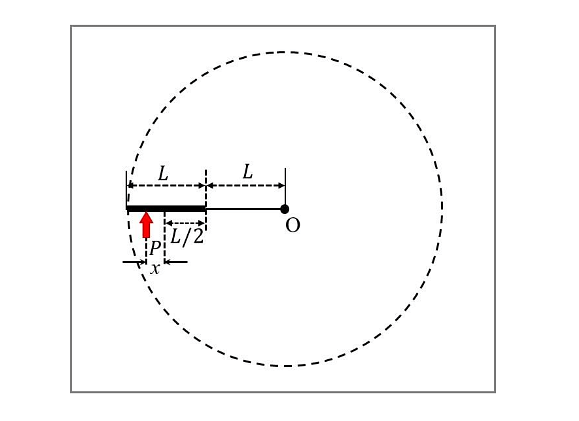
A thin uniform rod of length L and certain mass is kept on a frictionless horizontal table with a massless string of length L fixed to one end (top view is shown in the figure). The other end of the string is pivoted to a point O. If a horizontal impulse P is imparted to the rod at a distance x = L/n from the mid-point of the rod (see figure), then the rod and string revolve together around the point O, with the rod remaining aligned with the string. In such a case, the value of n is _____.
- JEE Advanced - 2024
- Friction