Question:medium
Ten moles of an ideal monoatomic gas, initially in state \(a\) at atmospheric pressure and temperature \(T_a = 27^\circ\text{C}\), is enclosed in a metal cylinder of volume \(V_0\) fitted with a frictionless piston. The gas is suddenly compressed to state \(b\) with volume \(V_0/3\). Now, keeping the piston stationary, the cylinder is submerged in a water bath of temperature \(11^\circ\text{C}\) until the gas reaches the temperature of the water bath, which is denoted as state \(c\). Finally, while still in the water bath, the piston is brought slowly to its initial position, which is denoted as state \(f\). If \(R\) is the universal gas constant, then the correct option(s) is/are:
Given: \(9^{1/3} = 2.08\)
Show Hint
Sudden compression is adiabatic, so use T V^(2/3) constant to get 624 K. Internal energy depends only on temperature, so compare 300 K with 284 K for the net change.
Updated On: Nov 19, 2026
- The schematic P-V diagram of the processes described above is:

- The change in internal energy in going from state $a$ to $b$ is $4860R$.
- The net change in the internal energy in the whole process is $-240R$.
- The pressure and temperature of the state $b$ are $2.08$ times the atmospheric pressure and $624 \text{ K}$, respectively.
Show Solution
The Correct Option is A, B, C
Solution and Explanation
Step 1: Use the first law for each process:
The gas has $n = 10$ and $C_v = 1.5R$. The processes are: $a \to b$ adiabatic, $b \to c$ isochoric, $c \to f$ isothermal.
For an ideal gas $\Delta U = nC_v\Delta T$ for every process, so we can add the pieces.
Step 2: Temperature and pressure at b using the gas law:
In the adiabatic step $T V^{2/3}$ is constant. With $V_b = V_a/3$ we get $T_b = 300 \times 3^{2/3}$.
\[ T_b = 300 \times 9^{1/3} = 300 \times 2.08 = 624\ \text{K} \]
Now use $PV = nRT$ between $a$ and $b$.
\[ \frac{P_b}{P_a} = \frac{T_b}{T_a} \times \frac{V_a}{V_b} = \frac{624}{300} \times 3 = 6.24 \]
So the pressure at $b$ is $6.24$ times atmospheric pressure, not $2.08$ times.
Step 3: Add the three energy changes:
\[ \Delta U_{ab} = 15R\,(624 - 300) = 4860R \]
\[ \Delta U_{bc} = 15R\,(284 - 624) = -5100R \]
\[ \Delta U_{cf} = 0 \quad \text{(isothermal)} \]
\[ \Delta U_{\text{net}} = 4860R - 5100R + 0 = -240R \]
Step 4: Check against the direct method:
Only the end temperatures matter, so $\Delta U_{af} = 15R\,(284 - 300) = -240R$. This agrees with the sum above.
Step 5: Shape of the P-V graph:
The adiabatic curve falls faster with volume than an isotherm, because $P \propto V^{-5/3}$ against $P \propto V^{-1}$.
So starting from $a$, the compression curve climbs steeply to $b$. The cooling $b \to c$ is vertical, and the isothermal $c \to f$ runs back to $V_0$ below the first curve.
The final pressure is $P_f = P_a \times 284/300 < P_a$, so $f$ sits just under $a$. Option (A) shows this.
Step 6: Verdict on each option:
(A) is correct because the sketch matches the three processes.
(B) is correct because $\Delta U_{ab} = 4860R$.
(C) is correct because $\Delta U_{\text{net}} = -240R$.
(D) is incorrect because the pressure at $b$ is $6.24$ times atmospheric, not $2.08$ times.
Final Answer:
Options (A), (B) and (C) are correct. \[ \boxed{\text{(A), (B), (C)}} \]
Was this answer helpful?
0
Top Questions on Thermodynamics
- The difference of temperature in a material can convert heat energy into electrical energy. To harvest the heat energy, the material should have:
- JEE Main - 2025
- Physics
- Thermodynamics
- Given below are two statements. One is labelled as Assertion (A) and the other is labelled as Reason (R).
Assertion (A): With the increase in the pressure of an ideal gas, the volume falls off more rapidly in an isothermal process in comparison to the adiabatic process.
Reason (R): In an isothermal process, \( PV = \text{constant} \), while in an adiabatic process \( PV^\gamma = \text{constant} \). Here, \( \gamma \) is the ratio of specific heats, \( P \) is the pressure and \( V \) is the volume of the ideal gas.
In the light of the above statements, choose the correct answer from the options given below:- JEE Main - 2025
- Physics
- Thermodynamics
- A poly-atomic molecule (C\(_3\)R, \(C_v = 4R\), where \(R\) is gas constant) goes from phase space point A (\(P_A = 10^4 \, \text{Pa}, V_A = 4 \times 10^{-3} \, \text{m}^3\)) to point B (\(P_B = 5 \times 10^4 \, \text{Pa}, V_B = 6 \times 10^{-7} \, \text{m}^3\)) to point C (\(P_C = 10^4 \, \text{Pa}, V_C = 8 \times 10^{-3} \, \text{m}^3\)). A to B is an adiabatic path and B to C is an isothermal path. The net heat absorbed per unit mole by the system is:

- JEE Main - 2025
- Physics
- Thermodynamics
- If \[ \text{C(diamond)} \rightarrow \text{C(graphite)} + X \, \text{kj mol}^{-1} \] \[ \text{C(diamond)} + \text{O}_2(g) \rightarrow \text{CO}(g) + Y \, \text{kj mol}^{-1} \] \[ \text{C(graphite)} + \text{O}_2(g) \rightarrow \text{CO}(g) + Z \, \text{kj mol}^{-1} \] At constant temperature. Then:
- JEE Main - 2025
- Chemistry
- Thermodynamics
- Want to practice more? Try solving extra ecology questions todayView All Questions
Questions Asked in JEE Advanced exam
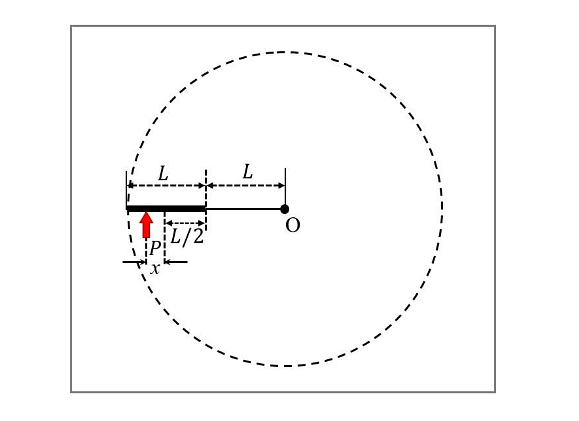
A thin uniform rod of length L and certain mass is kept on a frictionless horizontal table with a massless string of length L fixed to one end (top view is shown in the figure). The other end of the string is pivoted to a point O. If a horizontal impulse P is imparted to the rod at a distance x = L/n from the mid-point of the rod (see figure), then the rod and string revolve together around the point O, with the rod remaining aligned with the string. In such a case, the value of n is _____.
- JEE Advanced - 2024
- Friction