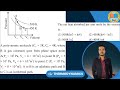
A poly-atomic molecule (C\(_3\)R, \(C_v = 4R\), where \(R\) is gas constant) goes from phase space point A (\(P_A = 10^4 \, \text{Pa}, V_A = 4 \times 10^{-3} \, \text{m}^3\)) to point B (\(P_B = 5 \times 10^4 \, \text{Pa}, V_B = 6 \times 10^{-7} \, \text{m}^3\)) to point C (\(P_C = 10^4 \, \text{Pa}, V_C = 8 \times 10^{-3} \, \text{m}^3\)). A to B is an adiabatic path and B to C is an isothermal path. The net heat absorbed per unit mole by the system is:
Show Hint
For adiabatic processes, no heat is exchanged, and the internal energy change equals the work done. In isothermal processes, the heat absorbed is related to the work done, which can be calculated using \( \Delta Q = nRT \ln \left( \frac{V_C}{V_B} \right) \).
The net heat absorbed is calculated using the first law of thermodynamics:
\[
\Delta Q = \Delta Q_{\text{adiabatic}} + \Delta Q_{\text{isothermal}}
\]
In the adiabatic process (A to B), there is no heat exchange ($\Delta Q_{\text{adiabatic}} = 0$). For the isothermal process (B to C), the heat absorbed is:
\[
\Delta Q_{\text{isothermal}} = W_{\text{isothermal}} = nRT \ln \left( \frac{V_C}{V_B} \right) = 450R \ln \left( \frac{V_C}{V_B} \right) = 450R(\ln 3)
\]
Consequently, the total net heat absorbed is $450R \ln 3$.